. 2022 Jul 2;12(1):11220.
doi: 10.1038/s41598-022-15413-1.

Human enteric adenovirus F40/41 as a major cause of acute gastroenteritis in children in Brazil, 2018 to 2020

Affiliations

Human enteric adenovirus F40/41 as a major cause of acute gastroenteritis in children in Brazil, 2018 to 2020

Lilian Gonçalves do Nascimento et al. Sci Rep. .

Abstract

Human adenovirus (HAdV) types F40/41 have long been recognized as major viral agents of acute gastroenteritis (AGE) in children. Despite this, studies on HAdV molecular epidemiology are sparse, and their real impact is likely under-estimated. Thus, our goal was to investigate HAdV incidence, enteric and non-enteric types circulation, co-detections with rotavirus and norovirus and DNA shedding in stool samples from inpatients and outpatients from eleven Brazilian states. During the three-year study, 1012 AGE stool samples were analysed by TaqMan-based qPCR, to detect and quantify HAdV. Positive samples were genotyped by partial sequencing of the hexon gene followed by phylogenetic analysis. Co-detections were accessed by screening for rotavirus and norovirus. Overall, we detected HAdV in 24.5% of single-detected samples (n = 248), with a prevalence of type F41 (35.8%). We observed a higher incidence in children between 6 to 24 months, without marked seasonality. Additionally, we observed a statistically higher median viral load among single-detections between enteric and non-enteric types and a significantly lower HAdV viral load compared to rotavirus and norovirus in co-detections (p < 0.0001). Our study contributes to the knowledge of HAdV epidemiology and reinforces the need for the inclusion of enteric types F40/41 in molecular surveillance programs.


Conflict of interest statement

The authors declare no competing interests.

Figures
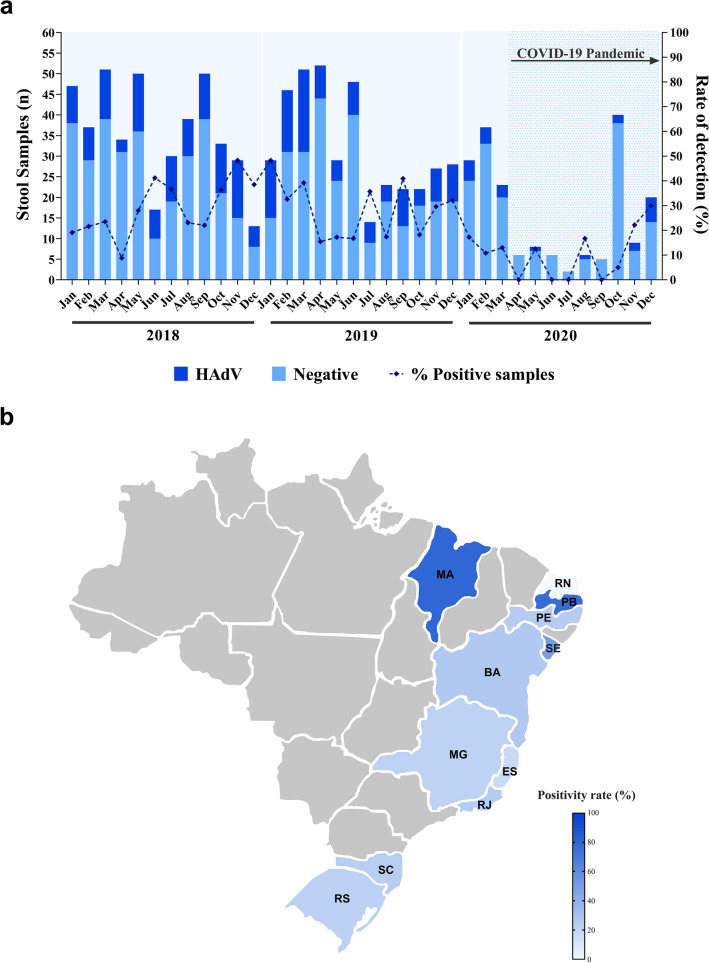
Figure 1
Figure 1
(a) Monthly distribution of tested acute gastroenteritis samples, HAdV-positive samples and detection rates in Brazil, 2018–2020. (b) Map of Brazil highlighting HAdV detection rates in each of the eleven states included in this three-year study. This figure was designed in Adobe Illustrator 26.0 (https://www.adobe.com/).
Figure 2
Figure 2
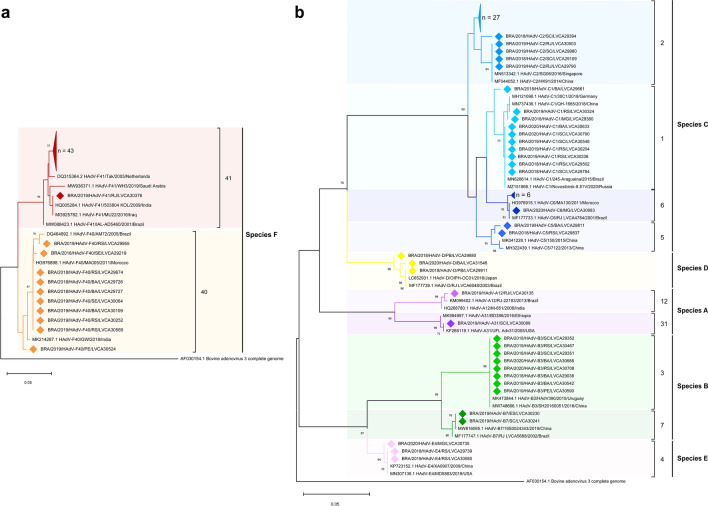
Phylogenetic analyses based on a conserved region of the hexon gene nucleotide (nt) sequence (located at positions 21–322, upstream of the surface loop l1) of the circulating Brazilian (a) enteric and (b) non-enteric Human Adenovirus (HAdV) types. Reference strains were downloaded from GenBank and labeled with their accession number followed by type, register number, year and country. Strains obtained (marked with a diamond) are shown as per country followed by type, year of collection, state and the LVCA internal register number (i.e., BRA/2019/HAdV-C2/RJ/LVCA30503). Neighbour-joining phylogenetic tree was constructed with MEGA X software and bootstrap tests (2000 replicates) based on the Kimura two-parameter model. Bootstrap values above 60% are given at branch nodes.
Figure 3
Figure 3
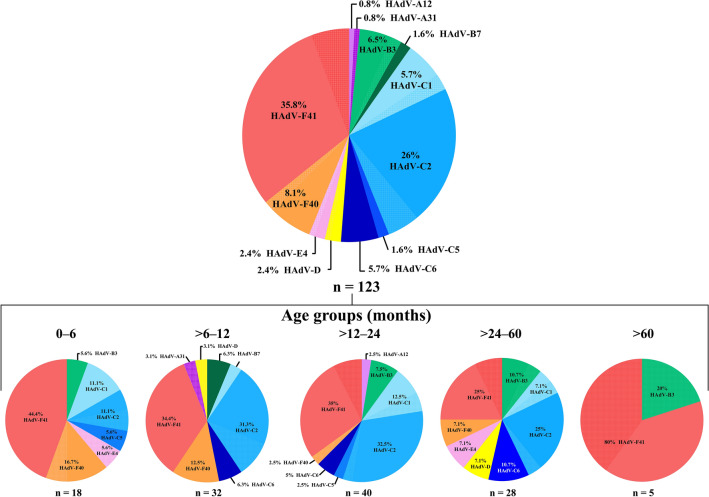
The total frequency of HAdV types obtained from sequenced samples and types percentage distribution by age groups. HAdV types obtained from co-detections with rotavirus or norovirus are represented by a crosshatched pattern.
Figure 4
Figure 4
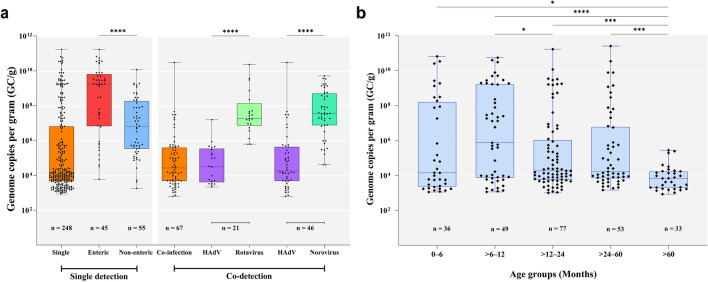
(a) Enteric viruses viral load expressed as genome copies per gram of stool (GC/g). Among HAdV single- and co-detected samples with rotavirus and norovirus. (b) HAdV single-detections viral load among different age groups in Brazil, 2018–2020. Box-and-whisker plots show the first and third quartiles (equivalent to the 5th and 95th percentiles), the median (the horizontal line in the box), and range of HAdV viral load concentrations. *p ≤ 0.05; ***p ≤ 0.001; ****p ≤ 0.0001.
Figure 5
Figure 5
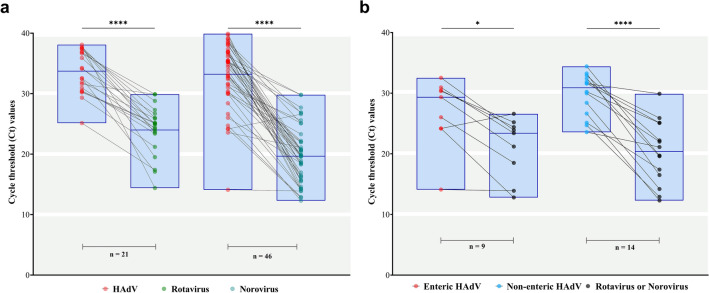
(a) Distribution of Cycle Threshold (Ct) values obtained from qPCR for HAdV and by qRT‐PCR for rotavirus and norovirus for each co-detected positive sample. (b) Detailed analyses of the Ct values of each characterized enteric and non-enteric HAdV, detected in co-detections with other enteric viruses (rotavirus or norovirus). Box-and-whisker plots show the first and third quartiles (equivalent to the 5th and 95th percentiles), the median (the horizontal line in the box). *p ≤ 0.05; ****p ≤ 0.0001.

References

    1. Levels and Trends in Child Mortality: Report 2020. https://www.who.int/publications/m/item/levels-and-trends-in-child-morta.... (2020).
    1. GBD 2016 Diarrhoeal Disease Collaborators. Estimates of the global, regional, and national morbidity, mortality, and aetiologies of diarrhoea in 195 countries: A systematic analysis for the Global Burden of Disease Study 2016. Lancet Infect. Dis.18, 1211–1228. 10.1097/QCO.0000000000000663 (2018). - PMC - PubMed
    1. Lee B, Damon CF, Platts-Mills JA. Pediatric acute gastroenteritis associated with adenovirus 40/41 in low-income and middle-income countries. Curr. Opin. Infect. Dis. 2020;33:398–403. doi: 10.1097/QCO.0000000000000663. - DOI - PMC - PubMed
    1. Bányai K, Estes MK, Martella V, Parashar UD. Viral gastroenteritis. Lancet. 2018;392:175–186. doi: 10.1016/S0140-6736(18)31128-0. - DOI - PMC - PubMed
    1. Tate, J. E., Burton, A. H., Boschi-Pinto, C., Parashar, U. D., & World Health Organization-Coordinated Global Rotavirus Surveillance Network. Global, regional, and national estimates of rotavirus mortality in children <5 years of age, 2000–2013. Clin. Infect. Dis.62(Suppl 2), S96–S105. 10.1093/cid/civ1013 (2016). - PMC - PubMed

Publication types

Supplementary concepts