Effectiveness of interventions to improve drinking water, sanitation, and handwashing with soap on risk of diarrhoeal disease in children in low-income and middle-income settings: a systematic review and meta-analysis
- PMID: 35780792
- PMCID: PMC9251635
- DOI: 10.1016/S0140-6736(22)00937-0
Effectiveness of interventions to improve drinking water, sanitation, and handwashing with soap on risk of diarrhoeal disease in children in low-income and middle-income settings: a systematic review and meta-analysis
Erratum in
-
Department of Error.Lancet. 2022 Jul 23;400(10348):272. doi: 10.1016/S0140-6736(22)01341-1. Lancet. 2022. PMID: 35871811 Free PMC article. No abstract available.
-
Department of Error.Lancet. 2023 Jun 17;401(10393):2040. doi: 10.1016/S0140-6736(23)01199-6. Lancet. 2023. PMID: 37330745 Free PMC article. No abstract available.
Abstract
Background: Estimates of the effectiveness of water, sanitation, and hygiene (WASH) interventions that provide high levels of service on childhood diarrhoea are scarce. We aimed to provide up-to-date estimates on the burden of disease attributable to WASH and on the effects of different types of WASH interventions on childhood diarrhoea in low-income and middle-income countries (LMICs).
Methods: In this systematic review and meta-analysis, we updated previous reviews following their search strategy by searching MEDLINE, Embase, Scopus, Cochrane Library, and BIOSIS Citation Index for studies of basic WASH interventions and of WASH interventions providing a high level of service, published between Jan 1, 2016, and May 25, 2021. We included randomised and non-randomised controlled trials conducted at household or community level that matched exposure categories of the so-called service ladder approach of the Sustainable Development Goal (SDG) for WASH. Two reviewers independently extracted study-level data and assessed risk of bias using a modified Newcastle-Ottawa Scale and certainty of evidence using a modified Grading of Recommendations, Assessment, Development, and Evaluation approach. We analysed extracted relative risks (RRs) and 95% CIs using random-effects meta-analyses and meta-regression models. This study is registered with PROSPERO, CRD42016043164.
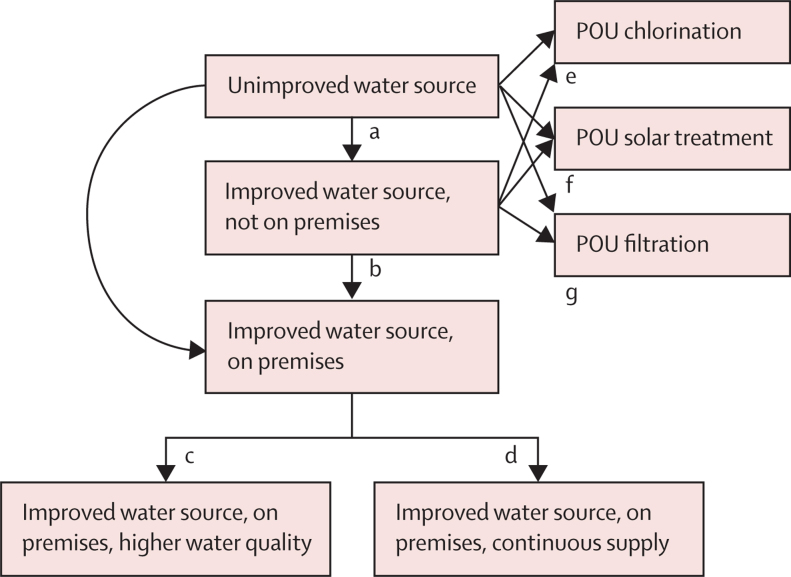
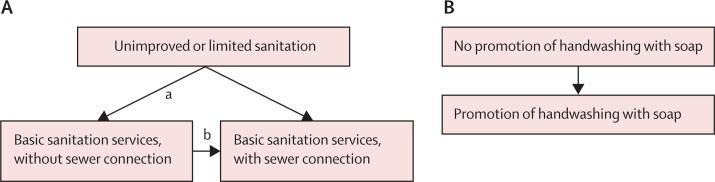
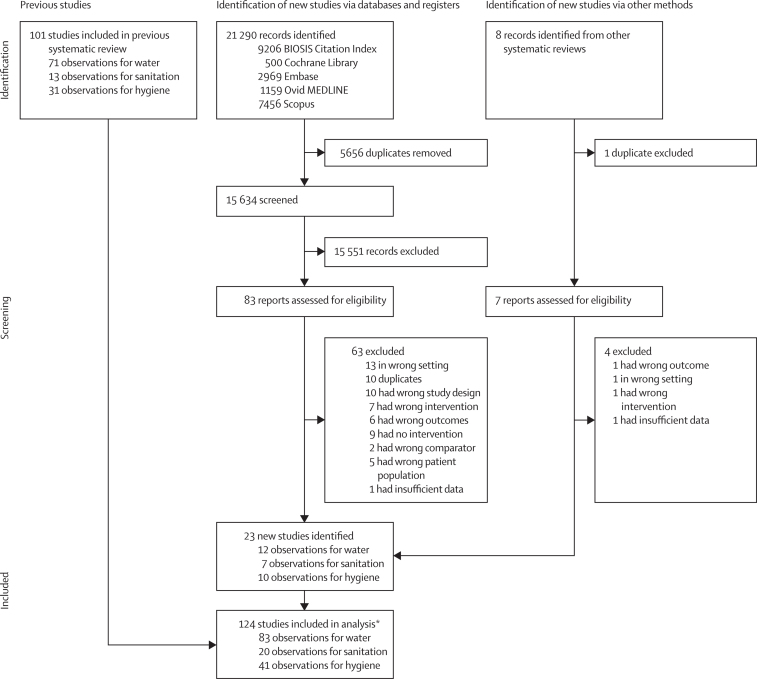
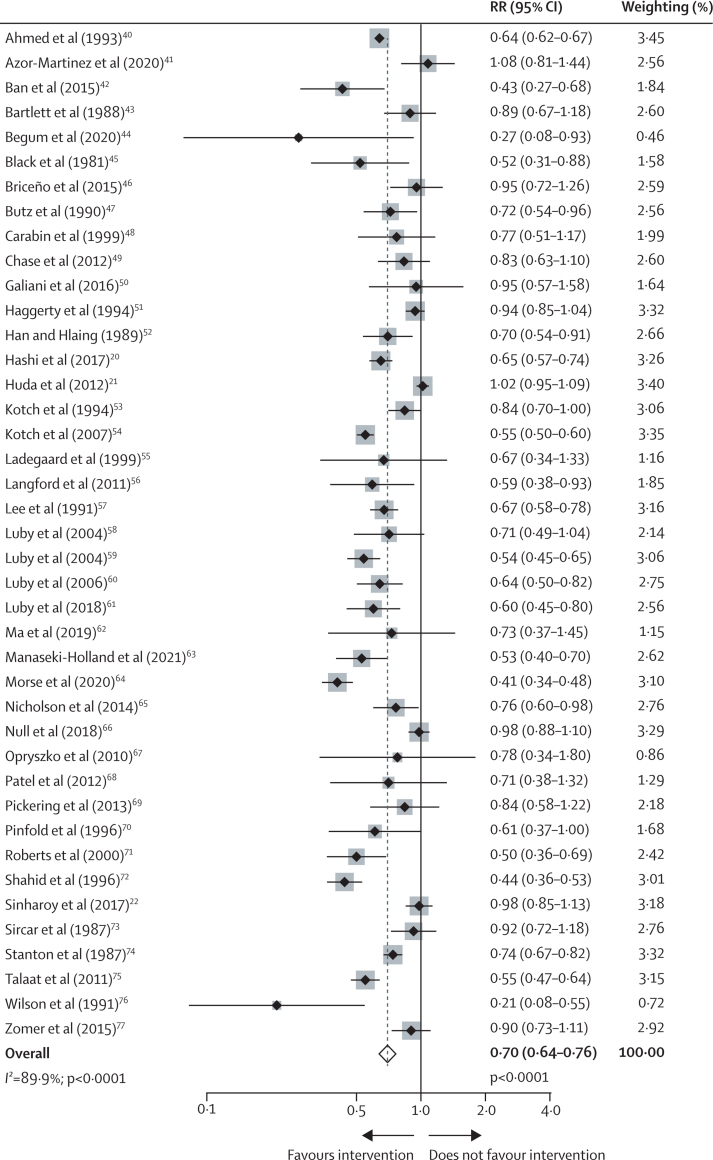
Findings: 19 837 records were identified from the search, of which 124 studies were included, providing 83 water (62 616 children), 20 sanitation (40 799 children), and 41 hygiene (98 416 children) comparisons. Compared with untreated water from an unimproved source, risk of diarrhoea was reduced by up to 50% with water treated at point of use (POU): filtration (n=23 studies; RR 0·50 [95% CI 0·41-0·60]), solar treatment (n=13; 0·63 [0·50-0·80]), and chlorination (n=25; 0·66 [0·56-0·77]). Compared with an unimproved source, provision of an improved drinking water supply on premises with higher water quality reduced diarrhoea risk by 52% (n=2; 0·48 [0·26-0·87]). Overall, sanitation interventions reduced diarrhoea risk by 24% (0·76 [0·61-0·94]). Compared with unimproved sanitation, providing sewer connection reduced diarrhoea risk by 47% (n=5; 0·53 [0·30-0·93]). Promotion of handwashing with soap reduced diarrhoea risk by 30% (0·70 [0·64-0·76]).
Interpretation: WASH interventions reduced risk of diarrhoea in children in LMICs. Interventions supplying either water filtered at POU, higher water quality from an improved source on premises, or basic sanitation services with sewer connection were associated with increased reductions. Our results support higher service levels called for under SDG 6. Notably, no studies evaluated interventions that delivered access to safely managed WASH services, the level of service to which universal coverage by 2030 is committed under the SDG.
Funding: WHO, Foreign, Commonwealth & Development Office, and National Institute of Environmental Health Sciences.
Copyright © 2022 World Health Organization; licensee Elsevier. This is an Open Access article published under the CC BY 3.0 IGO license which permits unrestricted use, distribution, and reproduction in any medium, provided the original work is properly cited. In any use of this article, there should be no suggestion that WHO endorses any specific organisation, products or services. The use of the WHO logo is not permitted. This notice should be preserved along with the article's original URL.
Conflict of interest statement
Declaration of interests JW and BG report grants from the UK Foreign, Commonwealth and Development Office, during the conduct of the study. SH reports grants from the National Institute of Environmental Health Sciences, during the conduct of the study. MB reports grants from Bill & Melinda Gates Foundation during the conduct of the study. BFA reports grants from National Institutes of Health, and grants and non-financial support from Bill & Melinda Gates Foundation, outside the submitted work. MCF reports personal fees from Reckitt, outside the submitted work. AM has received funding as a statistical consultant on The Lancet Commission on water, sanitation and hygiene, and health to analyse the associations between water, sanitation, hygiene, and handwashing and child health using Multiple Indicator Cluster Survey data and to complete an individual-participant data meta-analysis of WASH trials on pathogen contamination in the environment and child health. All other authors declare no competing interests.
Figures
Comment in
-
WASH services and health: syntheses and contexts.Lancet. 2022 Jul 2;400(10345):5-7. doi: 10.1016/S0140-6736(22)01108-4. Lancet. 2022. PMID: 35780793 No abstract available.
References
-
- Freeman MC, Garn JV, Sclar GD, et al. The impact of sanitation on infectious disease and nutritional status: a systematic review and meta-analysis. Int J Hyg Environ Health. 2017;220:928–949. - PubMed
-
- Sclar GD, Penakalapati G, Caruso BA, et al. Exploring the relationship between sanitation and mental and social well-being: a systematic review and qualitative synthesis. Soc Sci Med. 2018;217:121–134. - PubMed
-
- Wolf J, Hunter PR, Freeman MC, et al. Impact of drinking water, sanitation and handwashing with soap on childhood diarrhoeal disease: updated meta-analysis and meta-regression. Trop Med Int Health. 2018;23:508–525. - PubMed
Uncited References
-
- Ahmed NU, Zeitlin MF, Beiser AS, Super CM, Gershoff SN. A longitudinal study of the impact of behavioural change intervention on cleanliness, diarrhoeal morbidity and growth of children in rural Bangladesh. Soc Sci Med. 1993;37:159–171. - PubMed
-
- Azor-Martinez E, Garcia-Fernandez L, Strizzi JM, et al. Effectiveness of a hand hygiene program to reduce acute gastroenteritis at child care centers: a cluster randomized trial. Am J Infect Control. 2020;48:1315–1321. - PubMed
-
- Ban HQ, Li T, Shen J, et al. Effects of multiple cleaning and disinfection interventions on infectious diseases in children: a group randomized trial in China. Biomed Environ Sci. 2015;28:779–787. - PubMed
-
- Bartlett AV, Jarvis BA, Ross V, et al. Diarrheal illness among infants and toddlers in day care centers: effects of active surveillance and staff training without subsequent monitoring. Am J Epidemiol. 1988;127:808–917. - PubMed
-
- Begum MR, Al Banna MH, Akter S, et al. Effectiveness of WASH education to prevent diarrhea among children under five in a community of Patuakhali, Bangladesh. SN Compr Clin Med. 2020;2:1158–1162.
Publication types
MeSH terms
Substances
Grants and funding
LinkOut - more resources
Full Text Sources
Other Literature Sources
Medical