Review
. 2022 Jun 27:13:20406223221104987.
doi: 10.1177/20406223221104987. eCollection 2022.

Advancements in prevention and intervention of sensorineural hearing loss

Affiliations
Review

Advancements in prevention and intervention of sensorineural hearing loss

Hongmiao Ren et al. Ther Adv Chronic Dis. .

Abstract

The inner ear is a complex and difficult organ to study, and sensorineural hearing loss (SNHL) is a multifactorial sensorineural disorder with characteristics of impaired speech discrimination, recognition, sound detection, and localization. Till now, SNHL is recognized as an incurable disease because the potential mechanisms underlying SNHL have not been elucidated. The risk of developing SNHL is no longer viewed as primarily due to environmental factors. Instead, SNHL seems to result from a complicated interplay of genetic and environmental factors affecting numerous fundamental cellular processes. The complexity of SNHL is presented as an inability to make an early diagnosis at the earliest stages of the disease and difficulties in the management of symptoms during the process. To date, there are no treatments that slow the neurodegenerative process. In this article, we review the recent advances about SHNL and discuss the complexities and challenges of prevention and intervention of SNHL.

Keywords: age-related hearing loss; genetics; noise-induced hearing loss; prevention and intervention of SNHL; sensorineural hearing loss.


Conflict of interest statement

Conflict of interest statement: All of the authors declare that there are no conflicts of interests during the process of research and publication. The subjects’ written consent was approved by the First Affiliated Hospital, Sun Yat-Sen University.

Figures
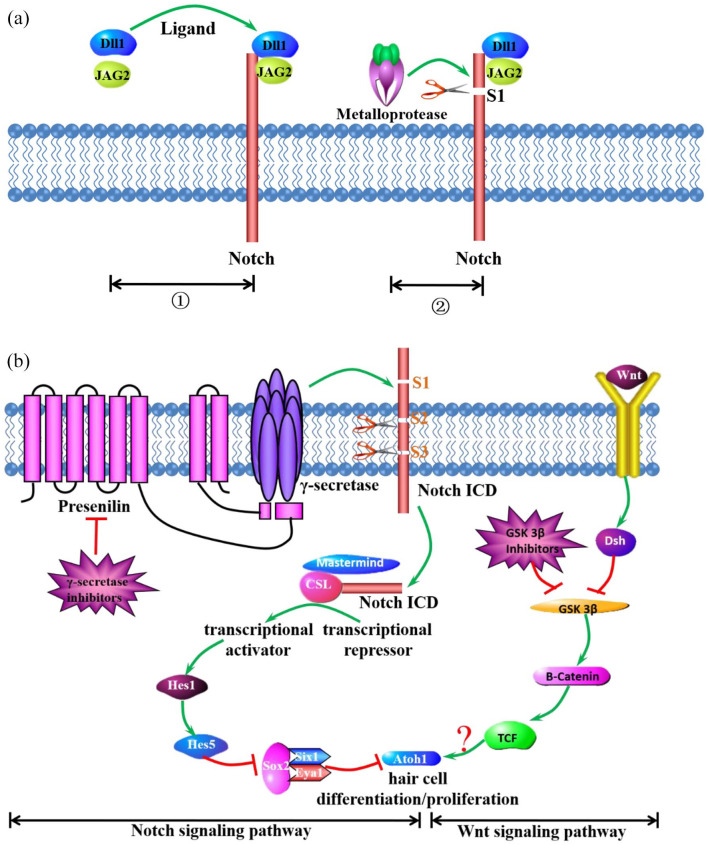
Figure 1.
Figure 1.
The role of Notch and Wnt signaling pathways on Atoh1-mediated hair cell differentiation and proliferation. (a), Dll1 and JAG2 are both activators of the notch signal by binding to the DSL region of the two ligands. Then, the notch signal is cleaved into three pieces by γ-secretase, and one piece of notch signal called Notch intracellular domain (ICD) is released into the intramembrane. Presenilin is the catalytic center of metalloprotease. (b), The Notch ICD translocates to the nucleus, where it interacts with CSL (C-promoter-binding factor). The binding of the Notch ICD and the recruitment of the co-activator protein Mastermind convert CSL from a transcriptional repressor to an activator, which results in the inhibition of hair cell death. Wnts binds to the cell surface receptors encoded by the Frizzled gene family, which in turn activates Dsh. The precise role of Dsh activation may turn off the expression of GSK3β and lead to the accumulation of β-catenin, which binds to T-cell factor and recruits other proteins to drive Atoh1-mediated hair cell death. Thus, it is necessary to promote the Wnt signaling pathway and inhibit the Notch signaling pathway to promote Atoh1-mediated hair cell differentiation or proliferation.

References

    1. Cunningham LL, Tucci DL. Hearing loss in adults. N Engl J Med 2017; 377: 2465–2473. - PMC - PubMed
    1. Ohmen J, Kang EY, Li X, et al. Genome-wide association study for age-related hearing loss (AHL) in the mouse: a meta-analysis. J Assoc Res Otolaryngol 2014; 15: 335–352. - PMC - PubMed
    1. Ren HM, Ren J, Liu W. Recognition and control of the progression of age-related hearing loss. Rejuvenation Res 2013; 16: 475–486. - PMC - PubMed
    1. Peixoto Pinheiro B, Vona B, Lowenheim H, et al. Age-related hearing loss pertaining to potassium ion channels in the cochlea and auditory pathway. Pflugers Arch 2021; 473: 823–840. - PMC - PubMed
    1. Xu J, Li J, Zhang T, et al. Chromatin remodelers and lineage-specific factors interact to target enhancers to establish proneurosensory fate within otic ectoderm. Proc Natl Acad Sci USA 2021; 118: e2025196118. - PMC - PubMed

LinkOut - more resources
