Review
. 2022 Sep 13:29:219-242.
doi: 10.1016/j.omtn.2022.06.017. Epub 2022 Jun 25.

Cytokines and microRNAs in SARS-CoV-2: What do we know?

Affiliations
Review

Cytokines and microRNAs in SARS-CoV-2: What do we know?

Fahimeh Zamani Rarani et al. Mol Ther Nucleic Acids. .

Abstract

The coronavirus disease 2019 (COVID-19) pandemic constitutes a global health emergency. Currently, there are no completely effective therapeutic medications for the management of this outbreak. The cytokine storm is a hyperinflammatory medical condition due to excessive and uncontrolled release of pro-inflammatory cytokines in patients suffering from severe COVID-19, leading to the development of acute respiratory distress syndrome (ARDS) and multiple organ dysfunction syndrome (MODS) and even mortality. Understanding the pathophysiology of COVID-19 can be helpful for the treatment of patients. Evidence suggests that the levels of tumor necrosis factor alpha (TNF-α) and interleukin (IL)-1 and IL-6 are dramatically different between mild and severe patients, so they may be important contributors to the cytokine storm. Several serum markers can be predictors for the cytokine storm. This review discusses the cytokines involved in severe acute respiratory syndrome coronavirus 2 (SARS-CoV-2) infection, focusing on interferons (IFNs) and ILs, and whether they can be used in COVID-19 treatment. Moreover, we highlight several microRNAs that are involved in these cytokines and their role in the cytokine storm caused by COVID-19.

Keywords: COVID-19; Janus kinases; NF-κB; SARS-CoV-2; STAT transcription factors; cytokines; interferons; interleukins; microRNAs.


Conflict of interest statement

M.R.H. declares the following potential conflicts of interest. Scientific advisory boards for Transdermal Cap Inc (Cleveland, OH), Hologenix Inc (Santa Monica, CA), Vielight (Toronto, Canada), and JOOVV Inc (Minneapolis St Paul MN); consulting for USHIO Corp (Japan) and Sanofi-Aventis Deutschland GmbH (Frankfurt am Main, Germany). The other authors declare no competing interests.

Figures
None
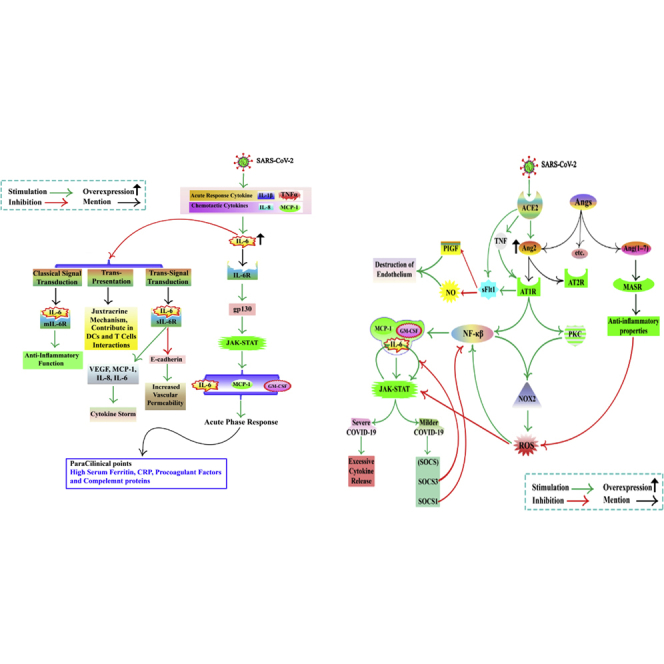
Graphical abstract
Figure 1
Figure 1
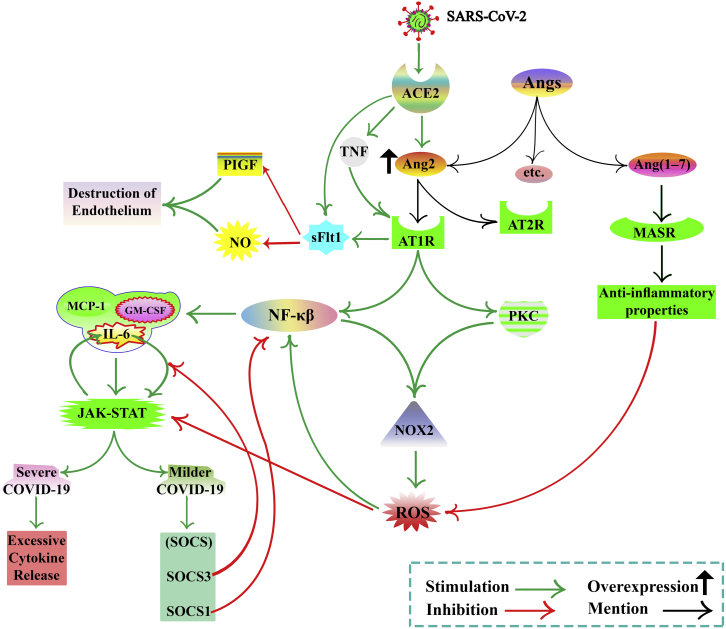
COVID-19 and cytokine storm, focusing on Ang2 concentration The concentrations of TNF-α, IL-6, and IL-10 are the most important mediator in cytokine storm formation. IL-6 receptors classify into two groups, mIL-6R and sIL-6R. During virus infection, host cells can express PRRs. PRRs detect PAMPs. ACE2 receptor acts as a PRR. ACE2 cleaves Ang2. ACE2 binds to viral S protein, so Ang2 concentrations increase. Ang2 has two types of receptors, AT1R and AT2R. The Ang2/AT1R complex activates PKC and NF-κB, leading to NOX2 activation and cytokine production. ROS production mediated by NOX2 and ROS activates NF-κB. NF-κB enhances the expression of IL-6, GM-CSF, MCP-1, etc. IL-6 induces the activation of NOX. IL-6, GM-CSF, and MCP-1 activate JAK-STAT signaling, resulting in an elevated level of SOCS, but, in severe disease, it leads to excessive cytokine production. SOCS blocks the JAK-STAT signaling. SOCS may provide a novel therapy for the treatment of COVID-19. The JAK-STAT pathway activates by ROS. IL-6 and JAK-STAT signaling pathway interaction can be defined as positive feedback. SOCS3 disrupts this vicious cycle by inhibiting IL-6 signaling. SOCS-1 inhibits NF-κB activation. NF-κB increases ACE2 expression. sFLT1 production is not clear (by binding the Ang2 to AT1 or directly induced by SARS-CoV-2 infection or upregulation of AT1 Receptor by TNF). sFLT1 inhibits PlGF, a VEGF, and impairs NO production, resulting in endothelial damage. Ang-(1–7) binds to the MASR and causes inhibition of ROS and anti-inflammatory properties. SARS-CoV-2, severe acute respiratory syndrome coronavirus 2; COVID-19, coronavirus disease 2019; Ang2, angiotensin2; IL, interleukin; TNF-α, tumor necrosis factor alpha; PRRs, pattern recognition receptors; ; PAMPs, pathogen-associated molecular patterns; ACE2, angiotensin-converting enzyme 2; AT1R, angiotensin II type 1 receptor; NF-κB, nuclear factor kappa-light-chain-enhancer of activated B cells; NOX, nicotinamide adenine dinucleotide phosphate oxidase; AT2R, angiotensin II type 2 receptor; GM-CSF, granulocyte-macrophage colony-stimulating factor; PKC, protein kinase C; ROS, reactive oxygen species; MCP-1, monocyte chemoattractant protein-1; SOCS, suppressor of cytokine signaling; JAK-STAT, Janus kinase-signal transducer and activator of transcription; sFLT1, soluble Fms-like tyrosine kinase-1; MASR, Mas oncogene receptor; gp130, glycoprotein 130; PlGF, placenta growth factor; NO, nitric oxide; sIL-6R, soluble IL-6 receptor; VEGF, vascular endothelial growth factor.
Figure 2
Figure 2
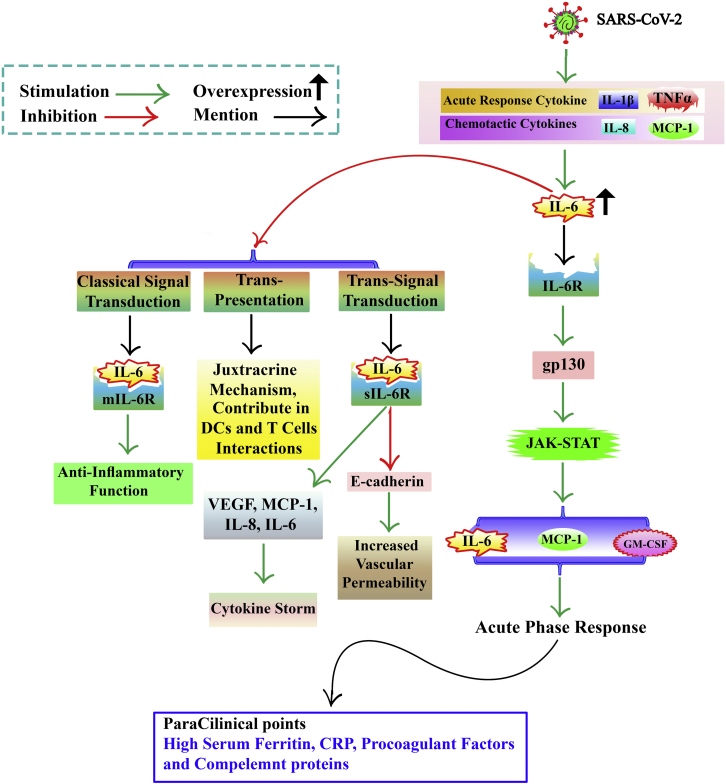
COVID-19 and cytokine storm, focusing on IL-6 IL-1b and TNF, as acute-response cytokines, and MCP-1 and IL-8, chemotactic cytokines, increase hypercytokinemia, which elevates IL-6. The IL-6/IL-6R acts on gp130 to increase IL-6, MCP-1, and GM-CSF by activating the JAK-STAT pathway. IL-6, GM-CSF, and MCP-1 may activate an acute-phase response indicated by a high serum ferritin, CRP, and pro-coagulant factors in paraclinical tests. Three IL-6 signal transductions of trans-presentation, trans-signal transduction, and classical signal transduction. IL-6/mIL-6R complex contributes to the classical signal transduction mode, which mediates anti-inflammatory function. IL-6 trans-signaling is more related to inflammatory processes. In this signaling, IL-6 binds to the sIL-6R. This leads to the production of VEGF, MCP-1, IL-8, IL-6, and E-cadherin. Expression in ECs is reduced. This increases vascular permeability and exacerbates the cytokine storm. IL-6 trans-presentation signaling pathway is a juxtracrine mechanism that contributes to dendritic and T cell interactions. mIL-6R, membrane-bound form of Interleukin-6 Receptor; CRP, C-reactive protein.

References

    1. Zhu N., Zhang D., Wang W., Li X., Yang B., Song J., Zhao X., Huang B., Shi W., Lu R., et al. China Novel Coronavirus Investigating and Research Team A novel coronavirus from patients with pneumonia in China, 2019. N. Engl. J. Med. 2020;382:727–733. doi: 10.1056/nejmoa2001017. - DOI - PMC - PubMed
    1. Fung T.S., Liu D.X. Human coronavirus: host-pathogen interaction. Annu. Rev. Microbiol. 2019;73:529–557. doi: 10.1146/annurev-micro-020518-115759. - DOI - PubMed
    1. Zhou Y., Fu B., Zheng X., Wang D., Zhao C., Qi Y., Sun R., Tian Z., Xu X., Wei H. Pathogenic T-cells and inflammatory monocytes incite inflammatory storms in severe COVID-19 patients. Natl. Sci. Rev. 2020;7:998–1002. doi: 10.1093/nsr/nwaa041. - DOI - PMC - PubMed
    1. Berry J.D., Jones S., Drebot M.A., Andonov A., Sabara M., Yuan X.Y., Weingartl H., Fernando L., Marszal P., Gren J., et al. Development and characterisation of neutralising monoclonal antibody to the SARS-coronavirus. J. Virol. Methods. 2004;120:87–96. doi: 10.1016/j.jviromet.2004.04.009. - DOI - PMC - PubMed
    1. Zhang B., Zhou X., Qiu Y., Feng F., Feng J., Jia Y., Zhu H., Hu K., Liu J., Liu Z. Clinical characteristics of 82 death cases with COVID-19. MedRxiv. 2020 doi: 10.1101/2020.02.26.20028191. Preprint at. - DOI - PMC - PubMed

LinkOut - more resources