. 2022 May 17;2(6):1395-1404.
doi: 10.1021/jacsau.2c00087. eCollection 2022 Jun 27.

Water-Based Dynamic Depsipeptide Chemistry: Building Block Recycling and Oligomer Distribution Control Using Hydration-Dehydration Cycles

Affiliations

Water-Based Dynamic Depsipeptide Chemistry: Building Block Recycling and Oligomer Distribution Control Using Hydration-Dehydration Cycles

Martin C et al. JACS Au. .

Abstract

The high kinetic barrier to amide bond formation has historically placed narrow constraints on its utility in reversible chemistry applications. Slow kinetics has limited the use of amides for the generation of diverse combinatorial libraries and selection of target molecules. Current strategies for peptide-based dynamic chemistries require the use of nonpolar co-solvents or catalysts or the incorporation of functional groups that facilitate dynamic chemistry between peptides. In light of these limitations, we explored the use of depsipeptides: biorelevant copolymers of amino and hydroxy acids that would circumvent the challenges associated with dynamic peptide chemistry. Here, we describe a model system of N-(α-hydroxyacyl)-amino acid building blocks that reversibly polymerize to form depsipeptides when subjected to two-step evaporation-rehydration cycling under moderate conditions. The hydroxyl groups of these units allow for dynamic ester chemistry between short peptide segments through unmodified carboxyl termini. Selective recycling of building blocks is achieved by exploiting the differential hydrolytic lifetimes of depsipeptide amide and ester bonds, which we show are controllable by adjusting the solution pH, temperature, and time as well as the building blocks' side chains. We demonstrate that the polymerization and breakdown of the depsipeptides are facilitated by cyclic morpholinedione intermediates, and further show how structural properties dictate half-lives and product oligomer distributions using multifunctional building blocks. These results establish a cyclic mode of ester-based reversible depsipeptide formation that temporally separates the polymerization and depolymerization steps for the building blocks and may have implications for prebiotic polymer chemical evolution.


Conflict of interest statement

The authors declare no competing financial interest.

Figures
Scheme 1
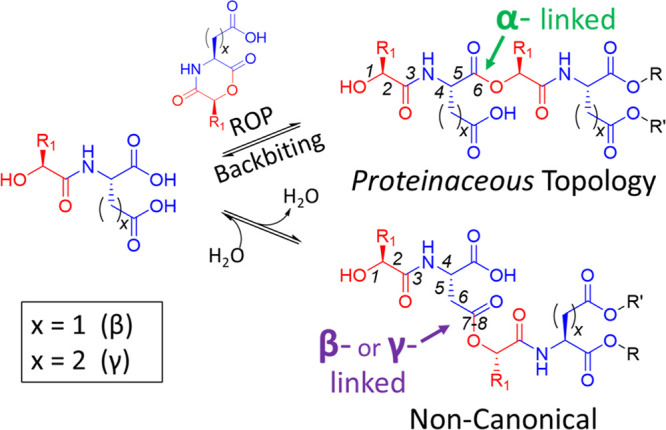
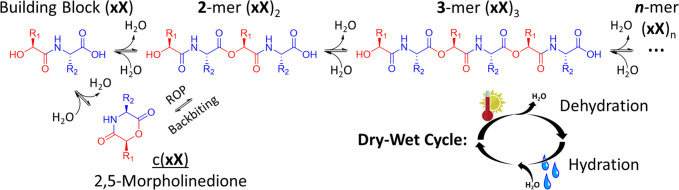
Scheme 1. Reversible Depsipeptide Formation Enabled by Dry–Wet Cycling
Figure 1
Figure 1
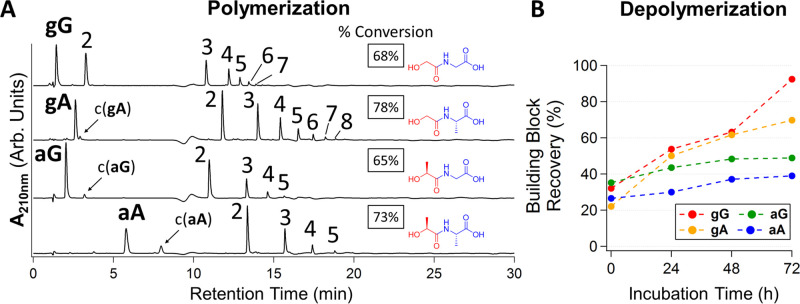
Depsipeptide formation following dry-heating and depsipeptide depolymerization (building block recycling) following a wet phase. (A) HPLC-UV chromatograms for building blocks dried from unbuffered solutions for 7 days at 65 °C to form depsipeptides. ″c(xX)″ denotes the 2,5-MD of a building block when observed. Numbers: polymer length, e.g., 4 = (gG)4. (B) Time-dependent recovery of building blocks gG, gA, aG, and aA during unbuffered (pH 3) aqueous incubations at 65 °C of 10 mM building block samples previously dried for 7 days at 65 °C.
Figure 2
Figure 2
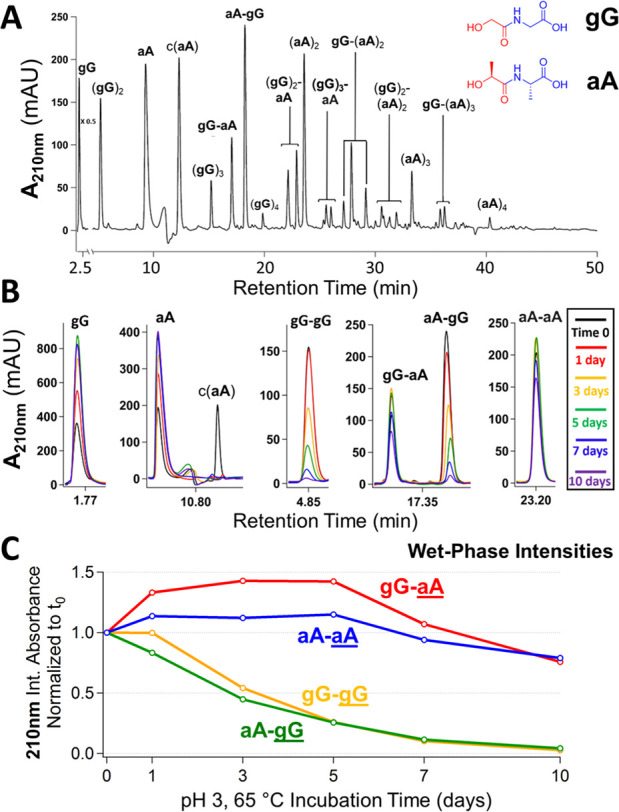
Differential aqueous persistence of depsipeptide sequence motifs. (A) HPLC-UV chromatograms of a mixture of gG and aA (1:1 molar ratio) dried for 7 days at 65 °C, unbuffered (pH 3). (B) Abundances of the four possible 2-mers formed in panel A are shown following up to 10 days of 65 °C unbuffered wet-phase incubation. (C) Integrated absorbances over incubation time with each normalized to the respective initial integrated absorbances in panel B indicate xX-aA motif persistence over xX-gG.
Figure 3
Figure 3
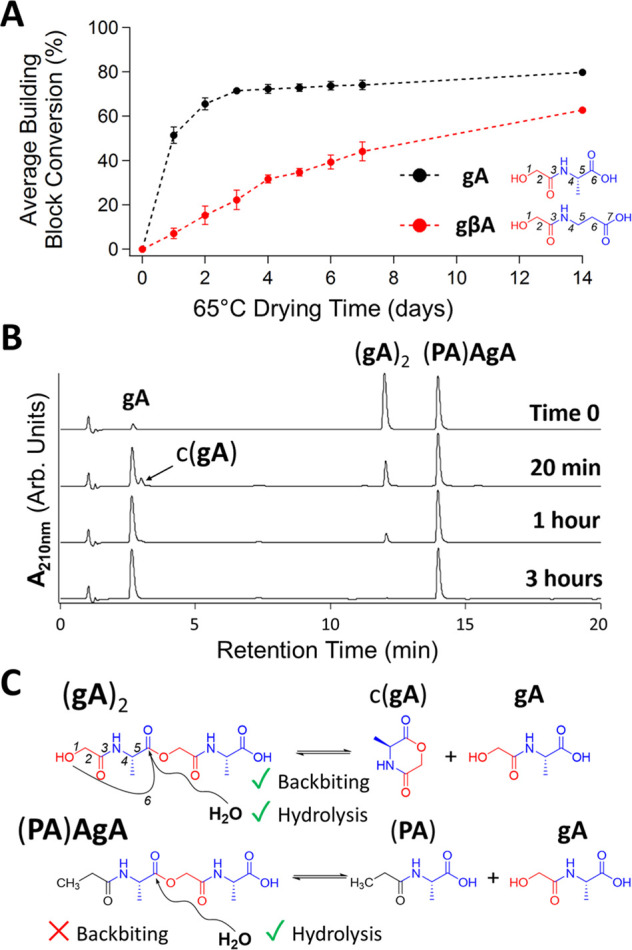
Structural factors influence building block polymerization and breakdown. (A) Time-dependent comparison of building block conversion to depsipeptides between gA and gβA, which can in principle form six- and seven-atom rings upon dehydration, respectively. Dashed lines were added to guide the eye. Bars: SD; n = 2. (B) Standards (gA)2 and (PA)AgA subject to pH 6, 65 °C aqueous incubation. (C) Structures of molecules used in panel B depicting depolymerization routes.
Scheme 2
Scheme 2. Bifunctional Building Blocks Allow for Variations in Depsipeptide Regiochemistry
Figure 4
Figure 4
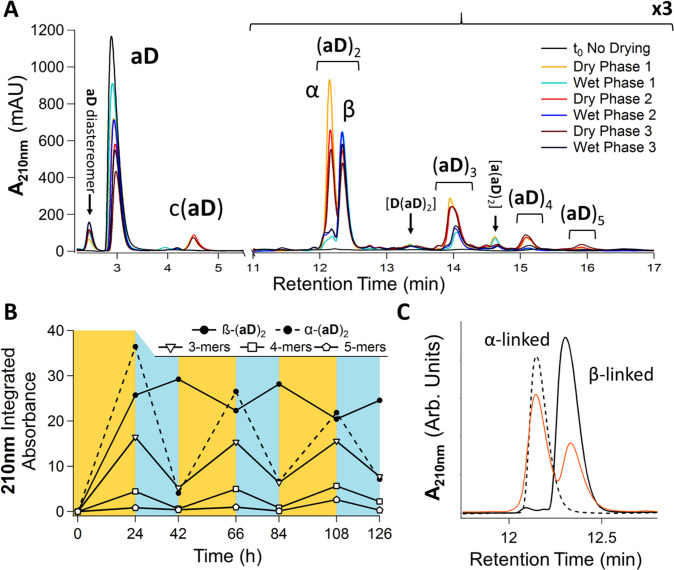
pH-controlled selectivity for side-chain-linked depsipeptides using bifunctional building blocks. (A) aD dry–wet cycled in pH 5.5 TEAOAc showed comparable abundances of both (aD)2 isomers formed following 24 h dry-heating phases (orange traces) and preferential preservation of β-(aD)2 following 18 h wet phases (blue traces). Peaks labeled [D/a(aD)2] displayed a mass consistent with a dehydration product from D/a + (aD)2. A stack plot of the chromatograms in panel A is provided in Figure S22 for clarity. (B) Integrated abundances of (aD)2 regioisomers and higher-order oligomer peaks (total integrated areas) from panel A over cycling time. Yellow regions indicate drying and heating at 75 °C (24 h). Blue regions indicate rehydration and incubation in the solution state at 65 °C (18 h). (C) Alignment with synthetic standards of α- and β-(aD)2 confirms regioisomer identities.
Figure 5
Figure 5
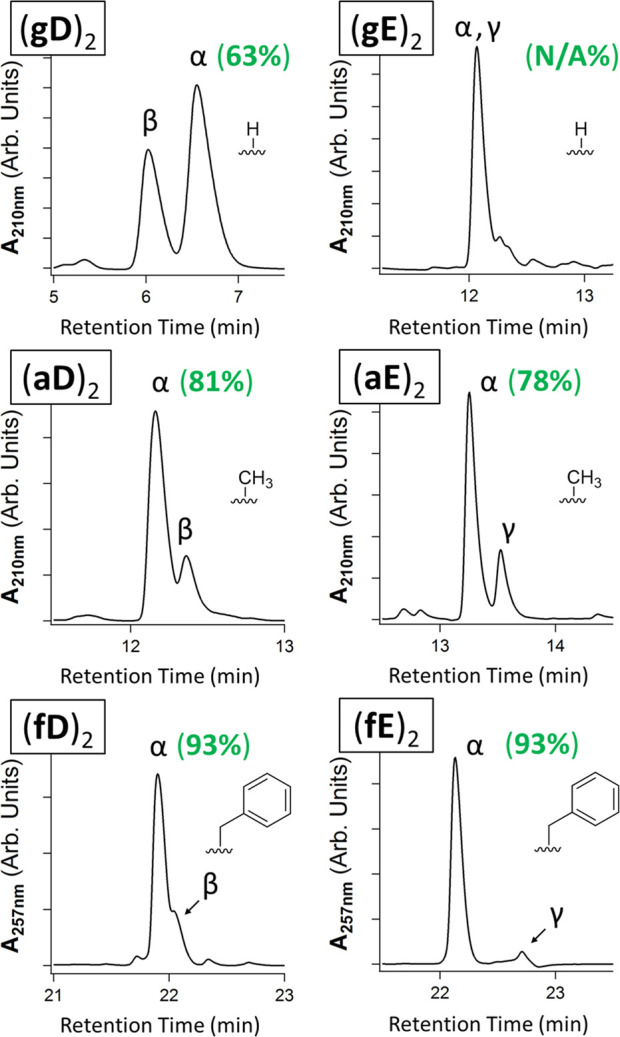
Hydroxy acid side chain size dictates native α-depsipeptide selectivity. Unbuffered 7 day, 65 °C drying of xD and xE building blocks showing 2-mers and percent α-linkage by integration. The α and γ regioisomers of (gE)2 appear to overlap; thus, their relative abundances are indeterminate. Hydroxy acid side chains are shown in each panel. The identities of the α- and γ-linked 2-mers of fE were determined using synthetic standards (Figure S26), while the 2-mers of fD were identified using an α-linked standard and by analysis of the degradation profile of the 2-mers (Figures S26–S27). fD and fE samples underwent drying with 1 equiv of 2-hydroxypyridine to prevent precipitation (Figure S28).

References

    1. Rowan S. J.; Cantrill S. J.; Cousins G. R. L.; Sanders J. K. M.; Stoddart J. F. Dynamic covalent chemistry. Angew. Chem., Int. Ed. 2002, 41, 898–952. 10.1002/1521-3773(20020315)41:6<898::AID-ANIE898>3.0.CO;2-E. - DOI - PubMed
    1. Corbett P. T.; Leclaire J.; Vial L.; West K. R.; Wietor J. L.; Sanders J. K.; Otto S. Dynamic combinatorial chemistry. Chem. Rev. 2006, 106, 3652–3711. 10.1021/cr020452p. - DOI - PubMed
    1. Beste L. F.; Houtz R. C. Amide interchange reactions. J. Polym. Sci. 1952, 8, 395–407. 10.1002/pol.1952.120080404. - DOI
    1. Isowa Y.; Ohmori M.; Ichikawa T.; Mori K.; Nonaka Y.; Kihara K.-i.; Oyama K.; Satoh H.; Nishimura S. The thermolysin-catalyzed condensation reactions of N-substituted aspartic and glutamic acids with phenylalanine alkyl esters. Tetrahedron Lett. 1979, 20, 2611–2612. 10.1016/S0040-4039(01)86363-2. - DOI
    1. De Martin L.; Ebert C.; Gardossi L.; Linda P. High isolated yields in thermolysin-catalysed synthesis of Z-l-aspartyl-l-phenylalanine methyl ester in toluene at controlled water activity. Tetrahedron Lett. 2001, 42, 3395–3397. 10.1016/S0040-4039(01)00452-X. - DOI