


The Association Between Dissemination and Characteristics of Pro-/Anti-COVID-19 Vaccine Messages on Twitter: Application of the Elaboration Likelihood Model
- PMID: 35783451
- PMCID: PMC9239316
- DOI: 10.2196/37077
The Association Between Dissemination and Characteristics of Pro-/Anti-COVID-19 Vaccine Messages on Twitter: Application of the Elaboration Likelihood Model
Abstract
Background: Messages on one's stance toward vaccination on microblogging sites may affect the reader's decision on whether to receive a vaccine. Understanding the dissemination of provaccine and antivaccine messages relating to COVID-19 on social media is crucial; however, studies on this topic have remained limited.
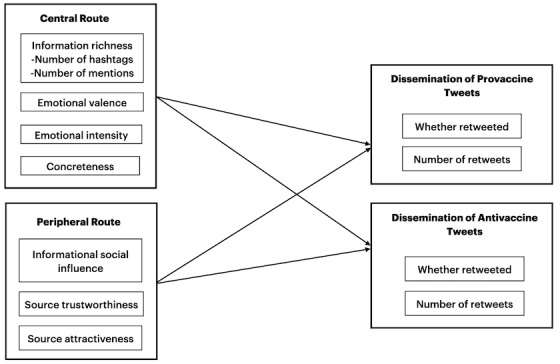
Objective: This study applies the elaboration likelihood model (ELM) to explore the characteristics of vaccine stance messages that may appeal to Twitter users. First, we examined the associations between the characteristics of vaccine stance tweets and the likelihood and number of retweets. Second, we identified the relative importance of the central and peripheral routes in decision-making on sharing a message.
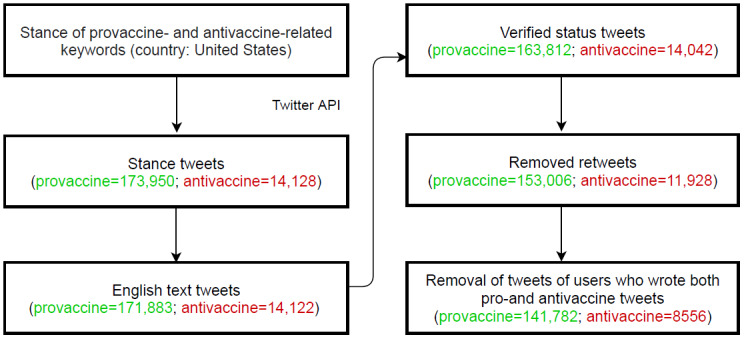
Methods: English-language tweets from the United States that contained provaccine and antivaccine hashtags (N=150,338) were analyzed between April 26 and August 26, 2021. Logistic and generalized negative binomial regressions were conducted to predict retweet outcomes. The content-related central-route predictors were measured using the numbers of hashtags and mentions, emotional valence, emotional intensity, and concreteness. The content-unrelated peripheral-route predictors were measured using the numbers of likes and followers and whether the source was a verified user.
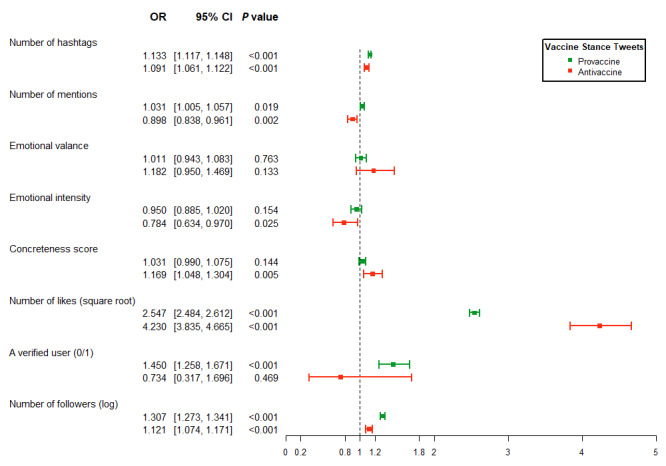
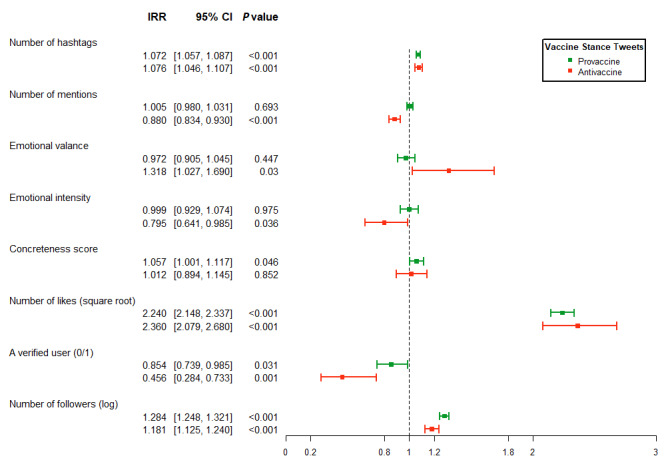
Results: Content-related characteristics played a prominent role in shaping decisions regarding whether to retweet antivaccine messages. Particularly, positive valence (incidence rate ratio [IRR]=1.32, P=.03) and concreteness (odds ratio [OR]=1.17, P=.01) were associated with higher numbers and likelihood of retweets of antivaccine messages, respectively; emotional intensity (subjectivity) was associated with fewer retweets of antivaccine messages (OR=0.78, P=.03; IRR=0.80, P=.04). However, these factors had either no or only small effects on the sharing of provaccine tweets. Retweets of provaccine messages were primarily determined by content-unrelated characteristics, such as the numbers of likes (OR=2.55, IRR=2.24, P<.001) and followers (OR=1.31, IRR=1.28, P<.001).
Conclusions: The dissemination of antivaccine messages is associated with both content-related and content-unrelated characteristics. By contrast, the dissemination of provaccine messages is primarily driven by content-unrelated characteristics. These findings signify the importance of leveraging the peripheral route to promote the dissemination of provaccine messages. Because antivaccine tweets with positive emotions, objective content, and concrete words are more likely to be disseminated, policymakers should pay attention to antivaccine messages with such characteristics.
Keywords: COVID-19; Twitter; antivaccine; content analysis; dissemination; elaboration likelihood model; emotional valence; infodemiology; provaccine; social media.
©Vipin Saini, Li-Lin Liang, Yu-Chen Yang, Huong Mai Le, Chun-Ying Wu. Originally published in JMIR Infodemiology (https://infodemiology.jmir.org), 27.06.2022.
Conflict of interest statement
Conflicts of Interest: None declared.
Figures
References
-
- World Health Organization 1st WHO Infodemiology Conference, WHO Infodemic Management: How Infodemics Affect the World & How They Can Be Managed. [2021-11-09]. https://www.who.int/news-room/events/detail/2020/06/30/default-calendar/... .
-
- Wilson SL, Wiysonge C. Social media and vaccine hesitancy. BMJ Glob Health. 2020 Oct;5(10):e004206. doi: 10.1136/bmjgh-2020-004206. https://gh.bmj.com/lookup/pmidlookup?view=long&pmid=33097547 bmjgh-2020-004206 - DOI - PMC - PubMed
-
- Eysenbach G. Infodemiology and infoveillance: framework for an emerging set of public health informatics methods to analyze search, communication and publication behavior on the Internet. J Med Internet Res. 2009 Mar 27;11(1):e11. doi: 10.2196/jmir.1157. https://www.jmir.org/2009/1/e11/ v11i1e11 - DOI - PMC - PubMed
-
- Tangcharoensathien V, Calleja N, Nguyen T, Purnat T, D'Agostino M, Garcia-Saiso S, Landry M, Rashidian A, Hamilton C, AbdAllah A, Ghiga I, Hill A, Hougendobler D, van Andel J, Nunn M, Brooks I, Sacco PL, De Domenico M, Mai P, Gruzd A, Alaphilippe A, Briand S. Framework for managing the COVID-19 infodemic: methods and results of an online, crowdsourced WHO technical consultation. J Med Internet Res. 2020 Jun 26;22(6):e19659. doi: 10.2196/19659. https://www.jmir.org/2020/6/e19659/ v22i6e19659 - DOI - PMC - PubMed
LinkOut - more resources
Full Text Sources
Miscellaneous
