


Trends in Musculoskeletal Rehabilitation Needs in China From 1990 to 2030: A Bayesian Age-Period-Cohort Modeling Study
- PMID: 35784203
- PMCID: PMC9240767
- DOI: 10.3389/fpubh.2022.869239
Trends in Musculoskeletal Rehabilitation Needs in China From 1990 to 2030: A Bayesian Age-Period-Cohort Modeling Study
Abstract
Background: Disability and medical expenses caused by musculoskeletal disorders in China had a great impact on the global health and economy. Rehabilitation is essential for dealing with musculoskeletal disorders. However, China's musculoskeletal rehabilitation needs remain unknown. This study aimed to examine the secular trends for musculoskeletal rehabilitation needs in China from 1990 to 2030.
Methods: Data on musculoskeletal rehabilitation needs were extracted from the Global Burden of Diseases, Injuries, and Risk Factors Study (GBD) repository. Estimated annual percentage changes (EAPCs) were calculated to reflect fluctuations in the age-standardized rates. The Bayesian age-period-cohort models were used to project rehabilitation needs.
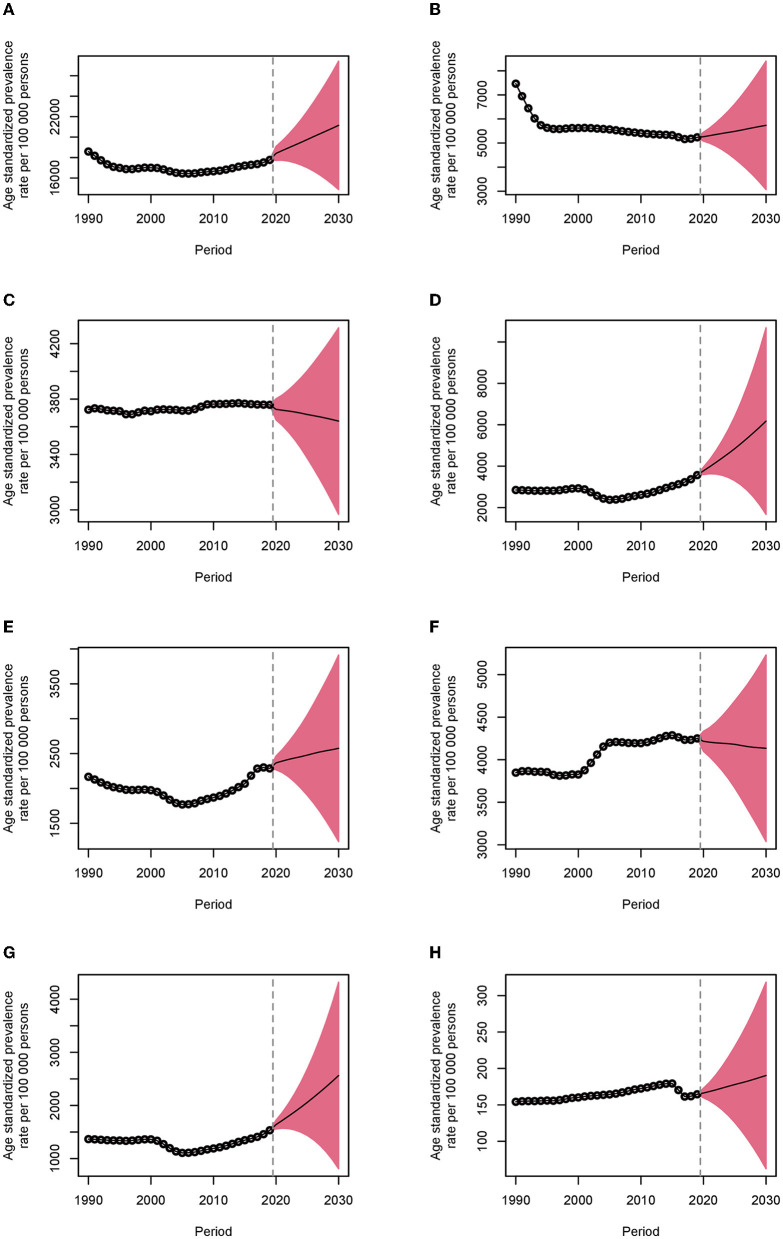
Results: The number of prevalent cases and years lived with disability (YLD) counts in need of musculoskeletal rehabilitation increased greatly in China from 1990 to 2019. There will be 465.9 million Chinese people in need of rehabilitation, with the age-standardized prevalence rate increasing to 21,151.0 [2.5-97.5% predictive interval (95% PI) 14,872.6-27,429.3] per 100,000 persons in 2030. Similarly, the YLD counts will increase to 40.1 million, with the age-standardized YLD rate increasing to 1,811.2 (95% PI 1,232.5-2,390.0) per 100,000 persons in 2030.
Conclusions: Increasing trends in musculoskeletal rehabilitation needs were found from 1990 to 2019, which will be anticipated through 2030. Rehabilitation is suggested to be integrated into primary care settings.
Keywords: musculoskeletal disorders; prediction; prevalence; rehabilitation; years lived with disability.
Copyright © 2022 Chen, Fong and Wong.
Conflict of interest statement
The authors declare that the research was conducted in the absence of any commercial or financial relationships that could be construed as a potential conflict of interest.
Figures
References
-
- de Sire A, Agostini F, Lippi L, Mangone M, Marchese S, Cisari C, et al. Oxygen-ozone therapy in the rehabilitation field: state of the art on mechanisms of action, safety and effectiveness in patients with musculoskeletal disorders. Biomolecules. (2021) 11:356. 10.3390/biom11030356 - DOI - PMC - PubMed
-
- Hayden JA, Wilson MN, Stewart S, Cartwright JL, Smith AO, Riley RD, et al. Exercise treatment effect modifiers in persistent low back pain: an individual participant data meta-analysis of 3514 participants from 27 randomised controlled trials. Br J Sports Med. (2020) 54:1277–8. 10.1136/bjsports-2019-101205 - DOI - PubMed
-
- Karlsson Å, Berggren M, Gustafson Y, Olofsson B, Lindelöf N, Stenvall M. Effects of geriatric interdisciplinary home rehabilitation on walking ability and length of hospital stay after hip fracture: a randomized controlled trial. J Am Med Dir Assoc. (2016) 17:e9–15. 10.1016/j.jamda.2016.02.001 - DOI - PubMed
MeSH terms
LinkOut - more resources
Full Text Sources
Medical
Research Materials
Miscellaneous
