


Retrospective Comparison of Efficacy and Safety of Rabbit Anti-Thymocyte Globulin and Porcine Anti-Lymphocyte Globulin in Patients With Acquired Aplastic Anemia Undergoing Hematopoietic Stem Cell Transplantation From Matched Sibling Donors
- PMID: 35784311
- PMCID: PMC9241985
- DOI: 10.3389/fimmu.2022.889784
Retrospective Comparison of Efficacy and Safety of Rabbit Anti-Thymocyte Globulin and Porcine Anti-Lymphocyte Globulin in Patients With Acquired Aplastic Anemia Undergoing Hematopoietic Stem Cell Transplantation From Matched Sibling Donors
Abstract
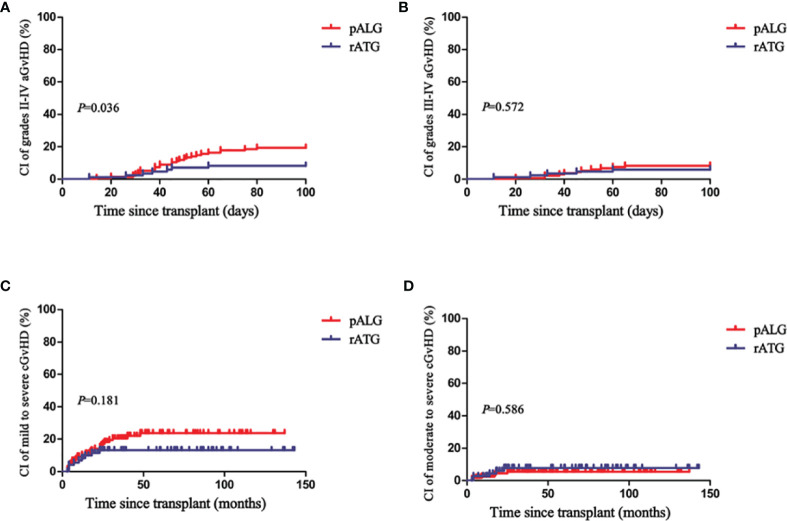
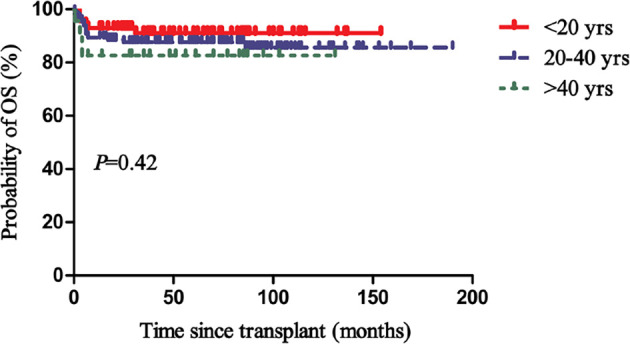
We compared the efficacy and safety of porcine anti-lymphocyte globulin (pALG) (n=140) and rabbit anti-thymocyte globulin (rATG) (n=86) in patients with acquired aplastic anemia (AA) receiving hematopoietic stem cell transplantation (HSCT) from matched sibling donors (MSD) in two transplantation centers in China ranging from 2005 to 2020. The groups had similar baseline characteristics except for a higher number of infused mononuclear cells (P<0.001) and a higher proportion of peripheral blood stem cells as graft sources (P=0.003) in the pALG group. The rates of neutrophil engraftment at day 28 (P=1), platelet engraftment at day 28 (P=0.228), bloodstream infection before engraftment (P=0.867), invasive fungal diseases (P=0.362), cytomegalovirus viremia (P=0.667), and graft rejection (P=0.147) were similar in the two groups. A higher cumulative incidence of grades II-IV acute graft versus host disease (aGvHD) at 100 days occurred in the pALG group (19% vs. 8%, P=0.035) while no significant differences in grades III-IV aGvHD (P=0.572), mild to severe chronic GvHD (cGvHD) (P=0.181), and moderate to severe cGvHD (P=0.586) were observed. The actuarial 5-year overall survival (OS), failure-free survival (FFS), and GvHD-free, FFS rates of the pALG group were 87% (95% confidence interval [CI], 82-93), 85% (95% CI, 80-92), and 78% (95% CI, 72-92) versus 91% (95% CI, 86-99) (P=0.33), 88% (95% CI, 82-97) (P=0.428), and 79% (95% CI, 72-90) (P=0.824) in the rATG group, respectively. A busulfan-containing conditioning regimen was the only adverse risk factor for OS and FFS in multivariate analysis. In conclusion, pALG is an alternative to rATG in patients with severe AA receiving MSD-HSCT. A prospective, large-sample study is needed to explore this therapy further.
Keywords: aplastic anemia; matched sibling donors; porcine; rabbit; stem cell transplantation.
Copyright © 2022 Zhang, Chen, Li, Li, Lin, Cao, Wang, Yang, Pang, Zhang, Ma, Zhai, He, Wei, Jiang, Han, Zhang and Feng.
Conflict of interest statement
The authors declare that the research was conducted in the absence of any commercial or financial relationships that could be construed as a potential conflict of interest.
Figures

References
-
- Bacigalupo A, Brand R, Oneto R, Bruno B, Socié G, Passweg J, et al. . Treatment of Acquired Severe Aplastic Anemia: Bone Marrow Transplantation Compared With Immunosuppressive Therapy–The European Group for Blood and Marrow Transplantation Experience. Semin Hematol (2000) 37(1):69–80. doi: 10.1016/s0037-1963(00)90031-3 - DOI - PubMed
-
- Locasciulli A, Oneto R, Bacigalupo A, Socié G, Korthof E, Bekassy A, et al. . Outcome of Patients With Acquired Aplastic Anemia Given First Line Bone Marrow Transplantation or Immunosuppressive Treatment in the Last Decade: A Report From the European Group for Blood and Marrow Transplantation (EBMT). Haematologica (2007) 92(1):11–8. doi: 10.3324/haematol.10075 - DOI - PubMed
-
- Yoshida N, Kobayashi R, Yabe H, Kosaka Y, Yagasaki H, Watanabe K, et al. . First-Line Treatment for Severe Aplastic Anemia in Children: Bone Marrow Transplantation From a Matched Family Donor Versus Immunosuppressive Therapy. Haematologica (2014) 99(12):1784–91. doi: 10.3324/haematol.2014.109355 - DOI - PMC - PubMed
-
- Dufour C, Pillon M, Sociè G, Rovò A, Carraro E, Bacigalupo A, et al. . Outcome of Aplastic Anaemia in Children. A Study by the Severe Aplastic Anaemia and Paediatric Disease Working Parties of the European Group Blood and Bone Marrow Transplant. Br J Haematol (2015) 169(4):565–73. doi: 10.1111/bjh.13297 - DOI - PubMed
Publication types
MeSH terms
Substances
LinkOut - more resources
Full Text Sources
Medical
