


Gamma Delta T-Cell Based Cancer Immunotherapy: Past-Present-Future
- PMID: 35784326
- PMCID: PMC9245381
- DOI: 10.3389/fimmu.2022.915837
Gamma Delta T-Cell Based Cancer Immunotherapy: Past-Present-Future
Abstract
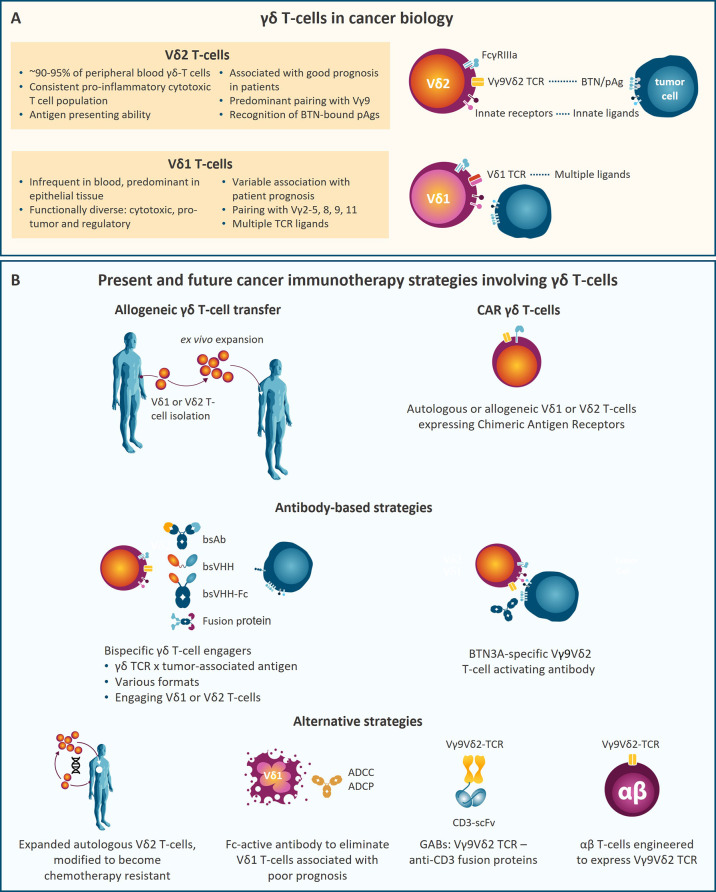
γδ T-cells directly recognize and kill transformed cells independently of HLA-antigen presentation, which makes them a highly promising effector cell compartment for cancer immunotherapy. Novel γδ T-cell-based immunotherapies, primarily focusing on the two major γδ T-cell subtypes that infiltrate tumors (i.e. Vδ1 and Vδ2), are being developed. The Vδ1 T-cell subset is enriched in tissues and contains both effector T-cells as well as regulatory T-cells with tumor-promoting potential. Vδ2 T-cells, in contrast, are enriched in circulation and consist of a large, relatively homogeneous, pro-inflammatory effector T-cell subset. Healthy individuals typically harbor in the order of 50-500 million Vγ9Vδ2 T-cells in the peripheral blood alone (1-10% of the total CD3+ T-cell population), which can rapidly expand upon stimulation. The Vγ9Vδ2 T-cell receptor senses intracellular phosphorylated metabolites, which accumulate in cancer cells as a result of mevalonate pathway dysregulation or upon pharmaceutical intervention. Early clinical studies investigating the therapeutic potential of Vγ9Vδ2 T-cells were based on either ex vivo expansion and adoptive transfer or their systemic activation with aminobisphosphonates or synthetic phosphoantigens, either alone or combined with low dose IL-2. Immune-related adverse events (irAE) were generally \mild, but the clinical efficacy of these approaches provided overall limited benefit. In recent years, critical advances have renewed the excitement for the potential of Vγ9Vδ2 T-cells in cancer immunotherapy. Here, we review γδ T-cell-based therapeutic strategies and discuss the prospects of those currently evaluated in clinical studies in cancer patients as well as future therapies that might arise from current promising pre-clinical results.
Keywords: adoptive cell transfer; aminobisphosphonates; bispecific t-cell engager; cancer; chimeric antigen receptor; gamma delta T-cell; immunotherapy; phosphoantigens.
Copyright © 2022 Saura-Esteller, de Jong, King, Ensing, Winograd, de Gruijl, Parren and van der Vliet.
Conflict of interest statement
JS-E, MJ and LK are funded by Lava therapeutics. HV, PP, EE, BW are employed by and hold stock of LAVA Therapeutics. TG holds stock of LAVA Therapeutics.
Figures
References
Publication types
MeSH terms
Substances
LinkOut - more resources
Full Text Sources
Other Literature Sources
Medical
Research Materials
Miscellaneous
