


Identification of a female murder victim found in Burgenland, Austria in 1993
- PMID: 35784408
- PMCID: PMC9246003
- DOI: 10.1080/20961790.2021.1924425
Identification of a female murder victim found in Burgenland, Austria in 1993
Abstract
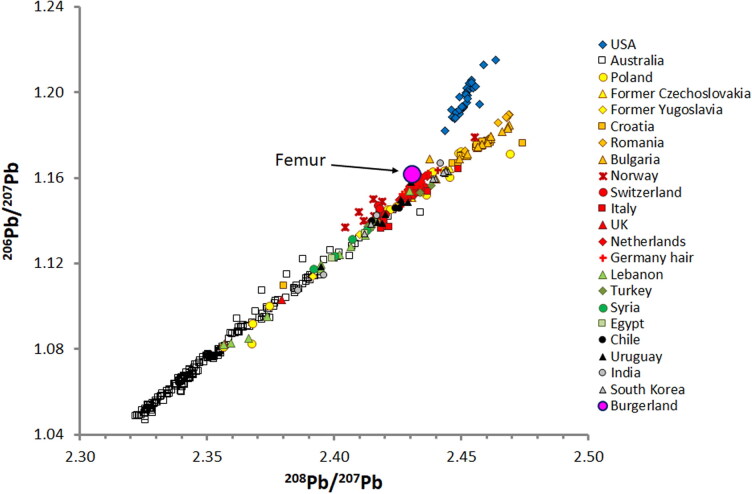
In 1993, the skeletal remains of a female corpse were found in Burgenland, Austria. Initial identification of the approximately 25-35-year-old female appeared impossible, but the case was reopened 23 years later. By applying biogeochemical isotope methods to her body tissues, the geographical origin of the unknown corpse could be predicted. The results of the C, N, S, H, Sr, and Pb isotope analyses suggested that the female did not originate from Europe and most likely spent her youth in the northern Caribbean. Using these findings, the police were able to identify the woman within 2 weeks. The female came from the Dominican Republic and resided in Austria for only a short period before she was murdered. This case shows that isotope biogeochemistry investigations can provide the police with crucial information that enables unknown persons to be identified.KeypointsC-N-S-H and Sr-Pb isotope analyses were applied to human remains associated with a cold case.It was possible to determine the region of origin of the unknown deceased individual as the northern Caribbean.After 23 years, the murder victim was successfully identified.
Keywords: Forensic sciences; bio-elements; forensic anthropology; geo-elements; human identification; provenance; stable isotope analysis.
© 2021 The Author(s). Published by Taylor & Francis Group on behalf of the Academy of Forensic Science.
Conflict of interest statement
The authors have no financial interest or benefit to disclose related to the publication of this article.
Figures
References
-
- Chesson LA, Meier‐Augenstein W, Berg GE, et al. . Basic principles of stable isotope analysis in humanitarian forensic science. In: Parra CR, Zapico CS, Ubelaker HD, editors. Forensic science and humanitarian action: interacting with the dead and the living. Hoboken (NJ): John Wiley & Sons Ltd.; 2020. p. 285–310.
-
- Chesson LA, Tipple BJ, Youmans LV, et al. Forensic identification of human skeletal remains using isotopes: a brief history of applications from archaeological dig sites to modern crime scenes. In: Latham K, Bartelink JE, Finnegan M, editors. New perspectives in forensic human skeletal identification. London (UK): Elsevier; 2018. p. 157–173.
-
- Font L, van der Peijl G, van Leuwen C, et al. . Identification of the geographical place of origin of an unidentified individual by multi-isotope analysis. Sci Justice. 2015;55:34–42. - PubMed
-
- Lehn C, Graw M.. Identifizierung einer skelettierten „Kofferleiche” aus Berlin. [Identification of a skeletonised “suitcase corpse” from Berlin, Germany]. Rechtsmedizin. 2016;26:429–435. German.
-
- Lehn C, Rossmann A, Graw M.. Provenancing of unidentified corpses by stable isotope techniques—presentation of case studies. Sci Justice. 2015;55:72–88. - PubMed
Publication types
LinkOut - more resources
Full Text Sources
Research Materials
Miscellaneous
