. 2022 May 26;2(6):100225.
doi: 10.1016/j.crmeth.2022.100225. eCollection 2022 Jun 20.

A versatile viral toolkit for functional discovery in the nervous system

Affiliations

A versatile viral toolkit for functional discovery in the nervous system

Gabrielle Pouchelon et al. Cell Rep Methods. .

Abstract

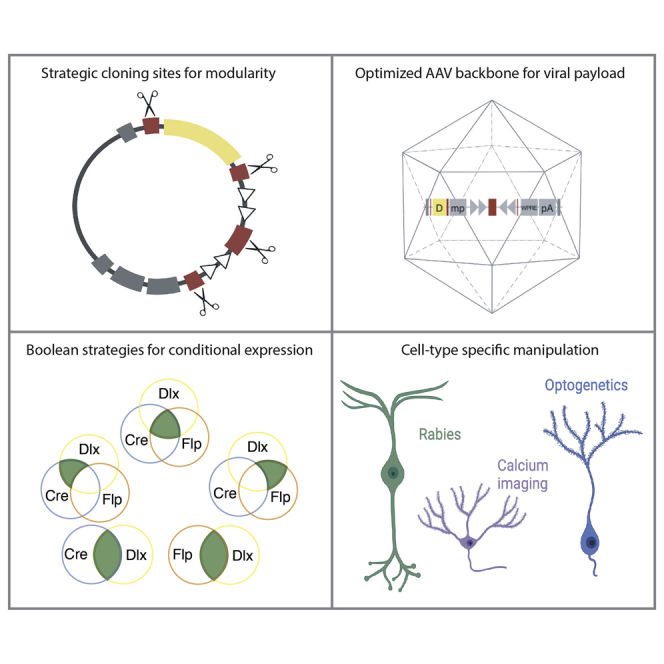
The ability to precisely control transgene expression is essential for basic research and clinical applications. Adeno-associated viruses (AAVs) are non-pathogenic and can be used to drive stable expression in virtually any tissue, cell type, or species, but their limited genomic payload results in a trade-off between the transgenes that can be incorporated and the complexity of the regulatory elements controlling their expression. Resolving these competing imperatives in complex experiments inevitably results in compromises. Here, we assemble an optimized viral toolkit (VTK) that addresses these limitations and allows for efficient combinatorial targeting of cell types. Moreover, their modular design explicitly enables further refinements. We achieve this in compact vectors by integrating structural improvements of AAV vectors with innovative molecular tools. We illustrate the potential of this approach through a systematic demonstration of their utility for targeting cell types and querying their biology using a wide array of genetically encoded tools.

Keywords: AAV; circuits; neuroscience; vector.


Conflict of interest statement

J.D. is founder, shareholder, and employee of Regel Therapeutics. G.F. is founder and shareholder of Regel Therapeutics. The work presented in this manuscript is unrelated to any aspect of Regel Therapeutics’ focus, work, or interest.

Figures
None
Graphical abstract
Figure 1
Figure 1
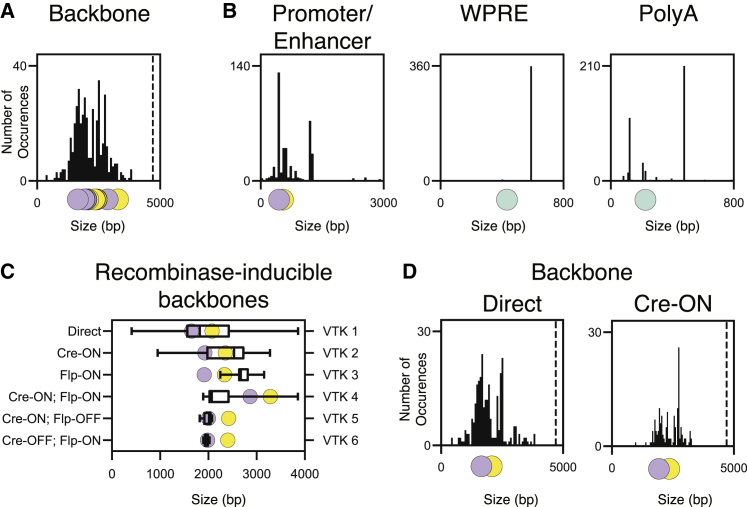
Constitutive elements analysis of Addgene most commonly used AAV vectors Number of occurrences of the indicated elements among Addgene’s top plasmids sorted by size (base pairs, bp). (A) Backbones. The dotted line shows the 4.7 kb payload limit. (B) Promoters. WPRE and polyA sequences. (C) Distribution of backbones’ sizes for recombinase-inducible plasmids from Addgene. Each row represents specific recombinase dependencies as described on the left y axis, and its corresponding VTK constructs are represented on the right y axis. (D) Number of occurrences of backbones in direct comparison to Cre-ON conformation. In (A–D), the colored dots on the x axis indicate the size of the corresponding elements used in VTK vectors. Green dots for common elements to all VTKs (WPRE and polyA), purple dots for VTKS1–6, and yellow dots for VTKD1–6. See also Figure S1 and Table S1.
Figure 2
Figure 2
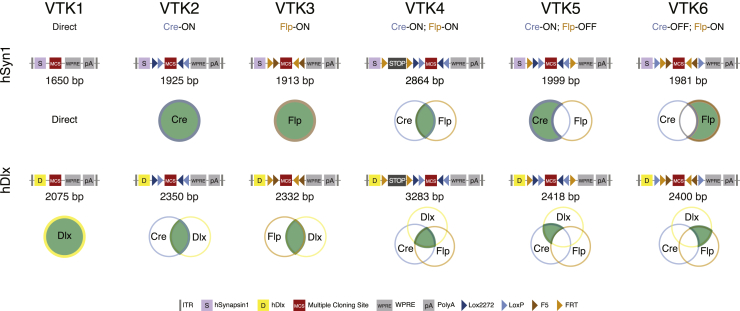
Optimization of a viral toolkit (VTK) for direct and combinatorial transgene expression Diagram representing each VTK plasmid. The size between ITRs and the corresponding Boolean strategy are displayed below the relevant plasmid backbone. Top row: VTKS1–6. Bottom row: VTKD1–6. MCS, multiple cloning site; pA: polyA; LoxP, Lox2272 are Cre-dependent sites; FRT, F5 are Flp-dependent sites. See also Figure S2 and Table S2.
Figure 3
Figure 3
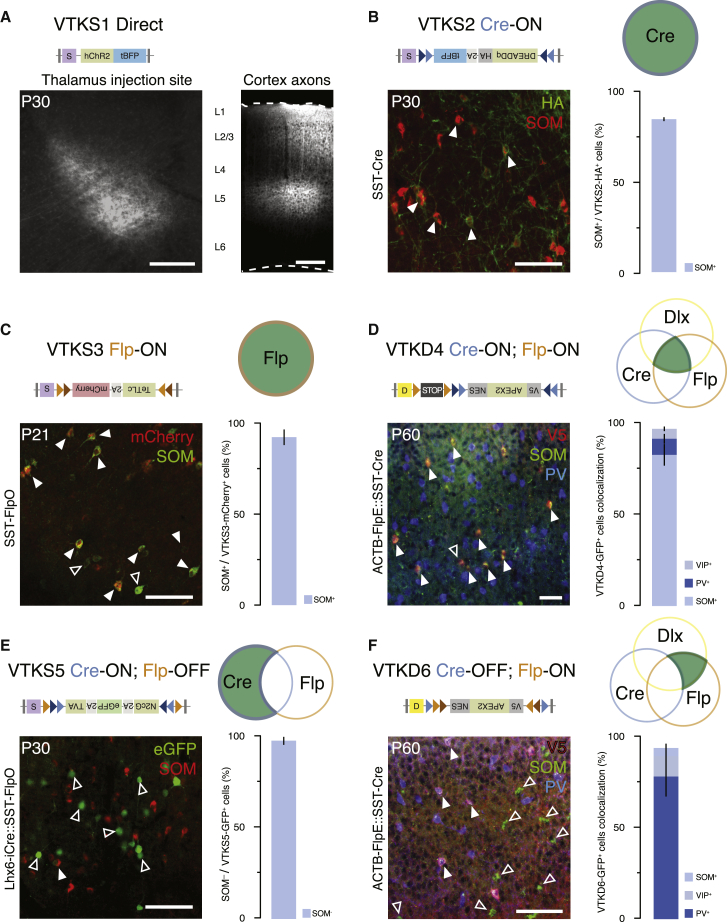
Validation of VTK vector cell-type specificity (A) Example of VTKS1-hChR2-tBFP injection in the thalamus and corresponding thalamocortical projections in the cortex. Scale bar: 100 μm (left) and 200 μm (right). (B) Colocalization of somatostatin (SOM) and Gq-HA tag showing SST-Cre-specific VTKS2-Dreadd-Gq recombination (87.32% ± 1.12%, N = 4). Scale bar: 100 μm. (C) Colocalization of SOM with mCherry showing the recombination of VTKS3-TeTLC upon SST-FlpO (92.26% ± 4.31%, N = 3). Scale bar: 100 μm. (D) Left, colocalization of V5 labeling with SOM and parvalbumin (PV). Scale bar: 100 μm. Right, quantification of V5 colocalization with SOM, PV, and vasoactive intestinal peptide (VIP)-expressing interneurons (SOM: 83.17% ± 5.95%; PV: 8.97% ± 2.67%; VIP: 5.5% ± 1.22%, N = 3) showing the recombination of VTKD4-NES-APEX2 in GABAergic interneurons and primarily in SOM+ cells. (E) Colocalization of EGFP and SOM showing the exclusion of VTKS5-helpers from SOM+ neurons (97.42% ± 0.19%, N = 3). Scale bar: 100 μm. (F) Left, colocalization of V5 with SOM and PV in the hippocampus. Scale bar, 100 μm. Right, quantification of V5 with SOM, PV, and VIP (PV: 78.27% ± 10.99%; VIP: 11.13% ± 2.55%; SOM: 4.5% ± 2.55%, N = 3) showing the recombination of VTKD6-NES-APEX2 in GABAergic interneurons and a majority of PV+ neurons (full arrows), except for SOM+ cells (empty arrows). See also Figure S3 and Table S2.
Figure 4
Figure 4
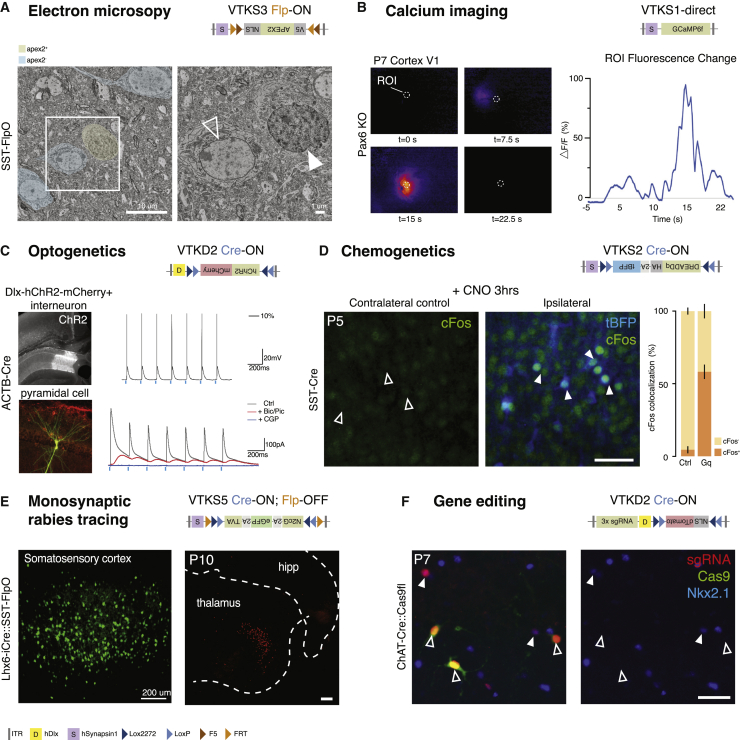
Validation of VTK vectors functionality (A) VTKS3-NLS-APEX2-V5 injected into the somatosensory cortex of SST-FlpO mice allowed for the labeling of sparse populations of nuclei. SST cells with an APEX2-positive nucleus are labeled in yellow (full arrow) and negative ones in blue (empty arrow). Scale bar: 10 μm (left) and 1 μm (right). (B) Calcium events from VTKS1-GCaMP6f-infected cells were found in the visual cortex of Pax6 knockout (KO) mice. Waves of spontaneous infected cell activity were detected. Graph represents the difference in fluorescence (ΔF/F%) detected in the region of interest (ROI) over time. (C) Top, cells infected by VTKD2-hChR2-mCherry in dorsal hippocampus of ACTB-Cre mice show depolarization upon blue-light stimulation; bottom, ChR2-mCherry-negative neighboring pyramidal cells receive light-evoked inhibitory postsynaptic currents (IPSCs). IPSCs are blocked by bicuculline (Bic)/picrotoxin (PIc) and CGP55845 (CGP) and GABAa and GABAb receptor antagonists, respectively. (D) VTKS2-driven Dreadd-Gq (tBFP) triggers the expression of the immediate-early gene, cFos, after 3 h of CNO activation compared with the control on the contralateral side (Ctrl: 4.47% ± 2.4%, N = 3; after CNO: 58.21% ± 5.19%, N = 6; data are shown as mean ± SEM). Full arrows: cFos + tBFP colocalization upon activation. Empty arrows: absence of cFos in Ctrl. Scale bar: 50 μm. (E) Left, VTKS5-rabies helpers (N2cG-eGFP-TVA) are injected in the somatosensory cortex of Lhx6-iCre::SST-FlpO animals. Right, example retrograde labeling tracing found at the thalamus level after secondary rabies infection of helper+ cells. Scale bar: 200 μm (left and right). (F) Three CRISPR guides (sgRNA) targeting Nkx2.1 gene are inserted in VTKD2-NLSdTomato and injected in ChAT-Cre mice::Floxed-Cas9 mice. sgRNA (red) in Cas9-positive (green) cells suppressed Nkx2.1 expression (blue, empty arrows). Cells without colocalization still express Nkx2.1 (full arrows). Scale bar: 50 μm. See also Figure S4 and Table S2.

References

    1. Ackman J.B., Burbridge T.J., Crair M.C. Retinal waves coordinate patterned activity throughout the developing visual system. Nature. 2012;490:219–225. doi: 10.1038/nature11529. - DOI - PMC - PubMed
    1. Alexander G.M., Rogan S.C., Abbas A.I., Armbruster B.N., Pei Y., Allen J.A., Nonneman R.J., Hartmann J., Moy S.S., Nicolelis M.A., et al. Remote control of neuronal activity in transgenic mice expressing evolved G protein-coupled receptors. Neuron. 2009;63:27–39. doi: 10.1016/j.neuron.2009.06.014. - DOI - PMC - PubMed
    1. Armbruster B.N., Li X., Pausch M.H., Herlitze S., Roth B.L. Evolving the lock to fit the key to create a family of G protein-coupled receptors potently activated by an inert ligand. Proc. Natl. Acad. Sci. U S A. 2007;104:5163–5168. doi: 10.1073/pnas.0700293104. - DOI - PMC - PubMed
    1. Atasoy D., Aponte Y., Su H.H., Sternson S.M. A FLEX switch targets Channelrhodopsin-2 to multiple cell types for imaging and long-range circuit mapping. J. Neurosci. 2008;28:7025–7030. doi: 10.1523/jneurosci.1954-08.2008. - DOI - PMC - PubMed
    1. Bedbrook C.N., Deverman B.E., Gradinaru V. Viral strategies for targeting the central and peripheral nervous systems. Annu. Rev. Neurosci. 2018;41:323–348. doi: 10.1146/annurev-neuro-080317-062048. - DOI - PubMed

Publication types

LinkOut - more resources