


Spermidine overrides INSR (insulin receptor)-IGF1R (insulin-like growth factor 1 receptor)-mediated inhibition of autophagy in the aging heart
- PMID: 35786404
- PMCID: PMC9542397
- DOI: 10.1080/15548627.2022.2095835
Spermidine overrides INSR (insulin receptor)-IGF1R (insulin-like growth factor 1 receptor)-mediated inhibition of autophagy in the aging heart
Abstract
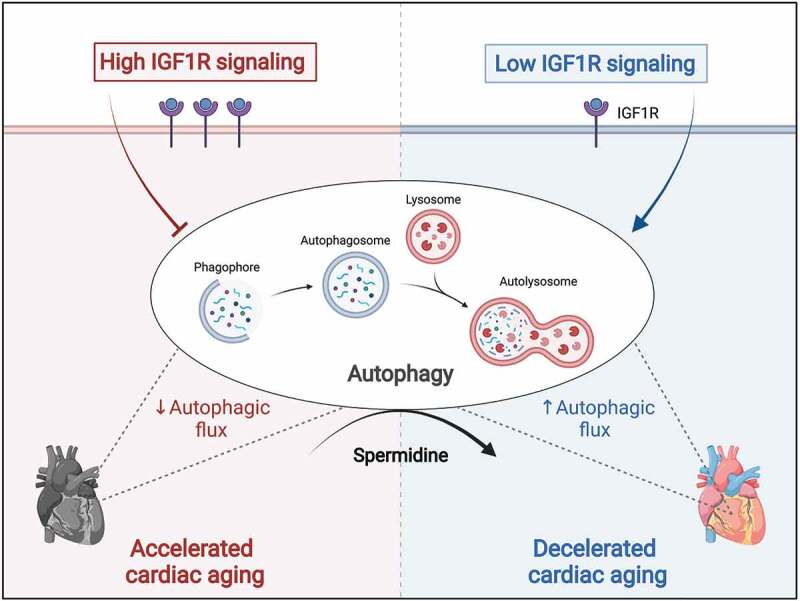
Although attenuated IGF1R (insulin-like growth factor 1 receptor) signaling has long been viewed to promote longevity in model organisms, adverse effects on the heart have been the subject of major concern. We observed that IGF1R is overexpressed in cardiac tissues from patients with end-stage non-ischemic heart failure, coupled to the activation of the IGF1R downstream effector AKT/protein kinase B and inhibition of ULK1 (unc-51 like autophagy activating kinase 1). Transgenic overexpression of human IGF1R in cardiomyocytes from mice initially induces physiological cardiac hypertrophy and superior function, but later in life confers a negative impact on cardiac health, causing macroautophagy/autophagy inhibition as well as impaired oxidative phosphorylation, thus reducing life expectancy. Treatment with the autophagy inducer and caloric restriction mimetic spermidine ameliorates most of these IGF1R-induced cardiotoxic effects in vivo. Moreover, inhibition of IGF1R signaling by means of a dominant-negative phosphoinositide 3-kinase (PI3K) mutant induces cardioprotective autophagy, restores myocardial bioenergetics and improves late-life survival. Hence, our results demonstrate that IGF1R exerts a dual biphasic impact on cardiac health, and that autophagy mediates the late-life geroprotective effects of IGF1R inhibition in the heart.
Keywords: Heart failure; IGF1R; PI3K; human; insulin signaling; longevity; mitochondrial dysfunction; mouse.
Conflict of interest statement
F.M. has financial interest in TLL, The Longevity Labs. G.K. has been holding research contracts with Daiichi Sankyo, Eleor, Kaleido, Lytix Pharma, PharmaMar, Osasuna Therapeutics, Samsara Therapeutics, Sanofi, Sotio, Tollys, Vascage and Vasculox/Tioma. G.K. has been consulting for Reithera. G.K. is on the Board of Directors of the Bristol Myers Squibb Foundation France. G.K. is a scientific co-founder of everImmune, Osasuna Therapeutics, Samsara Therapeutics and Therafast Bio. G.K. is the inventor of patents covering therapeutic targeting of aging, cancer, cystic fibrosis and metabolic disorders.
Figures
Comment on
-
Fine-Tuning Cardiac Insulin-Like Growth Factor 1 Receptor Signaling to Promote Health and Longevity.Circulation. 2022 Jun 21;145(25):1853-1866. doi: 10.1161/CIRCULATIONAHA.122.059863. Epub 2022 May 26. Circulation. 2022. PMID: 35616058 Free PMC article.
References
Publication types
MeSH terms
Substances
LinkOut - more resources
Full Text Sources
Other Literature Sources
Miscellaneous
