


ABA represses TOR and root meristem activity through nuclear exit of the SnRK1 kinase
- PMID: 35787039
- PMCID: PMC9282376
- DOI: 10.1073/pnas.2204862119
ABA represses TOR and root meristem activity through nuclear exit of the SnRK1 kinase
Erratum in
-
Correction for Belda-Palazón et al., ABA represses TOR and root meristem activity through nuclear exit of the SnRK1 kinase.Proc Natl Acad Sci U S A. 2022 Oct 4;119(40):e2215090119. doi: 10.1073/pnas.2215090119. Epub 2022 Sep 30. Proc Natl Acad Sci U S A. 2022. PMID: 36179049 Free PMC article. No abstract available.
Abstract
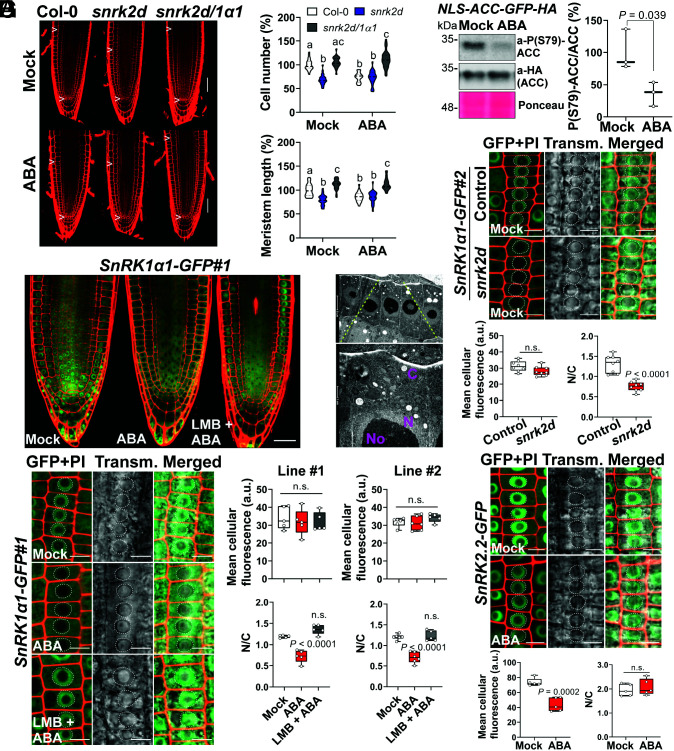
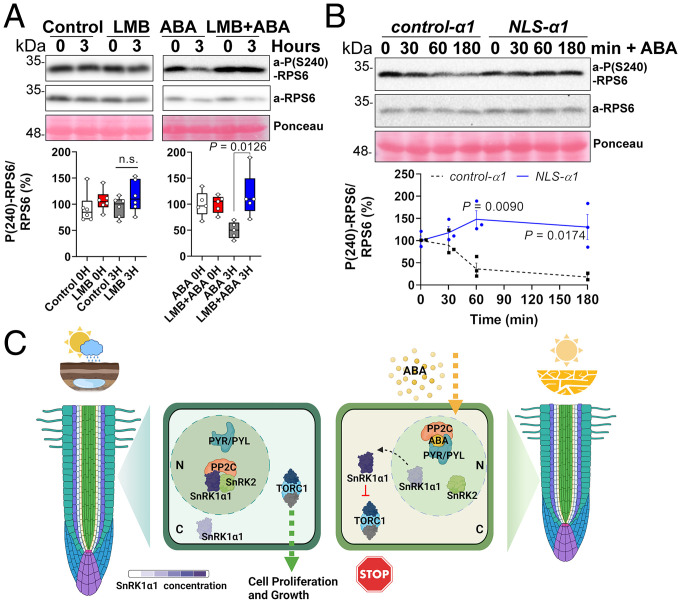
The phytohormone abscisic acid (ABA) promotes plant tolerance to major stresses such as drought, partly by modulating growth through poorly understood mechanisms. Here, we show that ABA-triggered repression of cell proliferation in the Arabidopsis thaliana root meristem relies on the swift subcellular relocalization of SNF1-RELATED KINASE 1 (SnRK1). Under favorable conditions, the SnRK1 catalytic subunit, SnRK1α1, is enriched in the nuclei of root cells, and this is accompanied by normal cell proliferation and meristem size. Depletion of two key drivers of ABA signaling, SnRK2.2 and SnRK2.3, causes constitutive cytoplasmic localization of SnRK1α1 and reduced meristem size, suggesting that, under nonstress conditions, SnRK2s promote growth by retaining SnRK1α1 in the nucleus. In response to ABA, SnRK1α1 translocates to the cytoplasm, and this is accompanied by inhibition of target of rapamycin (TOR), decreased cell proliferation, and reduced meristem size. Blocking nuclear export with leptomycin B abrogates ABA-driven SnRK1α1 relocalization to the cytoplasm and ABA-elicited inhibition of TOR. Furthermore, fusing SnRK1α1 to an SV40 nuclear localization signal leads to defective ABA-dependent TOR repression. Altogether, we demonstrate that SnRK2-dependent changes in SnRK1α1 subcellular localization are crucial for inhibiting TOR and root growth in response to ABA. Rapid relocalization of central regulators such as SnRK1 may represent a general strategy of eukaryotic organisms to respond to environmental changes.
Keywords: abscisic acid; energy signaling; growth control; root; target of rapamycin.
Conflict of interest statement
The authors declare no competing interest.
Figures
References
-
- Cutler S. R., Rodriguez P. L., Finkelstein R. R., Abrams S. R., Abscisic acid: Emergence of a core signaling network. Annu. Rev. Plant Biol. 61, 651–679 (2010). - PubMed
-
- Belda-Palazón B., et al. , A dual function of SnRK2 kinases in the regulation of SnRK1 and plant growth. Nat. Plants 6, 1345–1353 (2020). - PubMed
-
- Ahmad Z., Magyar Z., Bögre L., Papdi C., Cell cycle control by the target of rapamycin signalling pathway in plants. J. Exp. Bot. 70, 2275–2284 (2019). - PubMed
-
- Jamsheer K M., Kumar M., Srivastava V., SNF1-related protein kinase 1: The many-faced signaling hub regulating developmental plasticity in plants. J. Exp. Bot. 72, 6042–6065 (2021). - PubMed
Publication types
MeSH terms
Substances
LinkOut - more resources
Full Text Sources
Molecular Biology Databases
