Review
. 2022 Sep:188:114416.
doi: 10.1016/j.addr.2022.114416. Epub 2022 Jul 3.

The role of lipid components in lipid nanoparticles for vaccines and gene therapy

Affiliations
Review

The role of lipid components in lipid nanoparticles for vaccines and gene therapy

Camilla Hald Albertsen et al. Adv Drug Deliv Rev. 2022 Sep.

Abstract

Lipid nanoparticles (LNPs) play an important role in mRNA vaccines against COVID-19. In addition, many preclinical and clinical studies, including the siRNA-LNP product, Onpattro®, highlight that LNPs unlock the potential of nucleic acid-based therapies and vaccines. To understand what is key to the success of LNPs, we need to understand the role of the building blocks that constitute them. In this Review, we discuss what each lipid component adds to the LNP delivery platform in terms of size, structure, stability, apparent pKa, nucleic acid encapsulation efficiency, cellular uptake, and endosomal escape. To explore this, we present findings from the liposome field as well as from landmark and recent articles in the LNP literature. We also discuss challenges and strategies related to in vitro/in vivo studies of LNPs based on fluorescence readouts, immunogenicity/reactogenicity, and LNP delivery beyond the liver. How these fundamental challenges are pursued, including what lipid components are added and combined, will likely determine the scope of LNP-based gene therapies and vaccines for treating various diseases.

Keywords: Drug delivery; Helper lipid; Ionizable lipid; LNP; Lipid nanoparticles; Nucleic acid; PEGylated lipid; Physicochemical properties; Targeting; pK(a).


Conflict of interest statement

Declaration of Competing Interest The authors declare that they have no known competing financial interests or personal relationships that could have appeared to influence the work reported in this paper.

Figures
None
Graphical abstract
Fig. 1
Fig. 1
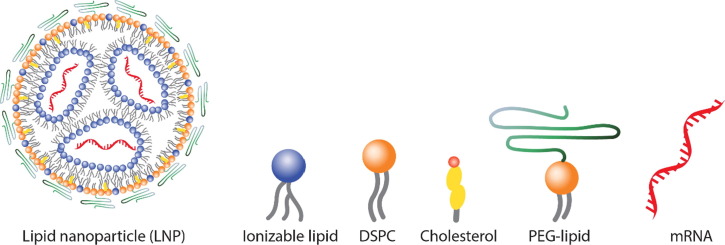
Simplistic illustration of LNP and its individual components, the focus of this Review. The LNP can encapsulate many nucleic acid cargo types including but not limited to DNA, ASOs, siRNA, microRNA, and mRNA (shown in this figure).
Fig. 2
Fig. 2
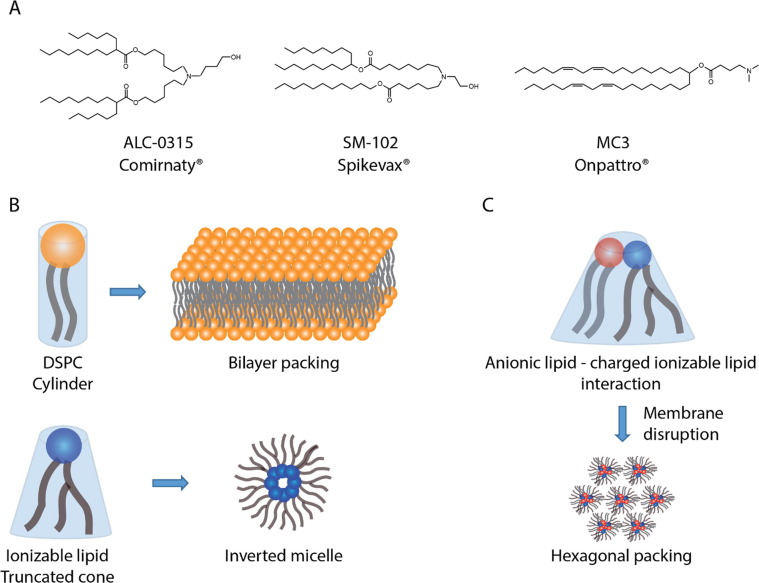
A) The ionizable lipids used in the COVID-19 LNP vaccines Comirnaty® (ALC-0315) and Spikevax® (SM-102) and in Onpattro® (MC3). B) Lipid packing theory explaining the relation between the molecular shape of amphipathic compounds (in this case DSPC and an arbitrary ionizable lipid) and the geometry of their self-assembled structures (a detailed description of the critical packing parameters of surfactants can be found in [25], [26]). C) The proposed mechanism by which charged ionizable lipids mediate endosomal disruption .
Fig. 3
Fig. 3
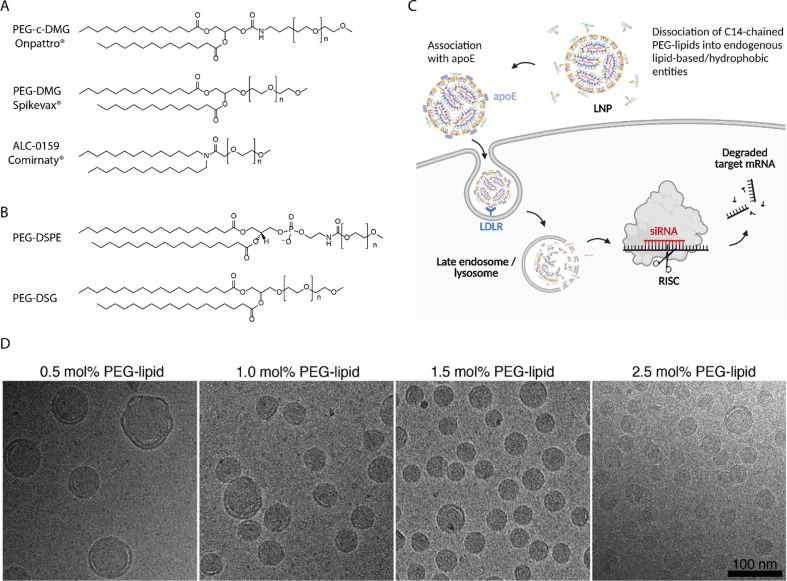
A) The PEG-lipids used in Onpattro® (PEG-c-DMG) and the COVID-19 vaccine LNP products Spikevax® (PEG-DMG) and Comirnaty® (ALC-0159). B) Additional PEG-lipids discussed in this Review. C) The proposed uptake mechanism for Onpattro® . The figure was created with BioRender.com. D) Cryo-TEM images of LNPs with varying molar ratios of PEG-lipid. Reproduced from with permission from the Royal Society of Chemistry.
Fig. 4
Fig. 4
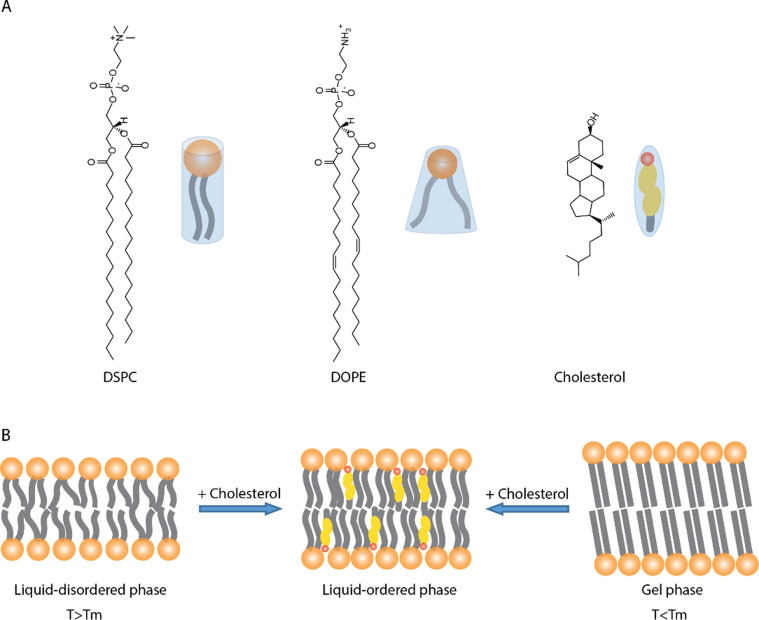
A) The molecular shape of standard helper lipids, including DSPC, DOPE, and cholesterol, used in LNPs. Current commercial LNPs use both DSPC and cholesterol. B) The three different lipid-membrane phases: liquid disordered, liquid-ordered, and gel phase.
Fig. 5
Fig. 5
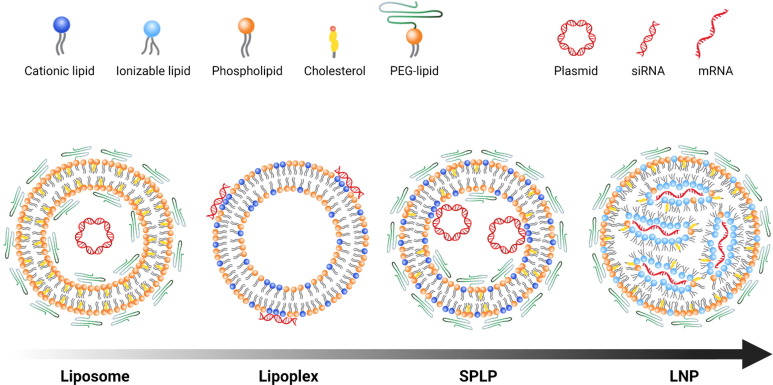
Simplistic illustration of some of the most tested lipid-based nucleic acid delivery systems in the order of their invention (indicated by the time arrow), starting with liposomes, lipoplexes, SPLPs and finally the LNPs. All structures are proposed structures and can vary depending on lipid composition, nucleic acid cargo and preparation method. The illustration also highlights the trend of decreasing mol% of phospholipids and increasing mol% of cationic or ionizable lipids, introduced to facilitate active nucleic acid encapsulation, which culminates with LNPs containing typically 10 mol% phospholipids and 50 mol% ionizable lipids. Representative types of nucleic acid cargos are presented in each type of delivery system. Plasmids were typically loaded into liposomes and SPLPs (the similar particles SALP and SNALP contain ASO and siRNA, respectively), while lipoplexes as well as LNPs have been loaded with several nucleic acid cargo types including siRNA, mRNA, microRNA, DNA, ASOs in case of LNPs. The figure was created with BioRender.com.
Fig. 6
Fig. 6
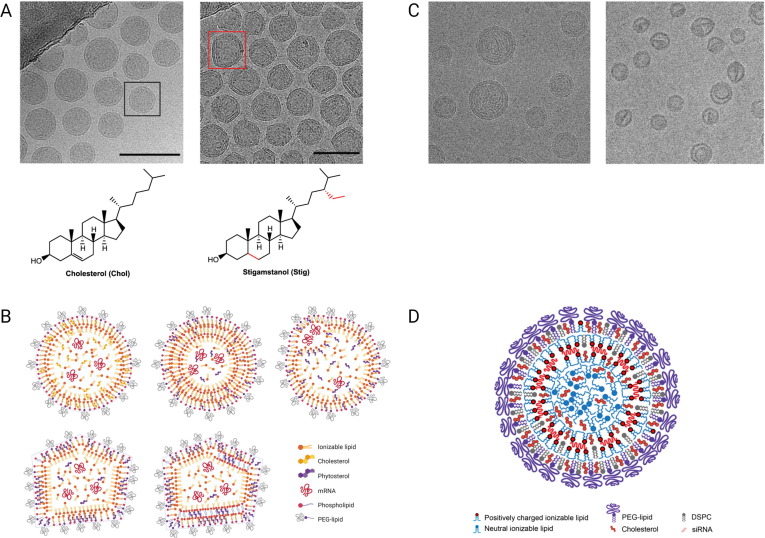
A) Cryo-TEM images of LNPs prepared with cholesterol, (adopt a single lipid bilayer structure (left)) and stigamstanol instead of cholesterol (adopt a multilamellar structure (right)). Reprinted (and adapted) with permission from . Copyright 2020 American Chemical Society. B) Structural models of different LNP types carrying mRNA cargo. Reprinted (and adapted) with permission from . Copyright 2020 American Chemical Society. C) Cryo-TEM images of LNPs encapsulating siRNA sandwiched between closely apposed monolayers (left) and LNPs prepared in the absence of siRNA (right). The uncharged ionizable lipids that are not interacting with siRNA can adopt an amorphous oil phase when pH is raised to 7.4. Reprinted (and adapted) with permission from . Copyright 2018 American Chemical Society. D) Structural model of LNP-siRNA showing two distinct phases, including a proposed oil-like phase containing the uncharged ionizable lipids and an aqueous phase. Reprinted (and adapted) with permission from . Copyright 2018 American Chemical Society.
Fig. 7
Fig. 7
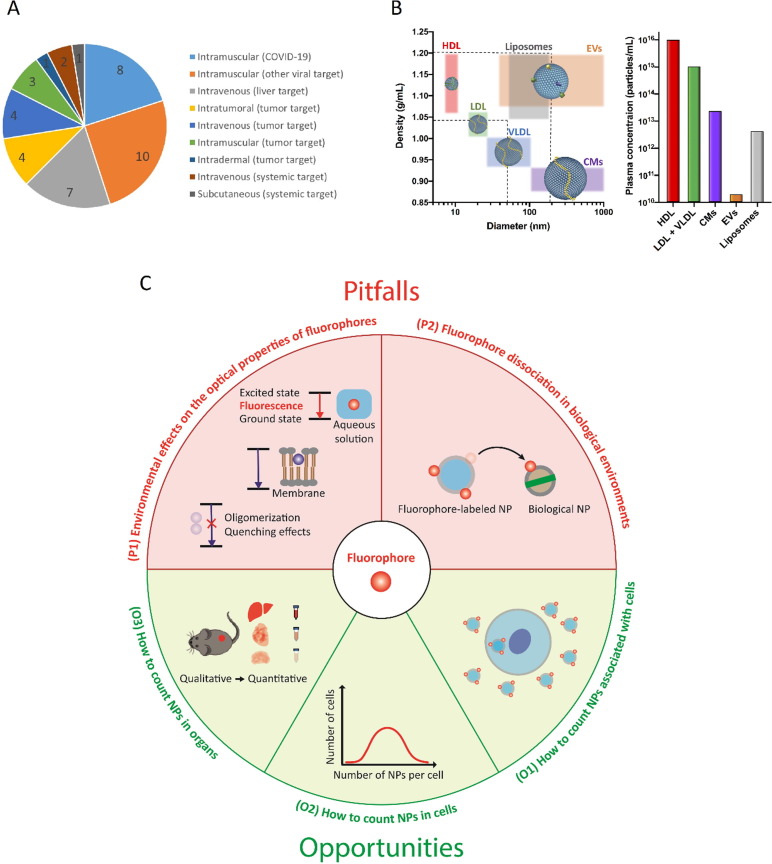
A) Administration routes and disease targets used in clinical trials based on LNP delivery of nucleic acid therapies/vaccines. Trials were identified on clinicaltrials.gov using the search string “lipid nanoparticles” and excluding non-LNP-based hits (search date 18.01.2022). Additional trials were identified from Moderna, BioNTech, and CureVac pipelines (search date 18.01.2022), as well as current literature , . B) Mapping the physical properties (size and density) of biological (high-density lipoproteins (HDL), low-density lipoproteins (LDL), very low-density lipoproteins, chylomicrons (CM), and extracellular vesicles (EVs)) and liposome-based nanoparticles including their particle concentrations in human plasma (the liposome concentration is based on 1 mM lipid concentration and a size of 100 nm with an average lipid footprint of 0.425 nm2). The LNP density may likely be slightly higher than liposomes due to its nucleic acid cargo . Reprinted with permission from WILEY. J. B. Simonsen, R. Münter, Angew. Chem. Int. Ed. 2020, 59, 12584. . C) Illustration of some of the pitfalls and opportunities in quantitative fluorescence-based nanomedicine studies discussed in . Reprinted from under the terms of Creative Commons license. Copyright 2021 Journal of Controlled Release.
Fig. 8
Fig. 8
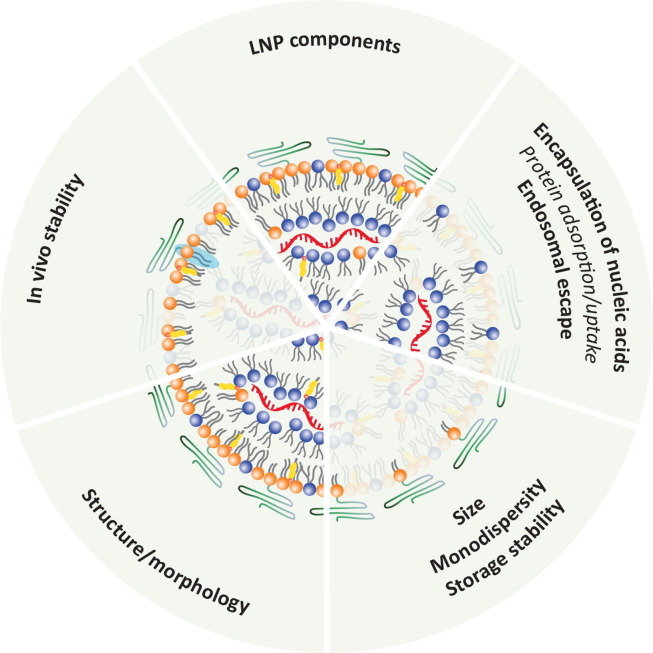
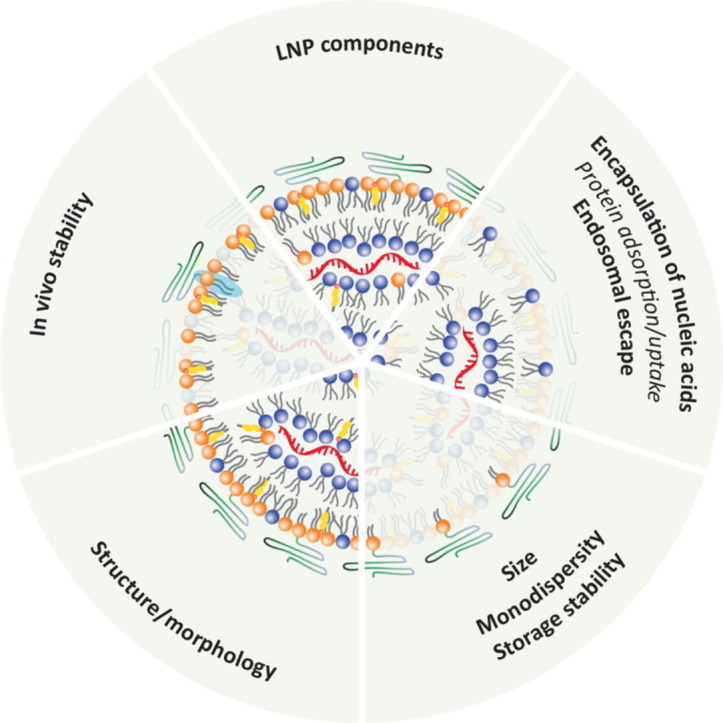
Summary of key functions of the different lipid components in commercial LNPs. Whether the ionizable surface lipids drive the “Protein adsorption/uptake” has not yet been thoroughly investigated but they are likely involved in protein/apoE corona formation on the LNP surface. Note that many structural and biological properties of LNPs should be ascribed not to a single lipid component but rather a combination of lipids, as illustrated above. This is illustrated by all the LNP components that contribute to the structure/morphology of LNPs. The PEG-lipids dictate the LNP size, and thus, influence the ratio of the surface to core distribution of the remaining components, and thereby ultimately their packing motif. The light blue highlight illustrates that PEG-lipids containing a long lipid tail improve the in vivo stability of LNPs. (For interpretation of the references to colour in this figure legend, the reader is referred to the web version of this article.)

References

    1. Polack F.P., Thomas S.J., Kitchin N., Absalon J., Gurtman A., Lockhart S., Perez J.L., Perez Marc G., Moreira E.D., Zerbini C., Bailey R., Swanson K.A., Roychoudhury S., Koury K., Li P., Kalina W.V., Cooper D., Frenck R.W., Jr, Hammitt L.L., Tureci O., Nell H., Schaefer A., Unal S., Tresnan D.B., Mather S., Dormitzer P.R., Sahin U., Jansen K.U., Gruber W.C. C.C.T. Group, Safety and Efficacy of the BNT162b2 mRNA Covid-19 Vaccine. N Engl J Med. 2020;383:2603–2615. - PMC - PubMed
    1. Baden L.R., El Sahly H.M., Essink B., Kotloff K., Frey S., Novak R., Diemert D., Spector S.A., Rouphael N., Creech C.B., McGettigan J., Khetan S., Segall N., Solis J., Brosz A., Fierro C., Schwartz H., Neuzil K., Corey L., Gilbert P., Janes H., Follmann D., Marovich M., Mascola J., Polakowski L., Ledgerwood J., Graham B.S., Bennett H., Pajon R., Knightly C., Leav B., Deng W., Zhou H., Han S., Ivarsson M., Miller J., Zaks T. C.S. Group, Efficacy and Safety of the mRNA-1273 SARS-CoV-2 Vaccine. N Engl J Med. 2021;384:403–416. - PMC - PubMed
    1. Adams D., Gonzalez-Duarte A., O'Riordan W.D., Yang C.C., Ueda M., Kristen A.V., Tournev I., Schmidt H.H., Coelho T., Berk J.L., Lin K.P., Vita G., Attarian S., Plante-Bordeneuve V., Mezei M.M., Campistol J.M., Buades J., Brannagan T.H., 3rd, Kim B.J., Oh J., Parman Y., Sekijima Y., Hawkins P.N., Solomon S.D., Polydefkis M., Dyck P.J., Gandhi P.J., Goyal S., Chen J., Strahs A.L., Nochur S.V., Sweetser M.T., Garg P.P., Vaishnaw A.K., Gollob J.A., Suhr O.B. Patisiran, an RNAi therapeutic, for hereditary transthyretin amyloidosis. N Engl J Med. 2018;379:11–21. - PubMed
    1. Tanaka H., Takata N., Sakurai Y., Yoshida T., Inoue T., Tamagawa S., Nakai Y., Tange K., Yoshioka H., Maeki M., Tokeshi M., Akita H. Delivery of oligonucleotides using a self-degradable lipid-like material. Pharmaceutics. 2021;13 - PMC - PubMed
    1. Gokita K., Inoue J., Ishihara H., Kojima K., Inazawa J. Therapeutic potential of LNP-mediated delivery of miR-634 for cancer therapy. Mol Ther Nucleic Acids. 2020;19:330–338. - PMC - PubMed