. 2022 Oct 20:844:157121.
doi: 10.1016/j.scitotenv.2022.157121. Epub 2022 Jul 2.

Quantification of SARS-CoV-2 RNA in wastewater treatment plants mirrors the pandemic trend in Hong Kong

Affiliations

Quantification of SARS-CoV-2 RNA in wastewater treatment plants mirrors the pandemic trend in Hong Kong

Xiawan Zheng et al. Sci Total Environ. .

Abstract

Wastewater-based epidemiology (WBE) for the SARS-CoV-2 virus in wastewater treatment plants (WWTPs) has emerged as a cost-effective and unbiased tool for population-level testing in the community. In the present study, we conducted a 6-month wastewater monitoring campaign from three WWTPs of different flow rates and catchment area characteristics, which serve 28 % (2.1 million people) of Hong Kong residents in total. Wastewater samples collected daily or every other day were concentrated using ultracentrifugation and the SARS-CoV-2 virus RNA in the supernatant was detected using the N1 and E primer sets. The results showed significant correlations between the virus concentration and the number of daily new cases in corresponding catchment areas of the three WWTPs when using 7-day moving average values (Kendall's tau-b value: 0.227-0.608, p < 0.001). SARS-CoV-2 virus concentration was normalized to a fecal indicator using PMMoV concentration and daily flow rates, but the normalization did not enhance the correlation. The key factors contributing to the correlation were also evaluated, including the sampling frequency, testing methods, and smoothing days. This study demonstrates the applicability of wastewater surveillance to monitor overall SARS-CoV-2 pandemic dynamics in a densely populated city like Hong Kong, and provides a large-scale longitudinal reference for the establishment of the long-term sentinel surveillance in WWTPs for WBE of pathogens which could be combined into a city-wide public health observatory.

Keywords: Longitudinal monitoring; SARS-CoV-2; WBE; WWTP.


Conflict of interest statement

Declaration of competing interest The authors declare that they have no known competing financial interests or personal relationships that could have appeared to influence the work reported in this paper.

Figures

Unlabelled Image
Graphical abstract
Fig. 1
Fig. 1
Description of sampling information in the three WWTPs. (a) Sampling period from December 24, 2020 to June 30, 2021. (b) Geoinformatics data. (c) Sampling locations and catchment areas.
Fig. 2
Fig. 2
Comparison of the supernatant and the pellet. (a) Detection rates and Ct value in SARS-CoV-2 using N1 and E assays, and PMMoV; (b) Ct value of PMMoV. (c) PMMoV concentrations (copies/L).
Fig. 3
Fig. 3
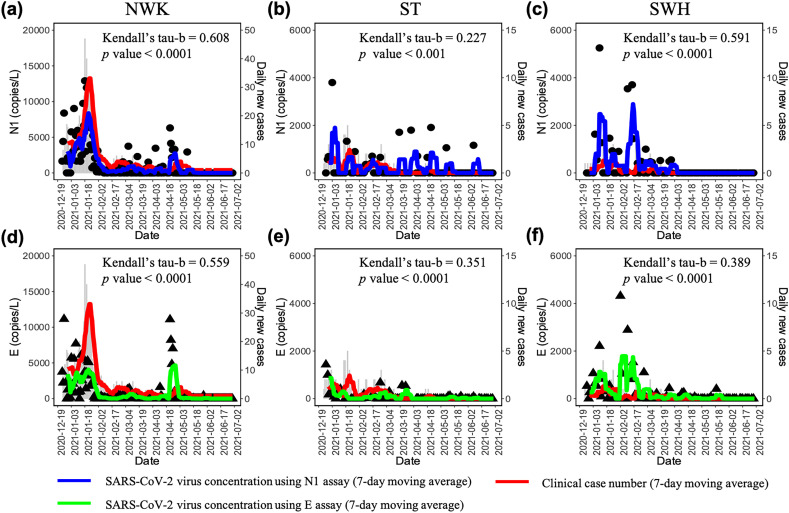
Longitudinal measurements of SARS-CoV-2 virus concentrations in wastewater samples using N1 and E detection assays, and their correlations with the number of daily new cases in the catchment areas of the three WWTPs. Red line: the clinical daily new cases number using 7-day moving average value. Blue line: the virus concentration (N1) using 7-day moving average value. Green line: the virus concentration (E) using 7-day moving average value.
Fig. 4
Fig. 4
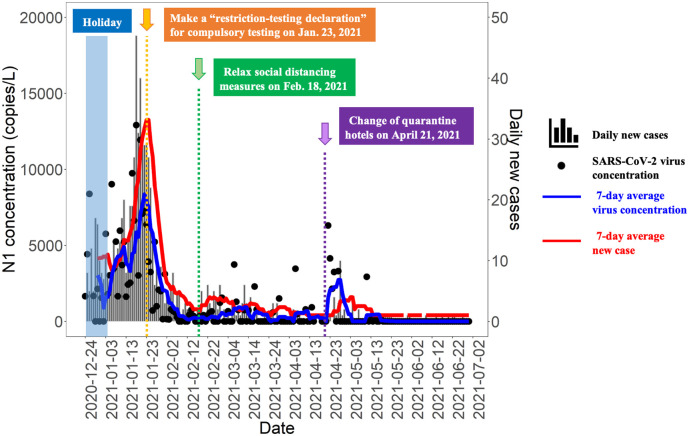
The SARS-CoV-2 concentration (using N1 set) in the supernant of the NWK wastewater samples and its correlation with the pandemic outbreak and the policy change.
Fig. 5
Fig. 5
Comparisons of prevalence rates calculated from the wastewater data (Pww) and the clinical data using (a) prevalence of daily new cases (Pdaily) and (b) prevalence of total new cases and convalescent patients within 7 days of sampling date (Pweekly).

References

    1. Ahmed W., Bivins A., Bertsch P.M., Bibby K., Gyawali P., Sherchan S.P., et al. Intraday variability of indicator and pathogenic viruses in 1-h and 24-h composite wastewater samples: implications for wastewater-based epidemiology. Environ. Res. 2021;193 - PMC - PubMed
    1. Ahmed W., Tscharke B., Bertsch P.M., Bibby K., Bivins A., Choi P., et al. SARS-CoV-2 RNA monitoring in wastewater as a potential early warning system for COVID-19 transmission in the community: a temporal case study. Sci. Total Environ. 2021;761 - PMC - PubMed
    1. Alamin M., Tsuji S., Hata A., Hara-Yamamura H., Honda R. Selection of surrogate viruses for process control in detection of SARS-CoV-2 in wastewater. Sci. Total Environ. 2022;823 - PMC - PubMed
    1. Betancourt W.Q., Schmitz B.W., Innes G.K., Prasek S.M., Pogreba Brown K.M., Stark E.R., et al. COVID-19 containment on a college campus via wastewater-based epidemiology, targeted clinical testing and an intervention. Sci. Total Environ. 2021;779:146408. - PMC - PubMed
    1. Bivins A., Kaya D., Bibby K., Simpson S.L., Bustin S.A., Shanks O.C., et al. Variability in RT-qPCR assay parameters indicates unreliable SARS-CoV-2 RNA quantification for wastewater surveillance. Water Res. 2021;203 - PMC - PubMed