


COVID-19 test positivity by occupation using the Delphi US COVID-19 trends and impact survey, September-November 2020
- PMID: 35790017
- PMCID: PMC9350248
- DOI: 10.1002/ajim.23410
COVID-19 test positivity by occupation using the Delphi US COVID-19 trends and impact survey, September-November 2020
Abstract
Background: The potential for work to be a risk factor for coronavirus disease 2019 (COVID-19) was recognized early in the pandemic based on the likelihood of work-related differences in exposures to COVID-19 in different occupations. Due to intense demands of the pandemic, implementation of recommendations to collect information on occupation in relation to COVID-19 has been uneven across the United States. The objective of this study was to investigate COVID-19 test positivity by occupation.
Methods: We analyzed data collected from September 8 to November 30, 2020, by the Delphi Group at Carnegie Mellon University US COVID-19 Trends and Impact Survey, offered daily to a random sample of US-based Facebook users aged 18 years or older, who were invited via a banner in their news feed. Our focus was ever testing positive for COVID-19 in respondents working outside the home for pay in the past 4 weeks.
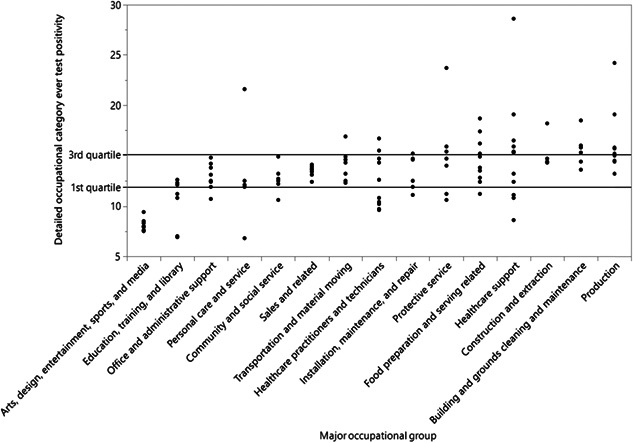
Results: The major occupational groups of "Production", "Building and grounds cleaning and maintenance," "Construction and extraction," "Healthcare support," and "Food preparation and serving" had the five highest test positivity percentages (16.7%-14.4%). Highest detailed occupational categories (28.6%-19.1%) were "Massage therapist," "Food processing worker," "Bailiff, correctional officer, or jailer," "Funeral service worker," "First-line supervisor of production and operating workers," and "Nursing assistant or psychiatric aide." Differences in test positivity by occupation remained after adjustment for age, gender, and pre-existing medical conditions.
Conclusion: Information on differences in test positivity by occupation can aid targeting of messaging for vaccination and testing and mitigation strategies for the current and future respiratory infection epidemics and pandemics. These results, obtained before availability of COVID-19 vaccines, can form a basis for comparison to evaluate impacts of vaccination and subsequent emergence of viral variants.
Keywords: COVID-19; detailed occupation; major occupation; test positivity.
© 2022 Wiley Periodicals LLC.
Conflict of interest statement
The authors declare that there are no conflicts of interest.
Figures
References
-
- Council of State and Territorial Epidemiologists . Recommended interim guidance for collecting employment information about COVID‐19 cases. Accessed January 25, 2022. https://cdn.ymaws.com/www.cste.org/resource/resmgr/publications/Guidance...
-
- Luckhaupt S, Burrer S, de Perio M, Sweeney MH. Collecting occupation and industry data in public health surveillance systems for COVID‐19. NIOSH Science Blog, Centers for Disease Control and Prevention. Accessed January 25, 2022. https://blogs.cdc.gov/niosh-science-blog/2020/06/11/covid-surveillance/
-
- CDC Guidance . Key information to collect during a case interview. Updated October 21, 2020. Accessed January 25, 2022. https://www.cdc.gov/coronavirus/2019-ncov/php/contact-tracing/keyinfo.html
-
- National Institute for Occupational Safety and Health : NIOSH Disaster Science Responder Research Program COVID‐19 Research Agenda. DHHS (NIOSH) Publication No. 2021‐113. U.S. Department of Health and Human Services, Centers for Disease Control and Prevention, National Institute for Occupational Safety and Health. 10.26616/NIOSHPUB2021113externalicon - DOI
MeSH terms
Substances
LinkOut - more resources
Full Text Sources
Medical
Miscellaneous
