. 2022 Jul 5;24(1):8.
doi: 10.1186/s12575-022-00171-1.

CRISPR/Cas9-mediated LINC00511 knockout strategies, increased apoptosis of breast cancer cells via suppressing antiapoptotic genes

Affiliations

CRISPR/Cas9-mediated LINC00511 knockout strategies, increased apoptosis of breast cancer cells via suppressing antiapoptotic genes

Narjes Azadbakht et al. Biol Proced Online. .

Abstract

Background: The growing detection of long noncoding RNAs (lncRNAs) required the application of functional approaches in order to provide absolutely precise, conducive, and reliable processed information along with effective consequences. We utilized genetic knockout (KO) techniques to ablate the Long Intergenic Noncoding RNA 00,511 gene in several humans who suffered from breast cancer cells and at the end we analyzed and examined the results.

Results: The predictive relevance of LINC00511 expression pattern was measured by using a pooled hazard ratio (HR) with a 95% confidence interval (CI). The link among LINC00511 expression profiles and cancer metastasis was measured by using a pooled odds ratio (OR) with a 95% confidence interval. This meta- analysis was composed of fifteen studies which contained a total of 1040 tumor patients. We used three distinct CRISPR/Cas9-mediated knockdown techniques to prevent the LINC00511 lncRNA from being transcribed. RT-PCR was used to measure lncRNA and RNA expression. We used CCK-8, colony formation tests, and the invasion transwell test to measure cell proliferation and invasion. The stemness was measured by using a sphere-formation test. To validate molecular attachment, luciferase reporter assays were performed. The functional impacts of LINC00511 gene deletion in knockdown breast cancer cell lines were confirmed by using RT-qPCR, MTT, and a colony formation test. This meta-analysis was composed of 15 trials which contained a total of 1040 malignant tumors. Greater LINC00511 expression was ascribed to a lower overall survival (HR = 1.93, 95% CI 1.49-2.49, < P 0.001) and to an increased proportion of lymph node metastasis (OR = 3.07, 95% CI 2.23-4.23, P < 0.001) in the meta-analysis. It was found that the role of LINC00511 was overexpressed in breast cancer samples, and this overexpression was ascribed to a poor prognosis. The gain and loss-of-function tests demonstrated findings such as LINC00511 increased breast cancer cell proliferation, sphere-forming ability, and tumor growth. Additionally, the transcription factor E2F1 binds to the Nanog gene's promoter site to induce transcription. P57, P21, Prkca, MDM4, Map2k6, and FADD gene expression in the treatment group (LINC00511 deletion) was significantly higher than in the control group (P < 0.01). In addition, knockout cells had lower expression of BCL2 and surviving genes than control cells P < 0.001). In each of the two target alleles, the du-HITI approach introduced a reporter and a transcription termination signal. This strategy's donor vector preparation was significantly easier than "CRISPR HDR," and cell selection was likewise much easier than "CRISPR excision." Furthermore, when this approach was used in the initial transfection attempt, single-cell knockouts for both alleles were generated.

Conclusions: The methods employed and described in this work could be extended to the production of LINC00511 knockout cell lines and, in theory, to the deletion of other lncRNAs to study their function.

Keywords: Breast cancer; CRISPR/Cas9; Knockout; LINC00511.


Conflict of interest statement

The authors declare that they have no competing interests.

Figures

Fig. 1
Fig. 1
A forest plot showing the correlation between LINC00511 overexpression and general survival in patients with breast tumors. B Kaplan–Meier survival evaluation of LINC00511 production for overall survival and, C disease-free survival in patients with breast cancers; D The relationship between LINC00511 overexpression and lymph node metastases is depicted as a forest plot
Fig. 2
Fig. 2
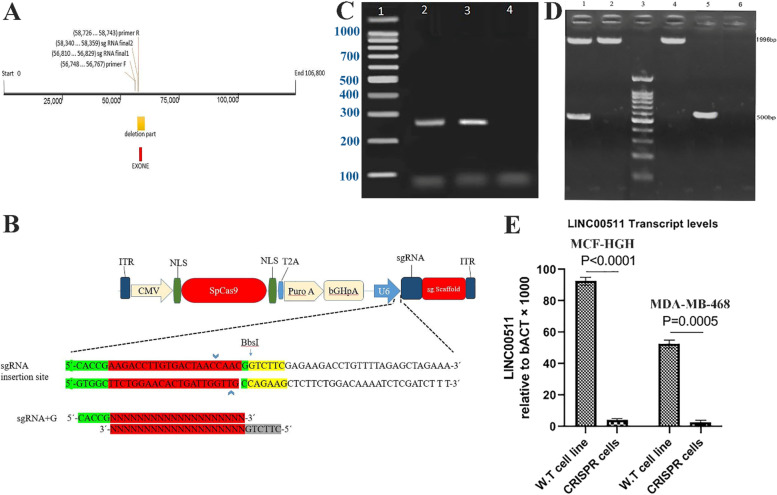
A LINC00511 gene schematic, gene length, sgRNA binding site, and gene primers. The position of the fragment deleted by the CRISPR / Cas9 technique is depicted in orange in this diagram. B expression portion of sgRNA in vector PX459. The BbsI enzyme is used to form a sticky end, which is then supplemented by sgRNA tags. C sgRNAs 1 and 2 results in the Px459 vector. No. 1 is a 100 bp DNA ladder. Nos. 2 and 3 PCR reactions were performed on recombinant vectors PX459-sgRNA1 and PX459-sgRNA2, respectively, yielding 276 bp bands. Negative PCR control (no. 4) (without DNA). D Column 1: Heterozygous cells with only one LINC00511 gene allele degraded and two bands 1996 and 480 visible. 2: Control group (PX459-control), in which just one band of 1996 pairs are transfected and the blank vector is transfected. This value indicates that the LINC00511 gene hasn't been degraded. Column 3 100-bp marker. Column 4: No vectors have been transfected blank control cells, and the 1996 band shows the pair. Column 5: Cells that have lost both alleles of the target gene and contain a small band of roughly 480 kb. Column 6: Negative control (no DNA in any of the PCR reagents). E LINC00511 transcript levels in MCF-HGH and MDA-MB-468 breast cancer cells compared to GAPDH levels in wild-type and "CRISPR " knockout cells
Fig. 3
Fig. 3
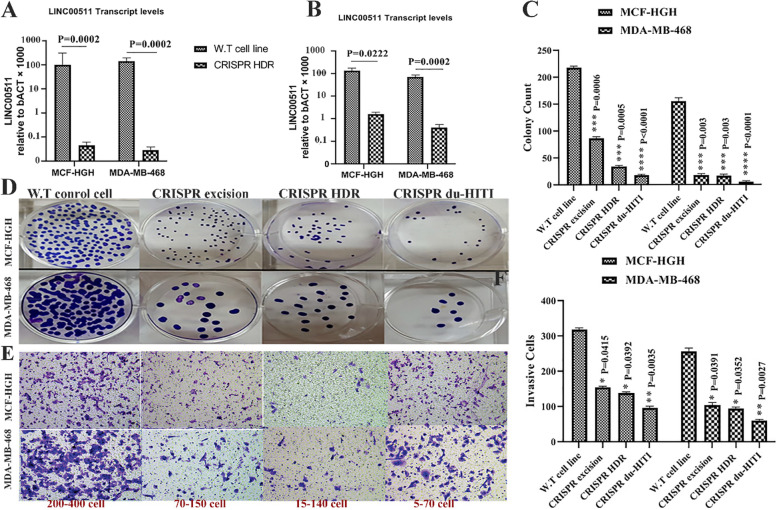
The knockout of LncRNA LINC00511 Suppress malignant cell proliferation and invasion in vitro. A, B In wild-type and "CRISPR HDR" knockdown MCF-HGH and MDA-MB-468 cancer cells, LINC00511 transcript levels were compared to GAPDH levels. Based on the relevant standard curves, the absolute copy number for LINC00511 and GAPDH transcripts were measured, and the amount of the LINC00511 transcript was multiplied by the amount of the GAPDH transcript was displayed for three samples of cell line cDNAs. The Mann–Whitney U test is used to examine the statistically significant differences between the wild-type and knockout cell lines. C, D MCF-HGH and MDA-MB-468 cells transfected with sh-LINC00511 or sh-NC colony formation test. MCF-HGH and MDA-MB-468 cells transfected with sh-LINC00511 or sh-NC were shown to proliferate in the CCK-8 test. E and F The number of MCF-HGH and MDA-MB-468 cells that have been invaded. **** p-value < 0.0001, *** p-value < 0.001, ** p-value < 0.01, and * p-value < 0.05
Fig. 4
Fig. 4
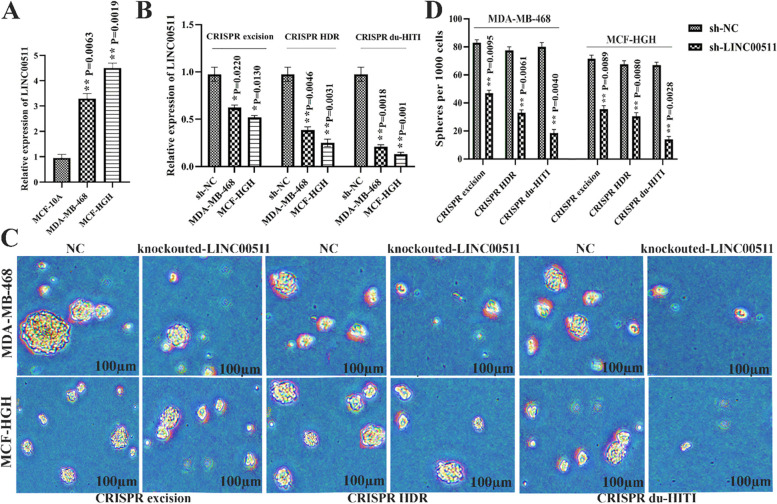
LncRNA LINC00511 has a role in preserving the breast cancer CSC trait. A MDA-MB-468 and MCF-HGH breast tumor cell lines, as well as MCF 10A normal cell lines, showed LINC00511 expression. B expression of LINC00511 in the MDA-MB-468 and MCF-HGH breast tumor cells. C When LINC00511 shRNA was transfected, the mammosphere width and amount decreased. D When improved LINC00511 plasmids are transfected, mammosphere amount decreases. ** P-value l < 0.01, * P-value < 0.05
Fig. 5
Fig. 5
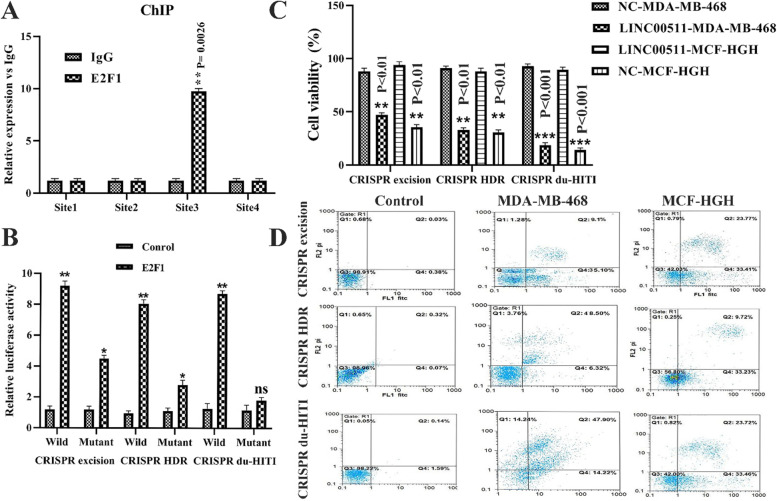
Nanog expression was boosted by E2F1. A chromatin immunoprecipitation (ChIP) test was used to determine which area of the Nanog promoter site was the most efficient binding site. B The luciferase reporter vector with wild type or mutant Nanog promoter domain sequences (− 586 ~  − 576) was created, as well as the luciferase activity of wild type and mutant Nanog promoter domain sequences. C The growth indices (PI) of three different groups were analyzed using a diagram. After 72 h, PI in the CRISPR du-HITI group was significantly lower than the blank control group (** < P0.001). D Evaluation of the cell apoptosis by Annexin V-FITC staining. Flow cytometer analysis of the apoptotic and necrotic cells. Q1: Necrotic percentage, Q2: late apoptotic percentage, Q3: Live percentage, and Q4: early apoptotic percentage. LINC00511 Knockout enhances apoptosis rate in MDA-MB-468 and MCF-HGH cells
Fig. 6
Fig. 6
Knockout of LINC00511 gene in MDA-MB-468 and MCF-HGH cell line leads to induction of expression of pro-apoptotic genes P57, P21, Prkca, MDM4, Map2k6, and FADD at a significant level ** P < 0.01 and reduction of expression of anti-apoptotic genes SURVIVIN and BCL2 at a significant level *** P < 0.001. Data were normalized by the GAPDH reference gene. There was no significant difference in the expression of pro/anti-apoptotic genes in the Blank control groups

References

    1. Katuwal S, Jousilahti P, Pukkala E. Causes of death among women with breast cancer: A follow-up study of 50 481 women with breast cancer in Finland. Int J Cancer. 2021;149(4):839–845. doi: 10.1002/ijc.33607. - DOI - PubMed
    1. Miricescu D, Totan A, Stanescu-Spinu II, Badoiu SC, Stefani C, Greabu M. PI3K/AKT/mTOR signaling pathway in breast cancer: From molecular landscape to clinical aspects. Int J Mol Sci. 2021;22(1):173. doi: 10.3390/ijms22010173. - DOI - PMC - PubMed
    1. Hamer J, Jones E, Chan A, Tahmasebi F. Can We Routinely Employ the Use of Low-Pressure Gynaecological Laparoscopy? A Systematic Review. Cureus. 2021;13(5):e15348. - PMC - PubMed
    1. Umeda M, Ikeuchi M, Ishikawa M, Ito T, Nishihama R, Kyozuka J, Torii KU, Satake A, Goshima G, Sakakibara H. Plant stem cell research is uncovering the secrets of longevity and persistent growth. Plant J. 2021;106(2):326–335. doi: 10.1111/tpj.15184. - DOI - PMC - PubMed
    1. Valle S, Martin-Hijano L, Alcalá S, Alonso-Nocelo M, Sainz B., Jr The ever-evolving concept of the cancer stem cell in pancreatic cancer. Cancers. 2018;10(2):33. doi: 10.3390/cancers10020033. - DOI - PMC - PubMed