


An international Delphi consensus regarding best practice recommendations for hyperkalaemia across the cardiorenal spectrum
- PMID: 35791065
- PMCID: PMC9804940
- DOI: 10.1002/ejhf.2612
An international Delphi consensus regarding best practice recommendations for hyperkalaemia across the cardiorenal spectrum
Erratum in
-
Corrigendum to: 'An international Delphi consensus regarding best practice recommendations for hyperkalaemia across the cardiorenal spectrum' and articles listed below.Eur J Heart Fail. 2023 Mar;25(3):444. doi: 10.1002/ejhf.2790. Epub 2023 Feb 17. Eur J Heart Fail. 2023. PMID: 36799255 Free PMC article. No abstract available.
Abstract
Aims: Renin-angiotensin-aldosterone system inhibitors (RAASi) are guideline-recommended therapy for individuals with cardiorenal disease. They are associated with increased risk of hyperkalaemia, a common and life-threatening disorder for this population. RAASi-induced hyperkalaemia often leads to dose reduction or discontinuation, reducing cardiorenal protection. Guideline recommendations differ between specialties for the clinical management of hyperkalaemia. Using a modified Delphi method, we developed consensus recommendations for optimal management of hyperkalaemia in adults with cardiorenal disease.
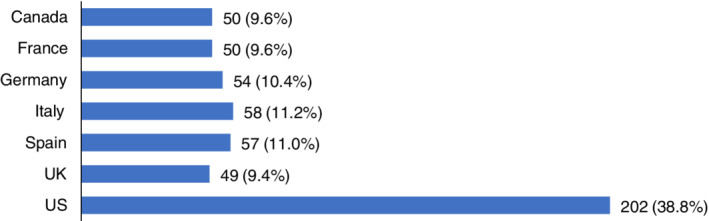
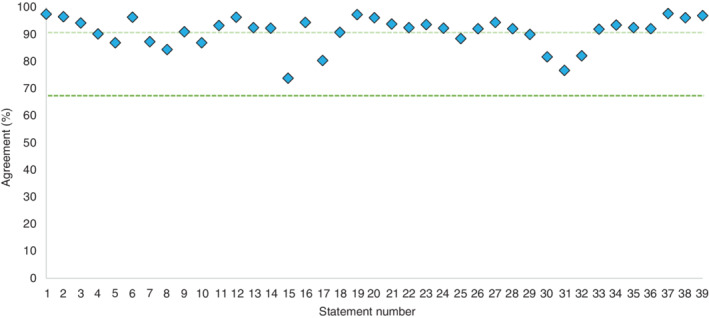
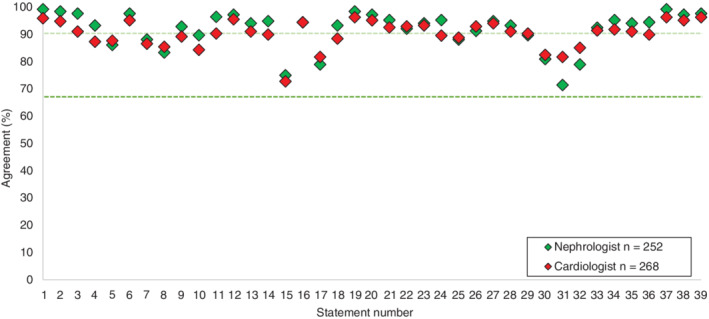
Methods and results: An international steering group of cardiologists and nephrologists developed 39 statements regarding hyperkalaemia care, including risk factors and risk stratification, prevention, correction, and cross-specialty coordination. Consensus was determined by agreement on an online questionnaire administered to cardiorenal specialists across Europe and North America. The threshold for consensus agreement was established a priori by the steering group at 67%. Across November 2021, 520 responses were received from Canada (n = 50), France (n = 50), Germany (n = 54), Italy (n = 58), Spain (n = 57), the UK (n = 49), and the US (n = 202); 268 from cardiologists and 252 from nephrologists. Twenty-nine statements attained very high agreement (≥90%) and 10 attained high agreement (≥67%-<90%), with strong alignment between cardiologists and nephrologists.
Conclusion: A high degree of consensus regarding hyperkalaemia evaluation and management exists among healthcare professionals. Based on high levels of agreement, the steering group derived six key recommendations for hyperkalaemia prevention and management in people with cardiorenal disease. Future studies examining the quality of hyperkalaemia care delivery are required.
Keywords: Cardiorenal patients; Consensus recommendation; Delphi method; Hyperkalaemia; Novel potassium binder; Renin-angiotensin-aldosterone system inhibitors.
© 2022 The Authors. European Journal of Heart Failure published by John Wiley & Sons Ltd on behalf of European Society of Cardiology.
Figures
References
-
- McDonagh TA, Metra M, Adamo M, Gardner RS, Baumbach A, Bohm M, et al. 2021 ESC Guidelines for the diagnosis and treatment of acute and chronic heart failure. Eur J Heart Fail. 2022;24:4–131. - PubMed
-
- Renal Association . Clinical Practice Guideline. Treatment of acute hyperkalaemia in adults. 2020. https://ukkidney.org/sites/renal.org/files/RENAL%20ASSOCIATION%20HYPERKA... (11 May 2022).
-
- Wang AY. Optimally managing hyperkalemia in patients with cardiorenal syndrome. Nephrol Dial Transplant. 2019;34:iii36–44. - PubMed
-
- House AA, Wanner C, Sarnak MJ, Piña IL, McIntyre CW, Komenda P, et al. Heart failure in chronic kidney disease: conclusions from a Kidney Disease: Improving Global Outcomes (KDIGO) controversies conference. Kidney Int. 2019;95:1304–17. - PubMed
Publication types
MeSH terms
LinkOut - more resources
Full Text Sources
Medical
