


Political differentiation and consolidation of choice in a U.S. media malaise environment: indirect effects of perceived alikeness on voter participation
- PMID: 35791337
- PMCID: PMC9245374
- DOI: 10.1007/s43545-022-00394-9
Political differentiation and consolidation of choice in a U.S. media malaise environment: indirect effects of perceived alikeness on voter participation
Abstract
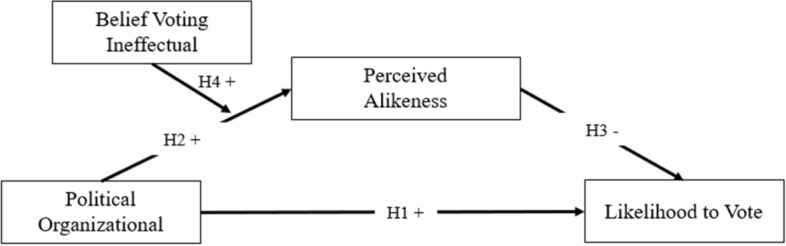
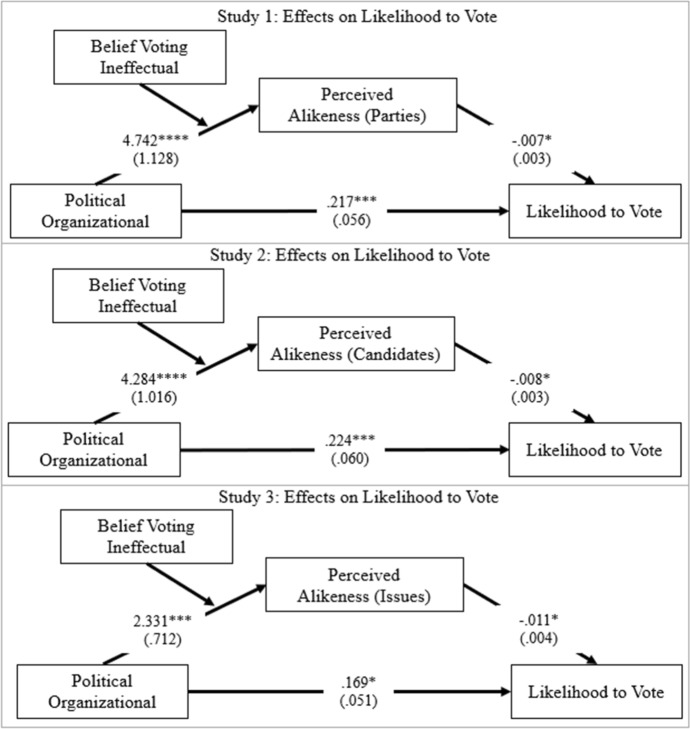
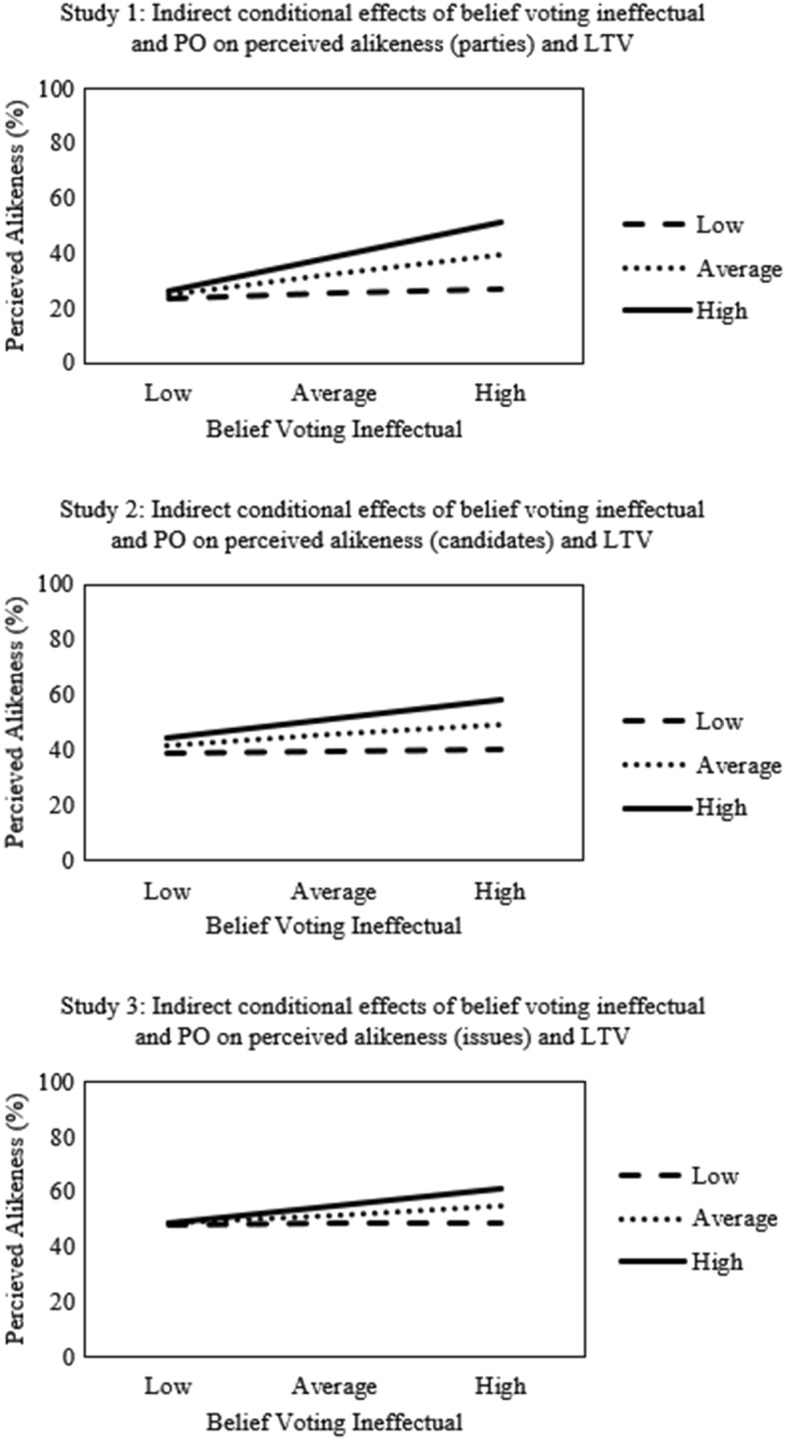
Political marketing campaigns expend enormous effort each campaign season to influence voter turnout. This cyclical democratic process and nonstop news cycle foster an environment of media malaise. Voter pessimism undercuts participation through increased perceived alikeness among ballot options. Differentiation and consolidation theory describe the voting decision process as reconciling rational and irrational information. Voters seek out differences to decide among presented options. More politically interested voters are more likely to vote. Counterintuitively, higher political organizational avocational interest is related to higher perceived alikeness. Across three studies, higher perceived alikeness of parties, candidates, and issues was related to a lower likelihood to vote (LTV). Conditional voting ineffectual beliefs exacerbated these indirect effects on LTV. In a saturated marketing atmosphere with massive spending during each election cycle, we discuss implications to influence LTV based on results.
Keywords: Differentiation and consolidation theory; Media malaise; Perceived alikeness; Political differentiation; Voter participation.
© The Author(s), under exclusive licence to Springer Nature Switzerland AG 2022.
Conflict of interest statement
Conflict of interestOn behalf of all authors, the corresponding author states that there is no conflict of interest.
Figures
References
-
- Aarts K, Semetko HA. The divided electorate: Media use and political involvement. J Politics. 2003;65(3):759–784. doi: 10.1111/1468-2508.00211. - DOI
-
- Arcuri L, Castelli L, Galdi S, Zogmaister C, Amadori A. Predicting the vote: implicit attitudes as predictors of the future behavior of decided and undecided voters. Polit Psychol. 2008;29(3):369–387. doi: 10.1111/j.1467-9221.2008.00635.x. - DOI
-
- Armstrong G, Adam S, Denize S, Kotler P. Principles of marketing. Melbourne: Pearson Australia; 2014.
-
- Avery JM. Videomalaise or virtuous circle? The influence of the news media on political trust. Int J Press Politics. 2009;14(4):410–433. doi: 10.1177/1940161209336224. - DOI
-
- Baines PR, Egan J. Marketing and political campaigning: mutually exclusive or exclusively mutual? J Cetacean Res Manag. 2001;4(1):25–34.
LinkOut - more resources
Full Text Sources