Drug Survival Associated With Effectiveness and Safety of Treatment With Guselkumab, Ixekizumab, Secukinumab, Ustekinumab, and Adalimumab in Patients With Psoriasis
- PMID: 35791876
- PMCID: PMC9260644
- DOI: 10.1001/jamadermatol.2022.2909
Drug Survival Associated With Effectiveness and Safety of Treatment With Guselkumab, Ixekizumab, Secukinumab, Ustekinumab, and Adalimumab in Patients With Psoriasis
Erratum in
-
Errors in Figure 2.JAMA Dermatol. 2022 Dec 1;158(12):1461. doi: 10.1001/jamadermatol.2022.5056. JAMA Dermatol. 2022. PMID: 36383368 Free PMC article. No abstract available.
Abstract
Importance: Drug survival of biologic therapies for psoriasis is a proxy for longer-term treatment effectiveness and safety. Patient factors that are associated with the survival of each biologic differently (effect modifiers) may inform the decision to choose between biologics.
Objective: To assess the drug survival associated with the effectiveness and safety of commonly used biologics for psoriasis in the UK and Ireland and identify effect modifiers for these biologics and their survival.
Design, setting, and participants: We conducted a prospective cohort study of patients with psoriasis using data from the British Association of Dermatologists Biologics and Immunomodulators Register (BADBIR) between November 2007 and August 2021.
Exposures: Adalimumab, ustekinumab, secukinumab, guselkumab, ixekizumab.
Main outcomes and measures: We conducted a survival analysis and fitted separate flexible parametric models for drug survival as a proxy for effectiveness and safety.
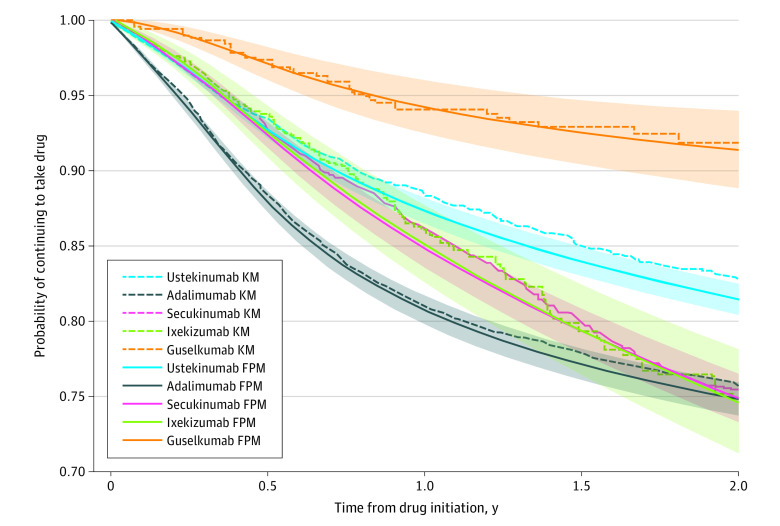
Results: A total of 16 122 treatment courses were included: 6607 (41.0%) in which treatment with adalimumab was initiated, 5405 (33.5%) with ustekinumab, 2677 (16.6%) with secukinumab, 730 (4.5%) with guselkumab, and 703 (4.4%) with ixekizumab. The crude survival functions at year 1 for measures of effectiveness for treatment with adalimumab was 0.81 (95% CI, 0.80-0.82), 0.89 for ustekinumab (95% CI, 0.88-0.89), 0.86 for secukinumab (95% CI, 0.85-0.87), 0.94 for guselkumab (95% CI, 0.92-0.96), and 0.86 for ixekizumab (95% CI, 0.83-0.89). The adjusted survival curves from the multivariable model for effectiveness showed that treatment with guselkumab had the higher survival (adjusted hazard ratio, 0.13; 95% CI, 0.03-0.56) and adalimumab had the lower survival (adjusted hazard ratio, 2.37; 95% CI, 2.03-2.76) compared with ustekinumab. Secukinumab and ixekizumab had similar survival curves over time. Psoriatic arthritis, previous biologic exposure, nail involvement, and ethnicity were effect modifiers for survival in association with treatment effectiveness. The crude survival functions at year 1 for safety were 0.91 for treatment with adalimumab (95% CI, 0.90-0.91), 0.94 for ustekinumab (95% CI, 0.94-0.95), 0.94 for secukinumab (95% CI, 0.92-0.94), 0.96 for guselkumab (95% CI, 0.94-0.98), and 0.92 for ixekizumab (95% CI, 0.89-0.94). Guselkumab, ustekinumab, and secukinumab had similar adjusted survival curves for safety, while adalimumab (adjusted hazard ratio, 1.66; 95% CI, 1.46-1.89) and ixekizumab (adjusted hazard ratio, 1.52; 95% CI, 1.13-2.03) had lower survival compared with ustekinumab.
Conclusions and relevance: The results of this cohort study suggest that guselkumab had the highest drug survival in BADBIR of the included biologics for treatment persistence that was associated with effectiveness, and guselkumab had highest drug survival for safety compared with other biologics except ustekinumab. Psoriatic arthritis, nail involvement, previous biologic exposure, and ethnicity were effect modifiers for biologics and their survival in association with treatment effectiveness. This information on longer-term treatment persistence, safety, and tolerability may help patients and their clinicians make an informed decision to initiate treatment with a biologic therapy.
Conflict of interest statement
Figures

References
-
- Yiu ZZN, Mason KJ, Hampton PJ, et al. ; BADBIR Study Group . Randomized trial replication using observational data for comparative effectiveness of secukinumab and ustekinumab in psoriasis: a study from the British Association of Dermatologists Biologics and Immunomodulators Register. JAMA Dermatol. 2021;157(1):66-73. doi:10.1001/jamadermatol.2020.4202 - DOI - PMC - PubMed
-
- Yiu ZZN, Mason KJ, Hampton PJ, et al. ; BADBIR Study Group . Drug survival of adalimumab, ustekinumab and secukinumab in patients with psoriasis: a prospective cohort study from the British Association of Dermatologists Biologics and Immunomodulators Register (BADBIR). Br J Dermatol. 2020;183(2):294-302. doi:10.1111/bjd.18981 - DOI - PubMed
-
- Blauvelt A, Shi N, Somani N, et al. . Comparison of two-year treatment adherence, persistence, discontinuation, reinitiation, and switching between psoriasis patients treated with ixekizumab or secukinumab in real-world settings. J Am Acad Dermatol. 2022;86(3):581-589. doi:10.1016/j.jaad.2021.06.878 - DOI - PubMed
Publication types
MeSH terms
Substances
LinkOut - more resources
Full Text Sources
Medical