. 2022 Oct;11(5):1611-1616.
doi: 10.1007/s40123-022-00543-6. Epub 2022 Jul 6.

Brachytherapy for Central Serous Chorioretinopathy

Affiliations

Brachytherapy for Central Serous Chorioretinopathy

Supriya Arora et al. Ophthalmol Ther. 2022 Oct.

Abstract

Brachytherapy is widely used for the treatment of choroidal melanoma and has recently been explored for the treatment of wet age-related macular degeneration. We propose the use of low dose radiation via episcleral brachytherapy in refractory cases of central serous chorioretinopathy (CSCR). The pathogenesis of CSCR involves dilatation and hyperpermeability of large choroidal vessels. Low dose radiation can induce intimal proliferation in large choroidal vessels and decrease their hyperpermeability. Concerns about the use of brachytherapy in CSCR include damage to the choriocapillaris or the retinal vessels. This can be addressed with the use of a specialized device through which a very precise and appropriate dose can be delivered. The dose of the radiation delivered decreases exponentially at a depth of approximately 0.5-1.5 mm from the devise-sclera interface. Considering an increased choroidal thickness in cases of CSCR, delivery of a safe dose can be assured.

Keywords: Brachytherapy; Brachytherapy source; Central serous chorioretinopathy; Low dose radiation; Radionuclide.


Figures

Fig. 1
Fig. 1
Depiction of exponential decline in radiation dose with depth from the device. a Graph showing exponential decline of the dose of radiation with increasing depth from the device. b In a normal eye, the dose of radiation delivered at the sclera–choroid interface is 12.4 Gy. The dose is 10 Gy at the interface of large choroidal vessels and medium vessels/choriocapillaris. c In an eye with central serous chorioretinopathy (CSCR), the dose of radiation delivered at the sclera–choroid interface would be less than 12.4 Gy considering increased scleral thickness in CSCR. The dose of radiation at the interface of large choroidal vessels and medium vessels/choriocapillaris will be 8 Gy because of the increased thickness of the large choroidal vessel layer
Fig. 2
Fig. 2
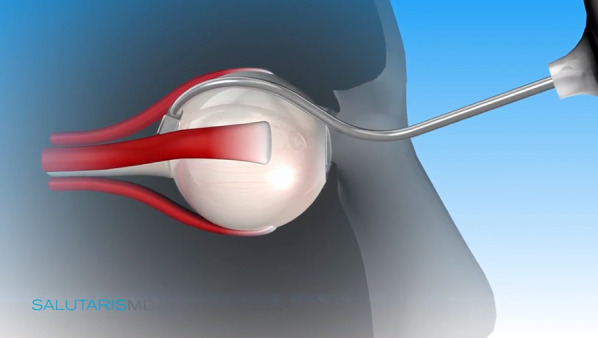
Episcleral brachytherapy device introduced via sub-Tenon route to deliver radiation to choroidal neovascular complex through sclera. (Courtesy: SalutarisMD)

References

    1. Lee M, Lee H, Kim HC, Chung H. Changes in stromal and luminal areas of the choroid in pachychoroid diseases: insights into the pathophysiology of pachychoroid diseases. Investig Ophthalmol Vis Sci. 2018;59(12):4896–4908. doi: 10.1167/iovs.18-25018. - DOI - PubMed
    1. Daruich A, Matet A, Dirani A, et al. Central serous chorioretinopathy: recent findings and new physiopathology hypothesis. Prog Retin Eye Res. 2015;48:82–118. doi: 10.1016/j.preteyeres.2015.05.003. - DOI - PubMed
    1. van Rijssen TJ, van Dijk EHC, Yzer S, et al. Central serous chorioretinopathy: towards an evidence-based treatment guideline. Prog Retin Eye Res. 2019;73:100770. doi: 10.1016/j.preteyeres.2019.07.003. - DOI - PubMed
    1. Lotery A, Sivaprasad S, O'Connell A, et al. Eplerenone for chronic central serous chorioretinopathy in patients with active, previously untreated disease for more than 4 months (VICI): a randomised, double-blind, placebo-controlled trial. Lancet. 2020;395(10220):294–303. doi: 10.1016/S0140-6736(19)32981-2. - DOI - PubMed
    1. Amoaku WM, Lafaut B, Sallet G, De Laey JJ. Radiation choroidal vasculopathy: an indocyanine green angiography study. Eye (Lond) 1995;9(Pt 6):738–744. doi: 10.1038/eye.1995.187. - DOI - PubMed

LinkOut - more resources