Clinical Trial
. 2022 Aug 1;79(8):760-769.
doi: 10.1001/jamapsychiatry.2022.1717.

Balovaptan vs Placebo for Social Communication in Childhood Autism Spectrum Disorder: A Randomized Clinical Trial

Affiliations
Clinical Trial

Balovaptan vs Placebo for Social Communication in Childhood Autism Spectrum Disorder: A Randomized Clinical Trial

Eric Hollander et al. JAMA Psychiatry. .

Abstract

Importance: There are no approved medications for the core symptoms of autism spectrum disorder (ASD), socialization and communication difficulties.

Objective: To evaluate the efficacy and safety of balovaptan, an oral selective vasopressin 1a receptor antagonist, compared with placebo in children and adolescents with ASD.

Design, setting, and participants: The aV1ation study was a randomized, double-blind, 24-week, parallel-group, placebo-controlled phase 2 trial. Between November 22, 2016, and September 3, 2019, individuals were screened and randomly assigned to treatment groups. The primary efficacy analysis population comprised participants taking age-adjusted balovaptan equivalent to a 10-mg adult dose and participants from the concurrently randomized placebo group. This multicenter trial took place across 41 sites in the US. Participants were aged 5 to 17 years with diagnosed ASD and an IQ of 70 or greater. Data were analyzed from April 8 to November 16, 2020.

Interventions: Participants were randomly assigned to daily 4-mg or 10-mg adult-equivalent balovaptan or placebo, until the 4-mg group was discontinued.

Main outcomes and measures: The primary end point was change from baseline on the Vineland-II two-domain composite (2DC; socialization and communication domains) score at week 24.

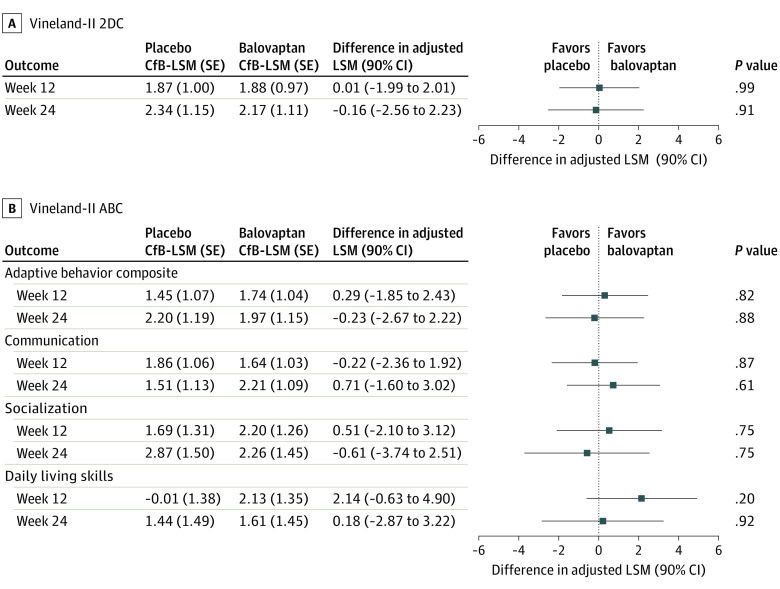
Results: Between November 2016 and September 2019, a total of 599 individuals were screened and 339 participants were randomly assigned to receive 4-mg balovaptan adult-equivalent dose (91 [26.8%]), 10-mg balovaptan adult-equivalent dose (126 [37.2%]), or placebo (122 [36.0%]). Primary analysis included 86 participants assigned to receive 10-mg balovaptan adult-equivalent dose and 81 assigned to receive placebo (mean [SD] age, 12.1 [3.4] years; 139 male participants [83.2%]). No statistically significant differences were observed between the balovaptan and placebo groups in change from baseline on the Vineland-II 2DC score at week 24 (difference in adjusted least-squares mean, -0.16; 90% CI, -2.56 to 2.23; P = .91). No improvements for balovaptan vs placebo were observed at week 24 for any secondary end points. Balovaptan was well tolerated with no emerging safety concerns. Similar proportions of participants reported adverse events (balovaptan, 66 of 86 [76.7%] vs placebo, 61 of 81 [75.3%]) and serious adverse events (balovaptan, 1 of 86 [1.2%] vs placebo, 4 of 81 [4.9%]).

Conclusions and relevance: In this randomized clinical trial, balovaptan did not demonstrate efficacy in improvement of socialization and communication in this population with pediatric ASD. Balovaptan was well tolerated in children 5 years or older. Further development of robust, sensitive, and objective outcome measures may help to improve future studies in the assessment of therapies targeting communication and socialization in pediatric ASD.

Trial registration: ClinicalTrials.gov Identifier: NCT02901431.


Conflict of interest statement

Conflict of Interest Disclosures: Dr Hollander reported receiving research grants from the US Department of Defense, the US Food and Drug Administration, GW Pharma, F. Hoffmann-La Roche Ltd; editorial stipends from Elsevier; and serving on scientific advisory boards for GW Pharma and F. Hoffmann-La Roche Ltd. Dr Jacob has reported receiving grant support from the National Institutes of Health and F. Hoffmann-La Roche Ltd and attending advisory boards for Fraser, Minnesota Independence College & Community, and F. Hoffmann-La Roche Ltd. Dr Jou reported that his institution received payments for clinical trial agreements from Roche Translational & Clinical Research Center and Genentech. Dr McNamara reported providing research support to F. Hoffmann-La Roche Ltd and consulting for Shire and receiving grant support from Forest Research Institute, Genentech, Lundbeck, Pfizer, F. Hoffmann-La Roche Ltd, Shire, Sunovion, and Zynerba. Dr Sikich reported receiving funding from the National Institute of Child Health and Human Development; and payment by F. Hoffmann-La Roche Ltd as a clinical research site investigator for involvement in conducting VANILLA and aV1ation studies; attending an advisory board for F. Hoffmann-La Roche Ltd; having a patent pending for new formulation of intranasal oxytocin by Duke University; and salary payment by the Duke Clinical Research Institute where she is providing thought leadership for trials sponsored by Tris Pharmaceuticals. Dr Tobe reported receiving grant support from Janssen and F. Hoffmann-La Roche Ltd and attending advisory boards for F. Hoffmann-La Roche Ltd. Dr Veenstra-VanderWeele reported receiving research support from the National Institutes of Health, the Simons Foundation, Health Canada, F. Hoffmann-La Roche Ltd, Janssen, Acadia, and Zynerba; royalties from Springer and Wiley; honoraria for lectures at the American Academy of Child and Adolescent Psychiatry, Karolinska Institute, Mount Sinai, National Institute of Neurological Disease and Stroke, Florida Atlantic University, UCLA, Stanford University, Child Mind Institute, and Pennsylvania State University; attending advisory boards for Roche; serving on the medical and/or scientific advisory boards for Autism Speaks, the Simons Foundation Autism Research Initiative, and the Brain Behavior Research Foundation; and serving as the cochair of the Autism and Intellectual Disability Committee for the American Academy of Child and Adolescent Psychiatry. Drs Smith, Sanders, Wandel, and Murtagh reported being employees of and having stocks and stock options in F. Hoffmann-La Roche Ltd. Ms Squassante and Ms Gleissl reported being employees of F. Hoffmann-La Roche Ltd. No other disclosures were reported.

Figures

Figure 1.
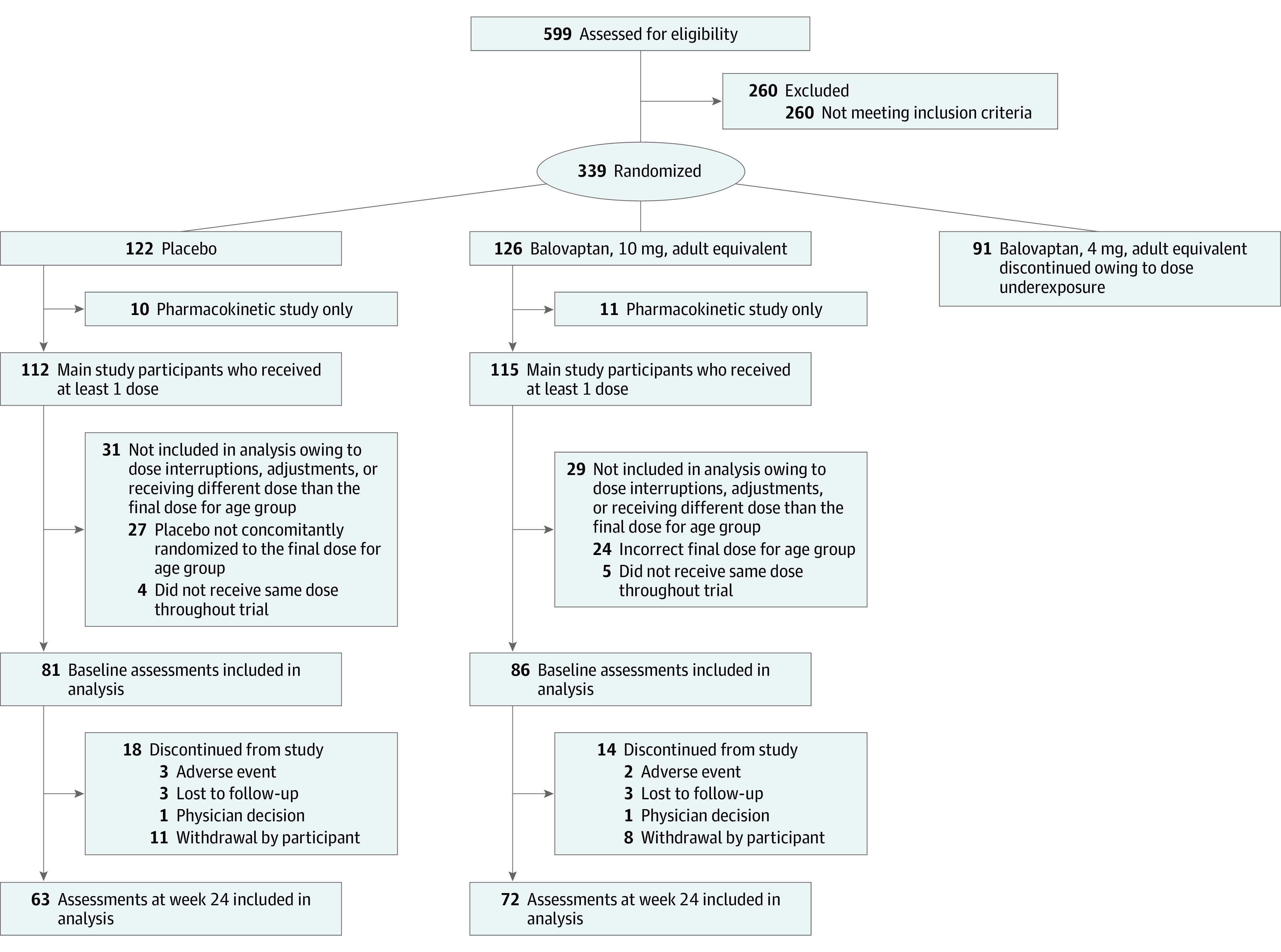
Figure 1.. Consolidated Standards of Reporting Trials (CONSORT) Flow Diagram for the aV1ation Phase 2 Trial
Numbers of participants who participated in both the pharmacokinetic study and main study: placebo (n = 2); balovaptan 10-mg adult-equivalent dose (n = 4); balovaptan, 4-mg adult-equivalent dose (n = 1). For assessments at week 24, n = number of nonmissing values at the respective visit.
Figure 2.
Figure 2.. Treatment Difference in Vineland-II Two-Domain Composite (2DC) and Vineland-II Adaptive Behavior Composite (ABC) at 12 and 24 Weeks
A, Vineland-II 2DC score and Vineland-II ABC (B) differences in adjusted least-squares mean (LSM) derived using mixed models for repeated measurement analysis are shown. At week 12: placebo (n = 66) and balovaptan (n = 70); at week 24: placebo (n = 61) and balovaptan (n = 67); week 24: socialization and daily living skills (n = 68). CfB indicates change from baseline.
Figure 3.
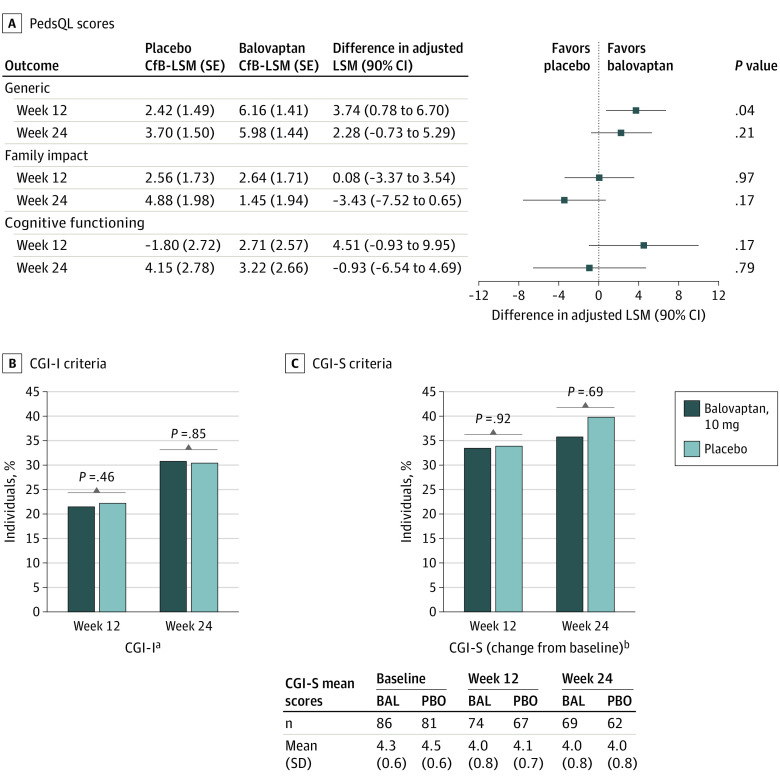
Figure 3.. Treatment Differences for Pediatric Quality of Life Inventory (PedsQL) Scores and Clinical Global Impression (CGI) Responders
A, Differences in adjusted least-squares mean (LSM) for PedsQL scores derived using mixed models for repeated measurement analysis are shown. Generic at week 12: placebo (n = 62) and balovaptan (n = 72); week 24: placebo (n = 59) and balovaptan (n = 65); family impact at week 12: placebo (n = 68) and balovaptan (n = 73); week 24: placebo (n = 62) and balovaptan (n = 67); cognitive functioning at week 12: placebo (n = 63) and balovaptan (n = 72); week 24: placebo (n = 59) and balovaptan (n = 65). B, CGI-Improvement (CGI-I) and C, CGI-Severity (CGI-S) week 12: placebo (n = 67) and balovaptan (n = 74); week 24: placebo (n = 62) and balovaptan (n = 68/69 [CGI-I/CGI-S]). BAL indicates balovaptan; CfB, change from baseline; PBO, placebo. aPercentage of responders with scores of 1 (much improved) or 2 (very much improved). b Percentage of individuals with an improvement in their rating of CGI-S of at least 1 point.

References

    1. Hodges H, Fealko C, Soares N. Autism spectrum disorder: definition, epidemiology, causes, and clinical evaluation. Transl Pediatr. 2020;9(suppl 1):S55-S65. doi:10.21037/tp.2019.09.09 - DOI - PMC - PubMed
    1. American Psychiatric Association . Diagnostic and Statistical Manual of Mental Disorders. 5th ed. American Psychiatric Association Publishing; 2013.

    1. Almandil NB, Alkuroud DN, AbdulAzeez S, AlSulaiman A, Elaissari A, Borgio JF. Environmental and genetic factors in autism spectrum disorders: special emphasis on data from Arabian studies. Int J Environ Res Public Health. 2019;16(4):658. doi:10.3390/ijerph16040658 - DOI - PMC - PubMed
    1. LeClerc S, Easley D. Pharmacological therapies for autism spectrum disorder: a review. P T. 2015;40(6):389-397. - PMC - PubMed
    1. Howes OD, Rogdaki M, Findon JL, et al. . Autism spectrum disorder: consensus guidelines on assessment, treatment and research from the British Association for Psychopharmacology. J Psychopharmacol. 2018;32(1):3-29. doi:10.1177/0269881117741766 - DOI - PMC - PubMed

Publication types

Associated data