


Assessment of multidrug-resistant Listeria monocytogenes in milk and milk product and One Health perspective
- PMID: 35793329
- PMCID: PMC9258876
- DOI: 10.1371/journal.pone.0270993
Assessment of multidrug-resistant Listeria monocytogenes in milk and milk product and One Health perspective
Abstract
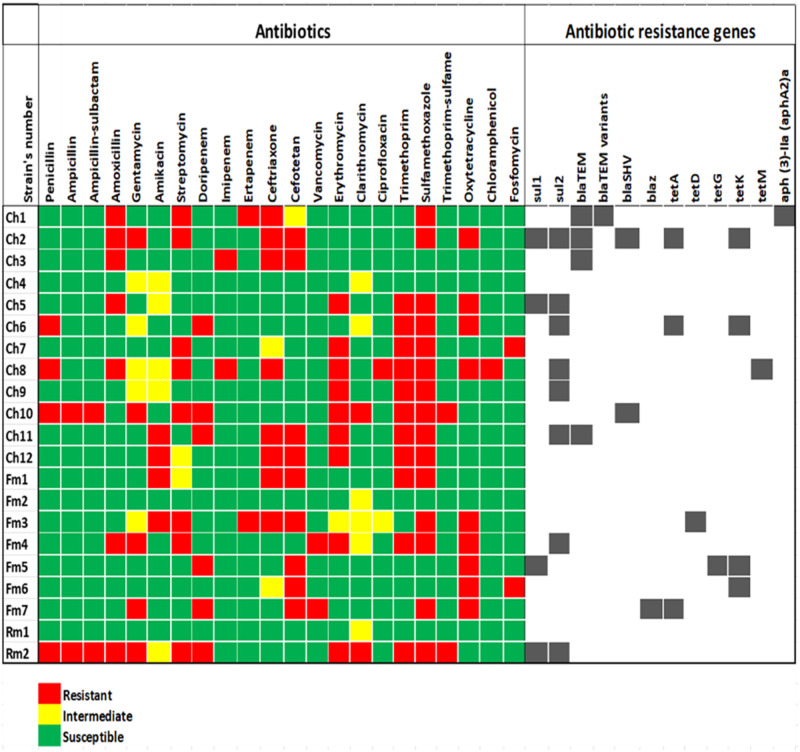
The occurrence and the antibiogram signatures of Listeria monocytogenes (Lm) recovered from 65 milk samples and its products within the Eastern Cape province were examined. The EN ISO 11290:2017 procedures Parts 1 and 2 described by the International Organization for Standardization for the enumeration and isolation of Lm was adopted for the study. Lm was detected in 18.46% of all the samples examined, and the strains recovered from the samples belong to serotypes 4b and 1/2b. The virulence determinants including prfA, plcA, plcB, inlA, inlC, hly, mpl, actA, inlJ and inlB were detected in all the isolates. About 95.24% of the studied Lm isolates demonstrated potential capacity for biofilm formation. The antibiogram profile revealed high resistance against sulfamethoxazole (71.43%), trimethoprim (52.86%); erythromycin, cefotetan and oxytetracycline (42.86% respectively). About 85.71% exhibited multiple antibiotic resistance phenotypes against the test antibiotics. The resistance determinants encoding resistance against the β-lactamase antibiotics [such as the blaTEM, blaSHV, blaTEM variants (TEM-1 and TEM-2) and the blaZ], the tetracycline resistance genes (including tetA, tetD, tetG and tetM and tetK) were detected among resistant isolates. In addition, the aminoglycoside resistance gene aph (3)-IIa (aphA2)a was detected only in one isolate. Finally, the sulfonamide resistance genes including the sul2 and the sul1 genes were the most frequently observed among Lm isolates. Generally, 71.43% of all Lm isolates recovered from the samples investigated harboured one or more resistance genes encoding resistance against various antibiotics. The antibiogram signatures of Lm isolates observed in this study is an indication that empirical treatment of listeriosis may be challenging in the future as the pathogen may obliterate the success of antibiotics. We, therefore, advocate for the recognition of the One Health approach to ensuring food safety and curbing the spread of antimicrobial resistance in food.
Conflict of interest statement
The authors have declared that no competing interests exist.
Figures
References
-
- Lee S, Cappato L, Guimarães J, Balthazar C, Rocha R, Franco L, et al. Listeria monocytogenes in Milk: Occurrence and Recent Advances in Methods for Inactivation. Beverages. 2019; 10(6): 1381. doi: 10.3390/beverages5010014 - DOI
-
- Claeys WL, Cardoen S, Daube G, De Block J, Dewettinck K, Dierick K, et al. Raw or heated cow milk consumption: Review of risks and benefits. Food Control. 2013; 60(6): 991–1006. doi: 10.1016/j.foodcont.2012.09.035 - DOI
-
- Garrido-Maestu A, Azinheiro S, Carvalho J, Fuciños P, Prado M. Development and evaluation of loop-mediated isothermal amplification, and Recombinase Polymerase Amplification methodologies, for the detection of Listeria monocytogenes in ready-to-eat food samples. Food Control. 2018; 86: 27–34. doi: 10.1016/j.foodcont.2017.11.006 - DOI
Publication types
MeSH terms
Substances
LinkOut - more resources
Full Text Sources
Molecular Biology Databases
Research Materials
Miscellaneous
