. 2022 Jul;10(7):e005107.
doi: 10.1136/jitc-2022-005107.

Rethinking the immunotherapy numbers game

Affiliations

Rethinking the immunotherapy numbers game

Rebecca A Bekker et al. J Immunother Cancer. 2022 Jul.

Abstract

Immunotherapies are a major breakthrough in oncology, yielding unprecedented response rates for some cancers. Especially in combination with conventional treatments or targeted agents, immunotherapeutics offer invaluable tools to improve outcomes for many patients. However, why not all patients have a favorable response remains unclear. There is an increasing appreciation of the contributions of the complex tumor microenvironment, and the tumor-immune ecosystem in particular, to treatment outcome. To date, however, there exists no immune biomarker to explain why two patients with similar clinical stage and molecular profile would have different treatment outcomes. We hypothesize that it is critical to understand both the immune and tumor states to understand how the complex system will respond to treatment. Here, we present how integrated mathematical oncology approaches can help conceptualize the effect of various immunotherapies on a patient's tumor and local immune environment, and how combinations of immunotherapy and cytotoxic therapy may be used to improve tumor response and control and limit toxicity on a per patient basis.

Keywords: computational biology; immunotherapy.


Conflict of interest statement

Competing interests: None declared.

Figures
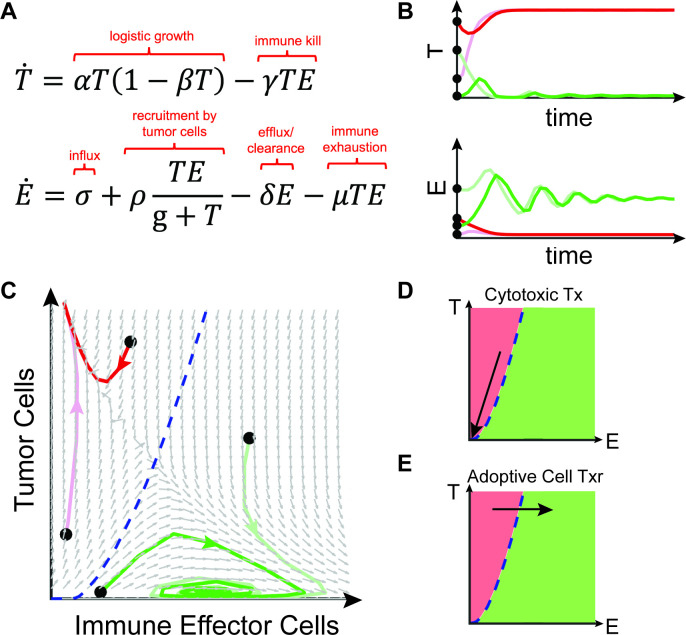
Figure 1
Figure 1
Tumor–immune interactions in a simplified system. (A) Ordinary differential equation representation of a simple model of tumor–immune effector cell interactions, which represents the change in number of tumor cells () and immune effector cells (Ė) over time. (B) Plots of tumor cells and immune effector cells over time for two initial conditions where the tumor evades the immune cells (red and pink) and two where the tumor is controlled by the immune population (green and light green). (C) Phase plane representation of the system with trajectories shown for the same four initial conditions from panel B. The gray vector field in the background depicts the instantaneous direction of the dynamical system for the respective tumor-immune states; the blue dashed curve is the separatrix between the two basins of attraction (immune evasion and immune escape). (D and E) Conceptual schematic of the disparate effects of cytotoxic therapies (D) and adoptive cell transfer (E) on the tumor–immune system.
Figure 2
Figure 2
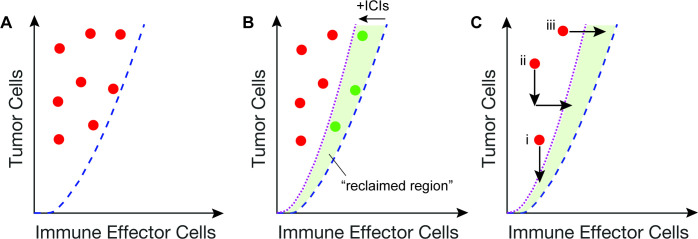
Model realizations of immune checkpoint inhibitor (ICI) therapy. (A) Examples of potential tumor–immune states resulting in immune-escaped tumors, where each circle represents different possible pretreatment states for individual patients. (B) Depiction of the effect of ICI therapy shifting the separatrix between the regions of tumor control and escape. Patients who would benefit from ICI therapy (green circles) due to their tumor–immune state in the ‘reclaimed region’ and those that would not (red circles). The ICIs induced ‘reclaimed region’ of tumor control is indicated in light green shading. (C) Potential combination therapy routes for patients that would not experience tumor control from ICI therapy alone.

References

    1. Bonaventura P, Shekarian T, Alcazer V, et al. Cold tumors: a therapeutic challenge for immunotherapy. Front Immunol 2019;10:168. 10.3389/fimmu.2019.00168 - DOI - PMC - PubMed
    1. Fridman WH, Pagès F, Sautès-Fridman C, et al. The immune contexture in human tumours: impact on clinical outcome. Nat Rev Cancer 2012;12:298–306. 10.1038/nrc3245 - DOI - PubMed
    1. Kuznetsov VA, Makalkin IA, Taylor MA, et al. Nonlinear dynamics of immunogenic tumors: parameter estimation and global bifurcation analysis. Bull Math Biol 1994;56:295–321. 10.1016/S0092-8240(05)80260-5 - DOI - PubMed
    1. Dunn GP, Old LJ, Schreiber RD. The three Es of cancer immunoediting. Annu Rev Immunol 2004;22:329–60. 10.1146/annurev.immunol.22.012703.104803 - DOI - PubMed
    1. Wangersky PJ. Lotka-Volterra population models. Annu Rev Ecol Syst 1978;9:189–218. 10.1146/annurev.es.09.110178.001201 - DOI

Publication types

Substances

LinkOut - more resources