Curcumin as a Promising Neuroprotective Agent for the Treatment of Spinal Cord Injury: A Review of the Literature
- PMID: 35793928
- PMCID: PMC9260551
- DOI: 10.14245/ns.2244148.074
Curcumin as a Promising Neuroprotective Agent for the Treatment of Spinal Cord Injury: A Review of the Literature
Abstract
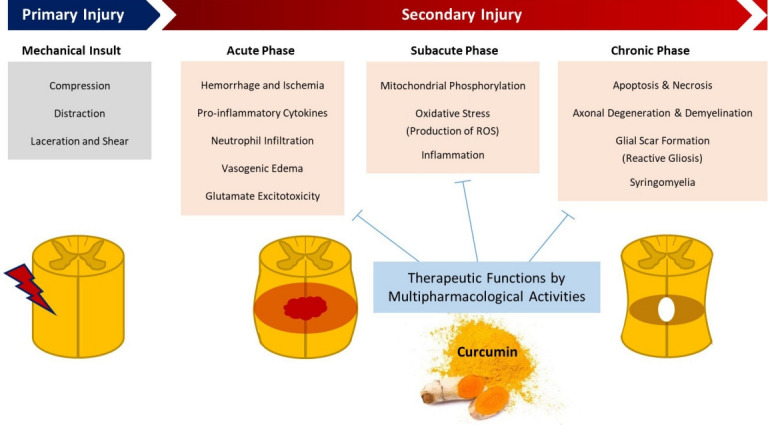
Curcumin is a polyphenolic chemical derived from the rhizomes of Curcuma longa. It has been used throughout the Indian subcontinent for medicinal purposes, religious events, and regional cuisine. It has various pharmacological benefits owing to its anti-inflammatory and antioxidant properties. Its neuroprotective effects on the brain and peripheral nerves have been demonstrated in several in vivo neuronal tissue studies. Because of these functional properties of curcumin, it is considered to have great potential for use in the treatment of spinal cord injuries (SCIs). Numerous immunopathological and biochemical studies have reported that curcumin can help prevent and alleviate subsequent secondary injuries, such as inflammation, edema, free radical damage, fibrosis, and glial scarring, after a primary SCI. Furthermore, following SCI, curcumin administration resulted in better outcomes of neurological function recovery as per the Basso, Beattie, and Bresnahan locomotor rating scale. However, to date, its utility in treating SCIs has only been reported in laboratories. More studies on its clinical applications are needed in the future for ensuring its bioavailability across the blood-brain barrier and for verifying the safe dose for treating SCIs in humans.
Keywords: Antioxidant; Curcumin; Inflammation; Neuroprotective agent; Recovery of function; Spinal cord injury.
Conflict of interest statement
The authors have nothing to disclose.
Figures
References
-
- Lee YS, Cho DC, Kim CH, et al. Effect of curcumin on the inflammatory reaction and functional recovery after spinal cord injury in a hyperglycemic rat model. Spine J. 2019;19:2025–39. - PubMed
-
- Gautam SC, Gao X, Dulchavsky S. In: The molecular targets and therapeutic uses of curcumin in health and disease. Aggarwal BB, Surh YJ, Shishodia S, editors. Boston (MA): Springer US; 2007. Immunomodulation by curcumin; pp. 321–41.
LinkOut - more resources
Full Text Sources