Review
. 2022 Jul 6;7(1):215.
doi: 10.1038/s41392-022-01064-1.

Signaling pathways involved in ischemic stroke: molecular mechanisms and therapeutic interventions

Affiliations
Review

Signaling pathways involved in ischemic stroke: molecular mechanisms and therapeutic interventions

Chuan Qin et al. Signal Transduct Target Ther. .

Erratum in

Abstract

Ischemic stroke is caused primarily by an interruption in cerebral blood flow, which induces severe neural injuries, and is one of the leading causes of death and disability worldwide. Thus, it is of great necessity to further detailly elucidate the mechanisms of ischemic stroke and find out new therapies against the disease. In recent years, efforts have been made to understand the pathophysiology of ischemic stroke, including cellular excitotoxicity, oxidative stress, cell death processes, and neuroinflammation. In the meantime, a plethora of signaling pathways, either detrimental or neuroprotective, are also highly involved in the forementioned pathophysiology. These pathways are closely intertwined and form a complex signaling network. Also, these signaling pathways reveal therapeutic potential, as targeting these signaling pathways could possibly serve as therapeutic approaches against ischemic stroke. In this review, we describe the signaling pathways involved in ischemic stroke and categorize them based on the pathophysiological processes they participate in. Therapeutic approaches targeting these signaling pathways, which are associated with the pathophysiology mentioned above, are also discussed. Meanwhile, clinical trials regarding ischemic stroke, which potentially target the pathophysiology and the signaling pathways involved, are summarized in details. Conclusively, this review elucidated potential molecular mechanisms and related signaling pathways underlying ischemic stroke, and summarize the therapeutic approaches targeted various pathophysiology, with particular reference to clinical trials and future prospects for treating ischemic stroke.


Conflict of interest statement

The author declares no competing interests.

Figures

Fig. 1
Fig. 1
Spatial and temporal relationships of the pathophysiology in ischemic stroke. BBB Blood-brain barrier, DAMPs Damage-associated molecular patterns, Th1 T-helper cell 1, Th2 T helper cell 2
Fig. 2
Fig. 2
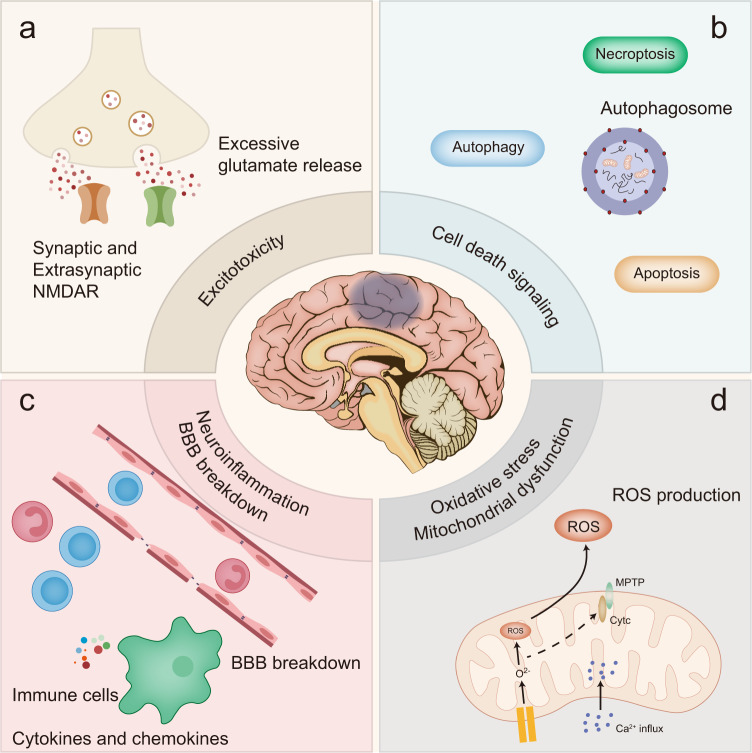
A brief summary for the pathophysiology involved in ischemic stroke. a Excitotoxicity in ischemic stroke, in which excessive glutamate are released and both synaptic and extra-synaptic NMDARs are involved; b Cell death signaling pathways, which mainly involves autophagy, apoptosis and necroptosis in ischemic stroke; c Neuroinflammation and BBB breakdown in ischemic stroke. Here we've presented the participation of various immune cells and chemokines and cytokines released, which thus contribute to blood-brain barrier breakdown; d Oxidative stress, which is mainly characterized by ROS production and mitochondrial dysfunction that involves Ca2+ influx into mitochondria and MPTP in ischemic stroke
Fig. 3
Fig. 3
Excitotoxicity and signaling pathways involved in ischemic stroke. NMDAR N-methyl-D-aspartate receptors, PI3K Phosphatidylinositol 3 kinase, BDNF Brain-derived neurotrophic factor, CREB cAMP-response element-binding protein PTEN Phosphate and tension homology deleted on chromosome ten, PIP3 plasma membrane intrinsic protein 3, DAPK1 Death-associated protein kinase 1, PSD95 Postsynaptic density protein 95, nNOS Neuronal nitric oxide synthase
Fig. 4
Fig. 4
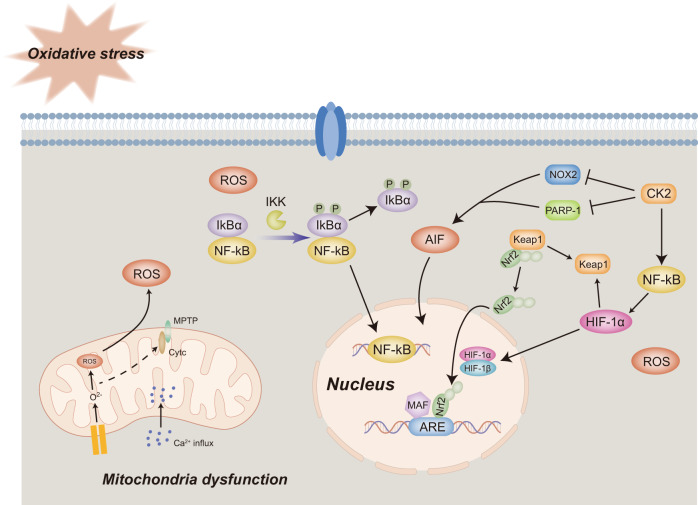
Oxidative stress and mitochondrial dysfunctions and signaling pathways involved in ischemic stroke. MPTP mitochondrial permeability transition pore, ROS Reactive oxygen species, ATP Adenosine triphosphate, HIF-1 Hypoxia-induced factor, Nrf2 Nuclear factor E2-related factor 2, ARE Antioxidant response element, CK2 Casein kinase 2, PARP-1 Poly ADP-ribose polymerase 1, AIF Apoptosis-inducing factor, PINK1 PTEN induced putative kinase 1, NF-kB Necrosis factor-kB
Fig. 5
Fig. 5
Cell death signaling pathways involved in ischemic stroke. GSK3β Glycogen synthase kinase-3β; Bcl-2 B-cell lymphoma-2; ERK Ras/extracellular signal-regulated kinase; CAMKs Ca2+/calmodulin-dependent protein kinases; MAPK Mitogen-activated protein kinase; TNF Tumor necrosis factor; mTOR mammalian target of rapamycin; AMPK 5′-AMP-activated protein kinase; FADD Fas-associating protein with a novel death domain; TRADD TNFRSF1A Associated Via Death Domain; RIPK Receptor-interacting protein kinase; MLKL Mixed lineage kinase domain-like protein; RIP1 Receptor interaction protein 1; RIP3 Receptor interaction protein 3; PGAM5 Phosphoglycerate Mutase Family Member 5; MLKL mixed lineage kinase domain like pseudokinase; Atg5 Autophagy related 5; Atg12 Autophagy related 12; TFEB Transcription factor EB; ULK1 Unc-51 Like Autophagy Activating Kinase 1; AMPK 5′-AMP-activated protein kinase; mTOR mammalian target of rapamycin; Apaf-1 Apoptotic peptidase activating factor 1
Fig. 6
Fig. 6
Neuroinflammation, BBB breakdown and related signaling pathways involved in ischemic stroke. DAMPs Damage-associated molecular patterns; AQP4 Aquaporin 4; HMGB1 High-mobility group box protein 1, TLR2 Toll-like receptor 2; TLR4 Toll-like receptor 4; MAPK Mitogen-activated protein kinase; NF-kB Necrosis factor-kB; NLRP3 Nod-like receptor protein-3; MCP-1 monocyte chemoattractant protein-1; MIP Macrophage inflammatory protein; CCL2 Chemokine-chemokine ligand 2; IL-1β Interleukin-1β; IL-6 Interleukin-6; TNF Tumor necrosis factor; BBB Blood-brain barrier; S1PRs Sphingosine-1-phosphate receptor; VCAM Vascular cell adhesion molecule; LFA Lymphocyte Function-associated Antigen; ICAM Intercellular cell adhesion molecule; DC Dendritic cells; MMP Matrix metalloproteinase

References

    1. Moskowitz MA, Lo EH, Iadecola C. The science of stroke: mechanisms in search of treatments. Neuron. 2010;67:181–198. doi: 10.1016/j.neuron.2010.07.002. - DOI - PMC - PubMed
    1. Feigin VL, et al. Global and regional burden of stroke during 1990–2010: findings from the Global Burden of Disease Study 2010. Lancet. 2014;383:245–255. doi: 10.1016/S0140-6736(13)61953-4. - DOI - PMC - PubMed
    1. Kleindorfer DO, et al. 2021 Guideline for the Prevention of Stroke in Patients With Stroke and Transient Ischemic Attack: A Guideline From the American Heart Association/American Stroke Association. Stroke. 2021;52:E364–E467. doi: 10.1161/STR.0000000000000375. - DOI - PubMed
    1. Adams HP, Jr., et al. Classification of subtype of acute ischemic stroke. Definitions for use in a multicenter clinical trial. TOAST. Trial of Org 10172 in Acute Stroke Treatment. Stroke. 1993;24:35–41. doi: 10.1161/01.STR.24.1.35. - DOI - PubMed
    1. Hankey GJ. Stroke. Lancet. 2017;389:641–654. doi: 10.1016/S0140-6736(16)30962-X. - DOI - PubMed

Publication types