


Mitochondrial Dysfunction in Parkinson's Disease: From Mechanistic Insights to Therapy
- PMID: 35795234
- PMCID: PMC9250984
- DOI: 10.3389/fnagi.2022.885500
Mitochondrial Dysfunction in Parkinson's Disease: From Mechanistic Insights to Therapy
Abstract
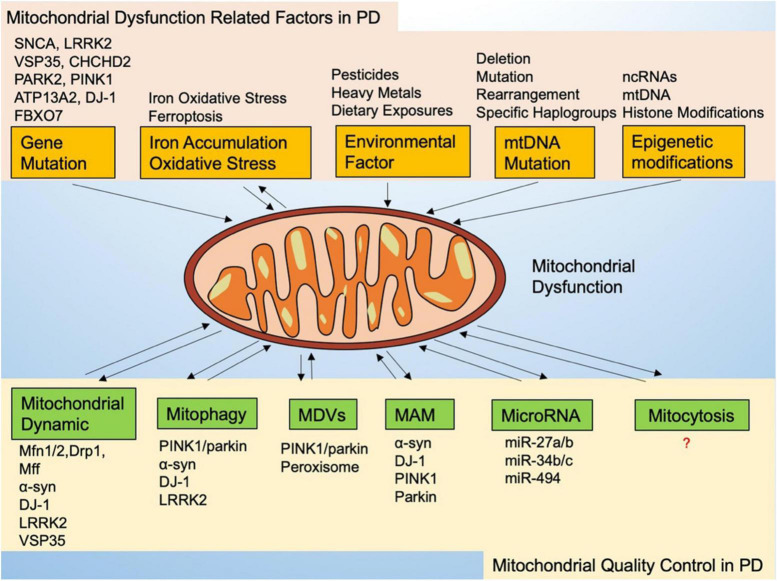
Parkinson's disease (PD) is one of the most common neurodegenerative movement disorders worldwide. There are currently no cures or preventative treatments for PD. Emerging evidence indicates that mitochondrial dysfunction is closely associated with pathogenesis of sporadic and familial PD. Because dopaminergic neurons have high energy demand, cells affected by PD exhibit mitochondrial dysfunction that promotes the disease-defining the loss of dopaminergic neurons in the substantia nigra pars compacta (SNpc). The mitochondrion has a particularly important role as the cellular "powerhouse" of dopaminergic neurons. Therefore, mitochondria have become a promising therapeutic target for PD treatments. This review aims to describe mitochondrial dysfunction in the pathology of PD, outline the genes associated with familial PD and the factors related to sporadic PD, summarize current knowledge on mitochondrial quality control in PD, and give an overview of therapeutic strategies for targeting mitochondria in neuroprotective interventions in PD.
Keywords: Parkinson’s disease; bioenergetics; mitochondrial dysfunction; mitochondrial quality control; therapy.
Copyright © 2022 Gao, Yang, Gu and Sun.
Conflict of interest statement
The authors declare that the research was conducted in the absence of any commercial or financial relationships that could be construed as a potential conflict of interest.
Figures
References
Publication types
LinkOut - more resources
Full Text Sources
Miscellaneous
