


The Association Between Plant-Based Diet Indices and Obesity and Metabolic Diseases in Chinese Adults: Longitudinal Analyses From the China Health and Nutrition Survey
- PMID: 35795587
- PMCID: PMC9251425
- DOI: 10.3389/fnut.2022.881901
The Association Between Plant-Based Diet Indices and Obesity and Metabolic Diseases in Chinese Adults: Longitudinal Analyses From the China Health and Nutrition Survey
Abstract
Background: A wide range of health benefits are associated with consuming a diet high in plant-based foods. Diet quality can be accurately assessed using plant-based diet indices, however there is inadequate evidence that plant-based diet indices are linked to obesity, hypertension, and type 2 diabetes (T2D), especially in Chinese cultures who have traditionally consumed plant-rich foods.
Methods: The data came from the China Nutrition and Health Survey. Overall, 11,580 adult participants were enrolled between 2004 and 2006 and followed up until 2009 or 2015 (follow-up rate: 73.4%). Dietary intake was assessed across three 24-h recalls, and two plant-based dietary indices [overall plant-based diet indice (PDI) and healthy plant-based diet indice (hPDI)] were calculated using China Food Composition Code and categorized into quintiles. The study's endpoints were overweight/obesity, hypertension, and T2D. The Hazard ratio (HR) and dose-response relationship were assessed using the Cox proportional risk model and restricted cubic splines. The areas under the curve of the receiver operating characteristic curve analyses were used to evaluate the predictive performance of the PDI and hPDI.
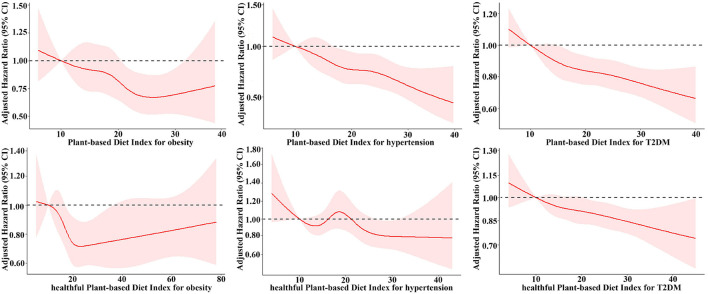
Results: During the median follow-up period of more than 10 years, 1,270 (33.4%), 1,509 (31.6%), and 720 (11.5%) participants developed overweight / obesity, hypertension, and T2D, respectively. The higher PDI score was linked with a reduced risk of overweight/obesity [HR: 0.71 (95% CI: 0.55-0.93), P-trend <0.001], hypertension [HR: 0.63 (95% CI: 0.51-0.79), P-trend <0.001], and T2D [HR: 0.79 (95% CI: 0.72-0.87), P-trend <0.001]. The hPDI score was inversely associated with overweight/obesity [HR: 0.79 (95% CI: 0.62-0.98), P-trend = 0.02] and T2D [HR: 0.84 (95% CI: 0.75-0.93), P-trend = 0.001]. In the aged <55-year-old group, subgroup analysis indicated a significant negative association between PDI/hPDI and overweight/obesity, hypertension, and T2D. There was no significant difference in the areas under the curve of the fully adjusted obesity, hypertension, and diabetes prediction models between PDI and hPDI.
Conclusion: The PDI and hPDI scores were very similar in application in Chinese populations, and our findings highlight that adherence to overall plant-based diet index helps to reduce the risk of T2D, obesity, and hypertension in Chinese adults who habitually consume plant-based foods, especially for those aged <55 year. Further understanding of how plant-based diet quality is associated with chronic disease will be needed in the future, which will help develop dietary strategies to prevent diabetes, hypertension, and related chronic diseases.
Keywords: China Health and Nutrition Survey; healthy plant-based diet index; longitudinal analyses; obesity and metabolic diseases; plant-based diet index.
Copyright © 2022 Chen, Zeng, Qin, Xu, Zhang, Li and Xu.
Conflict of interest statement
The authors declare that the research was conducted in the absence of any commercial or financial relationships that could be construed as a potential conflict of interest.
Figures


References
-
- Danaei G, Finucane MM, Lin JK, Singh GM, Paciorek CJ, Cowan MJ, et al. National, regional, and global trends in systolic blood pressure since 1980: systematic analysis of health examination surveys and epidemiological studies with 786 country-years and 5.4 million participants. Lancet. (2011) 377:568–77. 10.1016/S0140-6736(10)62036-3 - DOI - PubMed
LinkOut - more resources
Full Text Sources
