. 2022 Jun 20:13:910807.
doi: 10.3389/fimmu.2022.910807. eCollection 2022.

Gestational Diabetes Mellitus Changes Human Colostrum Immune Composition

Affiliations

Gestational Diabetes Mellitus Changes Human Colostrum Immune Composition

Ana Carolina de Sena Avellar et al. Front Immunol. .

Abstract

Breast milk is considered a complete food for babies. Up to 7 days postpartum, it is known as colostrum, rich in immunological compounds, responsible for providing nutrition and ensuring immune protection. However, some maternal factors, such as gestational diabetes mellitus (GDM), can change the concentration of bioactive compounds present in the colostrum and may affect the development of the newborn's immune system. The effect of GDM on colostrum cytokine, chemokine, and growth factors is not well described. Thus, the present study evaluated whether the occurrence of GDM changes the concentration of biomarkers in the colostrum. A cross-sectional study was carried out on postpartum women who had healthy pregnancies and women who had been diagnosed with GDM. A sample of colostrum was collected for Luminex analysis. Our results showed that GDM mothers had higher secretion of cytokines and chemokines in the colostrum, with a higher concentration of IFN-g, IL-6, and IL-15, and a lower concentration of IL-1ra. Among growth factors, we identified a decreased concentration of GM-CSF in the colostrum of GDM mothers. Thus, the data obtained support the idea that the disease leads to immune alterations in the colostrum.

Keywords: chemokines; colostrum; cytokines; gestational diabetes mellitus; growth factors; immune system.


Conflict of interest statement

The authors declare that the research was conducted in the absence of any commercial or financial relationships that could be construed as a potential conflict of interest.

Figures
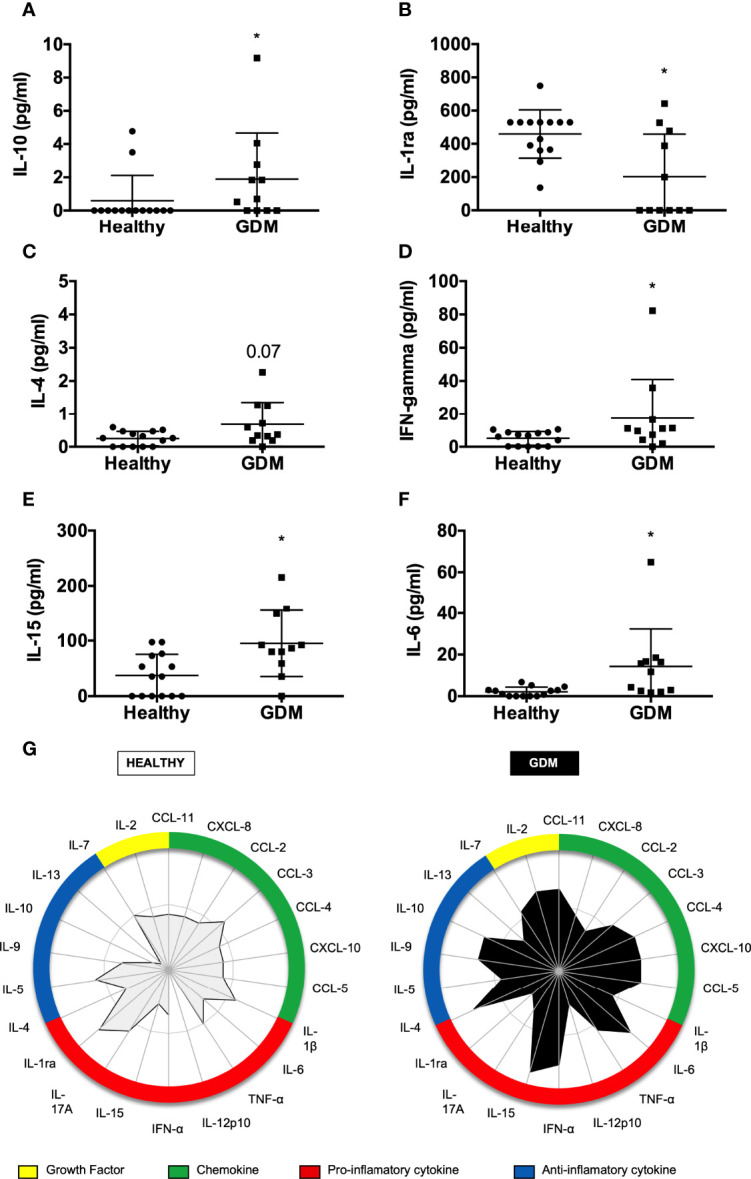
Figure 1
Figure 1
Comparison of cytokine levels in colostrum between healthy and GDM mothers. The concentrations of cytokines and chemokines were measured in colostrum by Luminex. The circles represent women classified as having a usual gestational risk. The squares represent women with GDM. A total of 25 samples were included in the analyses. Each geometric figure represents a participant. (A) IL-10, (B) IL-1ra, (C) IL-4, (D) IFN-γ, (E) IL-5, (F) IL-6. *p < 0.05. (G) Global profile of cytokines/chemokines in colostrum of postpartum women, according to risk classification during pregnancy. The radar graph shows the frequency of high producers of pro-inflammatory, anti-inflammatory, and chemokines levels, and the contribution of each in the different categorizations (habitual risk and GDM).
Figure 2
Figure 2
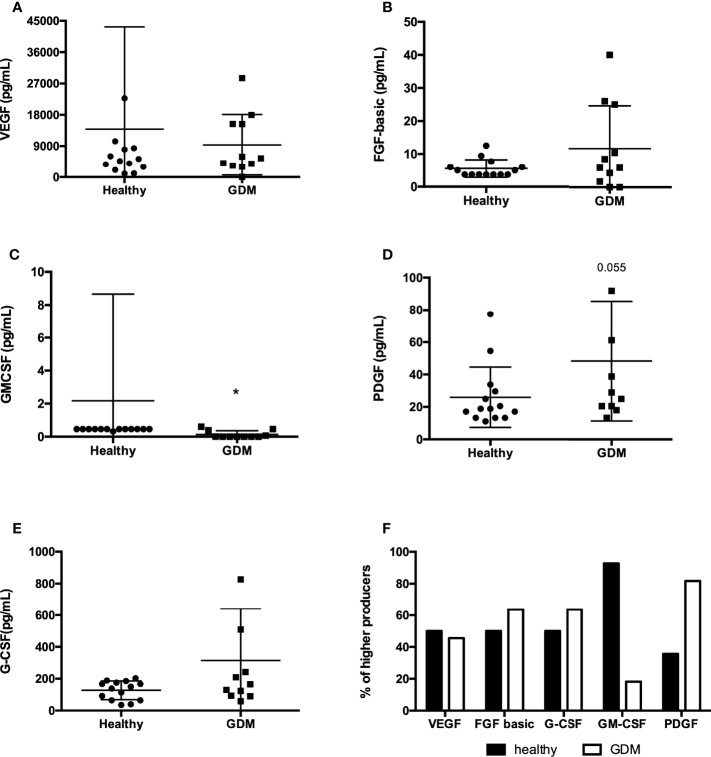
Concentration of growth factors in colostrum comparing healthy mothers with GDM. The concentrations of growth factors were measured in colostrum by Luminex. The circles represent women classified as having a usual gestational risk. The squares represent women with GDM. A total of 25 samples were included in the analyses. Each geometric figure represents a participant. (A) VEF, (B) FGF-basic, (C) GM-CSF, (D) PDGF, (E) G-CSF; *p < 0.05. (F) Frequency of high producers of growth factors in colostrum.
Figure 3
Figure 3
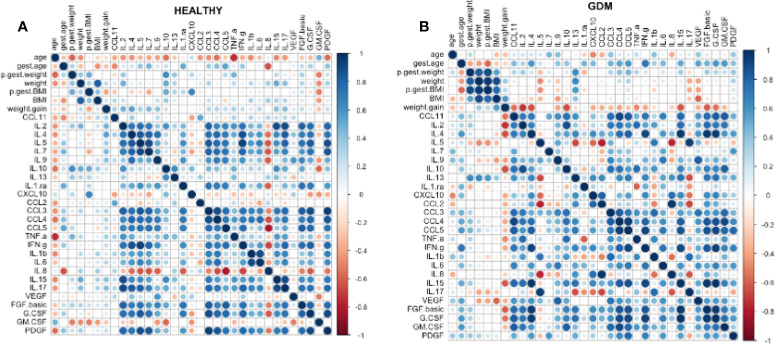
Spearman’s correlation was performed to verify the correlation between the 27 bioactive factors measured in the colostrum and the numerical variables. In the healthy group, dot colors are less intense, and we observed a more positive correlation between the bioactive factors themselves (A). A more significant correlation between the variables was observed mainly in the group of women who presented with GDM (B), through the intensity of the colors (more intense blue = stronger correlation). In addition, there is a negative correlation (more intense red = stronger negative correlation) between weight gain and the biomarkers.

References

    1. Carr LE, Virmani MD, Rosa F, Munblit D, Matazel KS, Elolimy AA, et al. . Role of Human Milk Bioactives on Gut and Immune Health. Front Immunol (2021) 12:604080. doi: 10.3389/FIMMU.2021.604080 - DOI - PMC - PubMed
    1. Isolauri E, Rautava S, Salminen S, Collado MC. Early-Life Nutrition and Microbiome Development. Nestle Nutr Inst Workshop Ser (2019) 90:151–62. doi: 10.1159/000490302 - DOI - PubMed
    1. Zambruni M, Villalobos A, Somasunderam A, Westergaard S, Nigalye M, Turin CG, et al. . Maternal and Pregnancy-Related Factors Affecting Human Milk Cytokines Among Peruvian Mothers Bearing Low-Birth-Weight Neonates. J Reprod Immunol (2017) 120:20–6. doi: 10.1016/j.jri.2017.04.001 - DOI - PMC - PubMed
    1. Qin J, Li R, Raes J, Arumugam M, Burgdorf KS, Manichanh C, et al. . A Human Gut Microbial Gene Catalogue Established by Metagenomic Sequencing. Nature (2010) 464:59–65. doi: 10.1038/nature08821 - DOI - PMC - PubMed
    1. Kollmann TR, Kampmann B, Mazmanian SK, Marchant A, Levy O. Protecting the Newborn and Young Infant From Infectious Diseases: Lessons From Immune Ontogeny. Immunity (2017) 46:350–63. doi: 10.1016/j.immuni.2017.03.009 - DOI - PubMed

Publication types

LinkOut - more resources