


The Importance of Functional Quality in Patient Satisfaction: Cosmetic Injectable Patient Experience Exploratory Study-Part 2
- PMID: 35795885
- PMCID: PMC9252022
- DOI: 10.1093/asjof/ojac044
The Importance of Functional Quality in Patient Satisfaction: Cosmetic Injectable Patient Experience Exploratory Study-Part 2
Abstract
Background: Quality assessment comprises 2 distinct forms: technical quality (TQ) and functional quality (FQ). On the one hand, TQ describes accuracy and excellence, the degree to which procedures are done "correctly." On the other hand, FQ is the way services are delivered and represents how the customer perceives and experiences the treatment or service.
Objectives: To determine the relative importance of functional quality factors in the care of cosmetic injectable patients and return patronage.
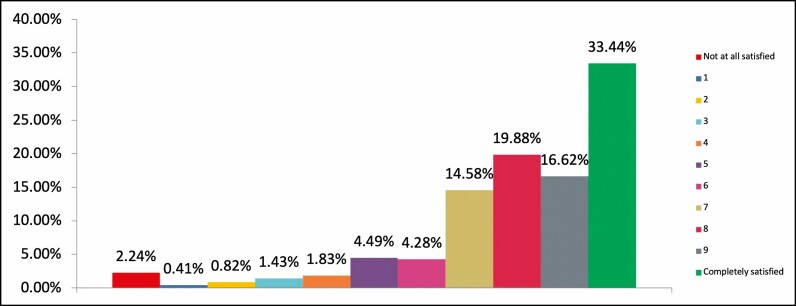
Methods: The Cosmetic Injectable Patient Experience Exploratory Study (CIPEES) survey assessed reasons for return patronage to a specific cosmetic injector and the correlation between satisfaction with cosmetic results (patient assessment of TQ) and respondents' trust level in their practitioner, a marker for FQ.
Results: The CIPEES survey collected 1488 responses across 75 countries, with 66% of participants completing all 15 questions. The respondents were 95.6% female and 4.4% male, with ages ranging from 18 years to >65 years old (median 33 years old). The number one ranked reason for returning to a previous cosmetic injector (return patronage) was "Trust in my practitioner's action and ability," closely followed by "Cosmetic result/outcome from the previous treatment/s." Respondents' level of satisfaction with their cosmetic results also correlated highly with trust in their practitioners.
Conclusions: In order to maximize patient satisfaction and return patronage, healthcare practitioners should focus on improving FQ care and value it at least as high as TQ in the delivery of cosmetic injectable treatments.
© 2022 The Aesthetic Society.
Figures


References
-
- Grönroos CA. Service quality model and its marketing implications. Eur J Mark. 1984;18(4):36-44. doi: 10.1108/EUM0000000004784 - DOI
LinkOut - more resources
Full Text Sources