


Overnight Abstinence Is Associated With Smaller Secondary Somatosensory Cortical Volumes and Higher Somatosensory-Motor Cortical Functional Connectivity in Cigarette Smokers
- PMID: 35796689
- PMCID: PMC9653081
- DOI: 10.1093/ntr/ntac168
Overnight Abstinence Is Associated With Smaller Secondary Somatosensory Cortical Volumes and Higher Somatosensory-Motor Cortical Functional Connectivity in Cigarette Smokers
Abstract
Introduction: Abstinence symptoms present challenges to successful cessation of cigarette smoking. Chronic exposure to nicotine and long-term nicotine abstinence are associated with alterations in cortical and subcortical gray matter volumes (GMVs).
Aims and methods: We aimed at examining changes in regional GMVs following overnight abstinence and how these regional functions relate to abstinence symptoms. Here, in a sample of 31 regular smokers scanned both in a satiety state and after overnight abstinence, we employed voxel-wise morphometry and resting-state functional connectivity (rsFC) to investigate these issues. We processed imaging data with published routines and evaluated the results with a corrected threshold.
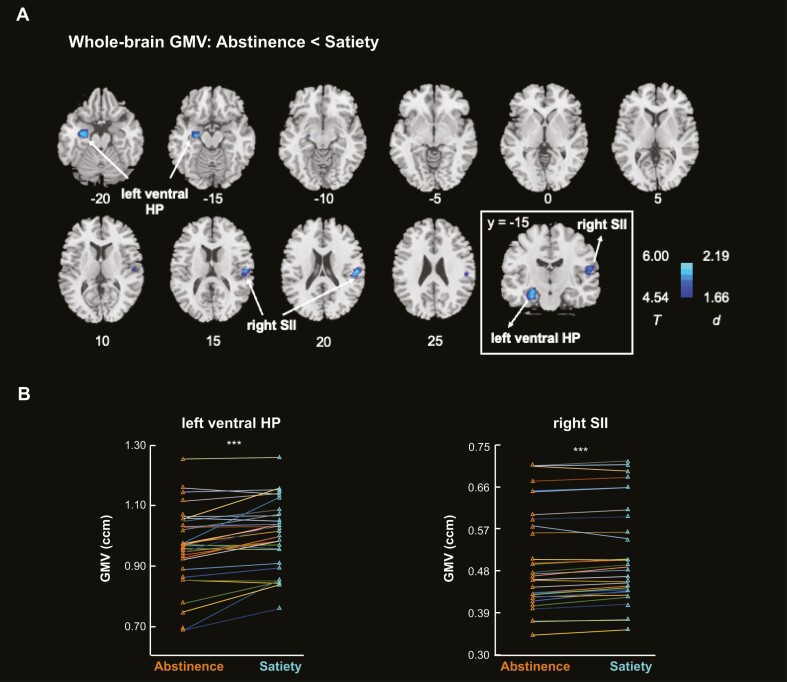
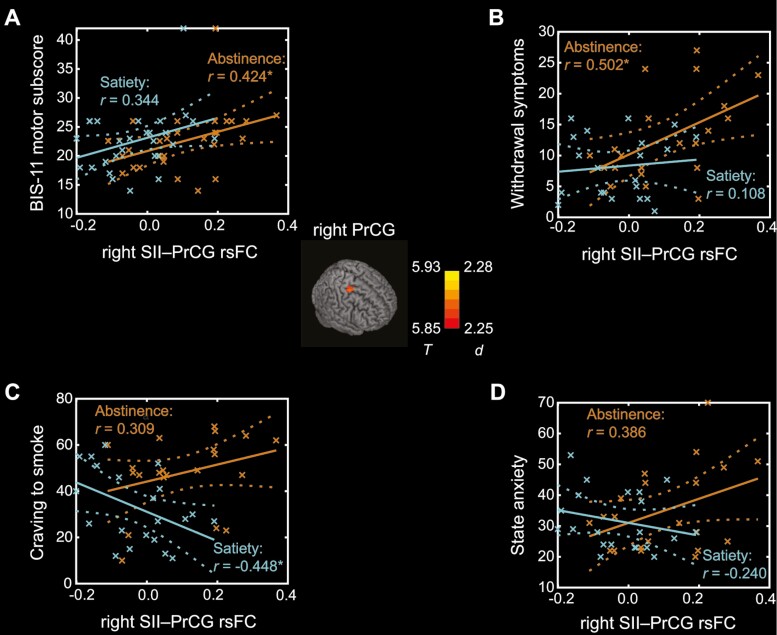
Results: Smokers showed smaller GMVs of the left ventral hippocampus and right secondary somatosensory cortex (SII) after overnight abstinence as compared to satiety. The GMV alterations in right SII were positively correlated with changes in withdrawal symptom severity between states. Furthermore, right SII rsFC with the precentral gyrus was stronger in abstinence as compared to satiety. The inter-regional rsFC was positively correlated with motor impulsivity and withdrawal symptom severity during abstinence and negatively with craving to smoke during satiety.
Conclusions: These findings highlight for the first time the effects of overnight abstinence on cerebral volumetrics and changes in functional connectivity of a higher-order sensory cortex. These changes may dispose smokers to impulsive behaviors and aggravate the urge to smoke at the earliest stage of withdrawal from nicotine.
Implications: Overnight abstinence leads to changes in gray matter volumes and functional connectivity of the second somatosensory cortex in cigarette smokers. Higher somatosensory and motor cortical connectivity in abstinence is significantly correlated with trait motor impulsivity and withdrawal symptom severity. The findings add to the literature of neural markers of nicotine addiction.
© The Author(s) 2022. Published by Oxford University Press on behalf of the Society for Research on Nicotine and Tobacco.
Figures
References
-
- Grant BF, Shmulewitz D, Compton WM.. Nicotine use and DSM-IV nicotine dependence in the United States, 2001-2002 and 2012-2013. Am J Psychiatry. 2020;177(11):1082–1090. - PubMed
-
- Kassel JD, Stroud LR, Paronis CA.. Smoking, stress, and negative affect: correlation, causation, and context across stages of smoking. Psychol Bull. 2003;129(2):270–304. - PubMed
-
- Yakir A, Rigbi A, Kanyas K, et al. Why do young women smoke? III. Attention and impulsivity as neurocognitive predisposing factors. Eur Neuropsychopharmacol. 2007;17(5):339–351. - PubMed
-
- Pattij T, De Vries TJ.. The role of impulsivity in relapse vulnerability. Curr Opin Neurobiol. 2013;23(4):700–705. - PubMed
Publication types
MeSH terms
Substances
Grants and funding
LinkOut - more resources
Full Text Sources
