


Affective Symptoms and Oropharyngeal Dysphagia in Head-and-Neck Cancer Patients: A Systematic Review
- PMID: 35796877
- PMCID: PMC9873770
- DOI: 10.1007/s00455-022-10484-8
Affective Symptoms and Oropharyngeal Dysphagia in Head-and-Neck Cancer Patients: A Systematic Review
Abstract
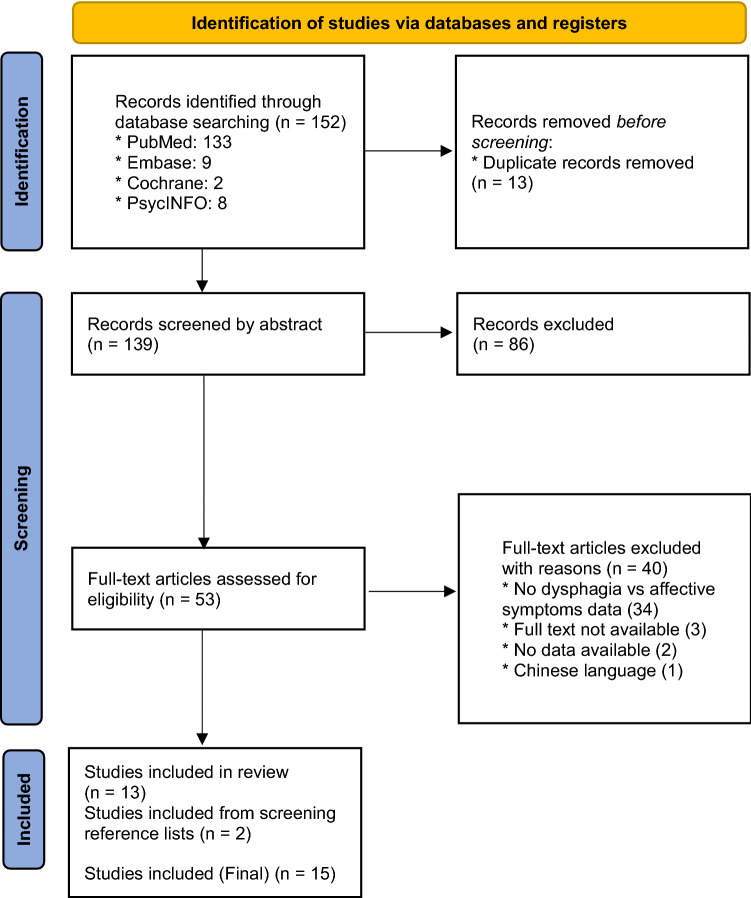
Oropharyngeal dysphagia (OD) is a high impact morbidity in head-and-neck cancer (HNC) patients. A wide variety of instruments are developed to screen for affective symptoms and OD. The current paper aims to systematically review and appraise the literature to obtain insight into the prevalence, strength, and causal direction of the relationship between affective symptoms and OD in HNC patients. This review was conducted in accordance with the PRISMA statement. A systematic search of the literature was performed using PubMed, PsycINFO, Cochrane, and Embase. All available publications reporting on the relationship between affective conditions and swallowing function in HNC patients were included. Conference papers, tutorials, reviews, and studies with less than 5 patients were excluded. Fifteen studies met the inclusion criteria. The level of evidence and methodological quality were assessed using the ABC-rating scale and QualSyst critical appraisal tool. Eleven studies reported a positive relationship between affective symptoms and OD. The findings of this paper highlight the importance of affective symptom screening in dysphagic HNC patients as clinically relevant affective symptoms and OD seems to be prevalent and coincident in this population. Considering the impact of affective symptoms and OD on patients' daily life, early detection and an integrated interdisciplinary approach are recommended. However, due to the heterogeneity of study designs, outcomes, and outcome measures, the generalization of study results is limited.
Keywords: Affective symptoms; Anxiety; Deglutition disorders; Depression; Head-and-neck cancer; Oropharyngeal dysphagia.
© 2022. The Author(s).
Conflict of interest statement
This research did not receive any specific grant from funding agencies in the public, commercial, or not-for-profit sectors. The authors have no conflicts of interest to disclose.
Figures
References
-
- Huckabee SKDM, et al. Dysphagia following stroke. 3. San Diego: Plural Publishing; 2019. pp. 35–36.
-
- Dysphagia Section OCSG, Multinational Association of Supportive Care in Cancer (MASCC)/International Society of Oral Oncology (ISOO) Raber-Durlacher JE, Brennan MT, et al. Swallowing dysfunction in cancer patients. Support Care Cancer. 2012;20(3):433–443. doi: 10.1007/s00520-011-1342-2. - DOI - PMC - PubMed
Publication types
MeSH terms
LinkOut - more resources
Full Text Sources
Medical
Miscellaneous
