


Comparison of the prevalence of kidney disease by proteinuria and decreased estimated glomerular filtration rate determined using three creatinine-based equations among patients admitted on medical wards of Masaka Regional Referral Hospital in Uganda: a prospective study
- PMID: 35799132
- PMCID: PMC9264612
- DOI: 10.1186/s12882-022-02865-w
Comparison of the prevalence of kidney disease by proteinuria and decreased estimated glomerular filtration rate determined using three creatinine-based equations among patients admitted on medical wards of Masaka Regional Referral Hospital in Uganda: a prospective study
Abstract
Background: Despite estimated glomerular filtration rate (eGFR) being the best marker for kidney function, there are no studies in sub-Saharan Africa comparing the performance of various equations used to determine eGFR. We compared prevalence of kidney disease determined by proteinuria of ≥ + 1 and or kidney disease improving global outcomes (KDIGO) eGFR criteria of < 60 ml/minute/1.73m2 determined using three creatinine-based equations among patients admitted on medical ward of Masaka Regional Referral Hospital.
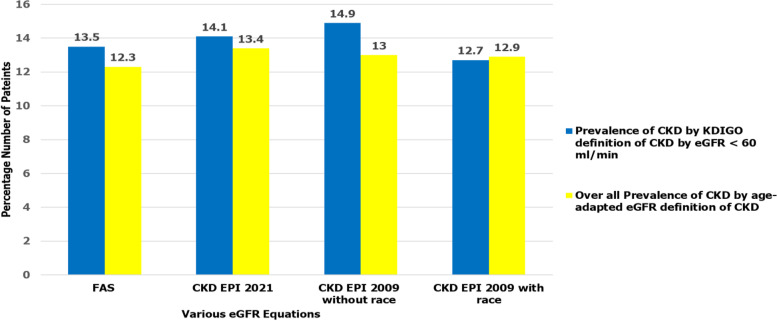
Methods: This was a prospective study conducted among adult patients admitted on medical wards between September 2020 to March 2021. Spot urine samples were collected to assess for proteinuria and blood samples were collected to assess serum creatinine levels. Kidney disease was defined as proteinuria of ≥ 1 + on spot urine dipstick and or KDIGO eGFR criteria of < 60 ml/minute/1.73m2. Estimated glomerular filtration rate was calculated using three creatinine-based equations: a) Full Age Spectrum equation (FAS), b) chronic kidney disease-Epidemiology collaboration (CKD-EPI) 2021 equation, c) CKD EPI 2009 (without and with race factor) equation. CKD was determined after followed up at 90 days post enrollment to determine the chronicity of proteinuria of ≥ + 1 and or KDIGO eGFR criteria of < 60mls /minute/1.73m2. We also compared prevalence of CKD determined by KDIGO eGFR criteria of < 60mls /minute/1.73m2 vs age adapted eGFR threshold criteria for defining CKD.
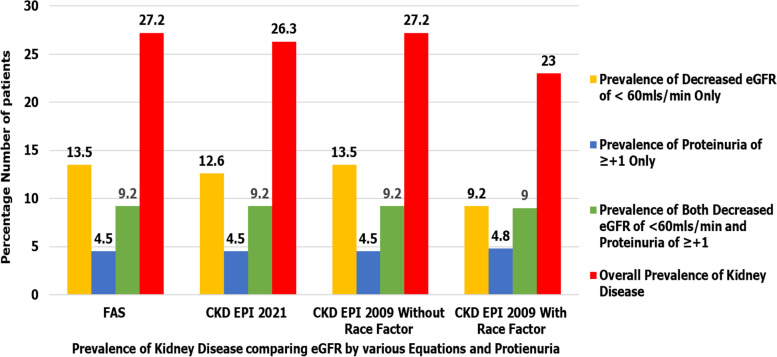
Results: Among the 357 patients enrolled in the study, KDIGO eGFR criteria of < 60mls / minute determined using FAS and CKD-EPI 2009 without race factor equations and or proteinuria of ≥ + 1 showed the highest overall prevalence of kidney disease at 27.2%. Prevalence of confirmed CKD at 90 days was highest with proteinuria ≥ + 1 and or KDIGO eGFR criteria of < 60mls/min determined using CKD EPI 2009 without race factor Equation (15.1%).
Conclusions: Use of KDIGO eGFR criteria of < 60mls / minute /1.73m2 using FAS and CKD-EPI 2009 without race equations identifies the largest number of patients with CKD. Health care systems in sub-Saharan Africa should calculate eGFR using FAS equations or CKD-EPI 2009 without race equations during basic screening and management protocols.
Keywords: Comparison of prevalence of kidney disease; Estimated glomerular filtration rate equations; Kidney disease.
© 2022. The Author(s).
Conflict of interest statement
The authors declare that they have no competing interests.
Figures



References
-
- James SL, Abate D, Abate KH, Abay SM, Abbafati C, Abbasi N, et al. Global, regional, and national incidence, prevalence, and years lived with disability for 354 diseases and injuries for 195 countries and territories, 1990–2017: a systematic analysis for the Global Burden of Disease Study 2017. The Lancet. 2018;392(10159):1789–1858. doi: 10.1016/S0140-6736(18)32279-7. - DOI - PMC - PubMed
-
- Kellum JA, Lameire N, Aspelin P, Barsoum RS, Burdmann EA, Goldstein SL, et al. Kidney disease: improving global outcomes (KDIGO) acute kidney injury work group KDIGO clinical practice guideline for acute kidney injury. Kidney Int Suppl. 2012;2(1):1–138. doi: 10.1038/kisup.2012.1. - DOI
-
- Kiggundu B, Kalyesubula R, Ssinabulya i, Achilles K, Emmanuel S. Chronic Kidney Disease among Hypertensive Patients Attending a National Referral Hospital in Uganda. J Urol Renal Dis. 2017;2017(06):144. 10.29011/2575-7903.000044.
Publication types
MeSH terms
Substances
Grants and funding
LinkOut - more resources
Full Text Sources
Medical
Research Materials
Miscellaneous
