Review
. 2022 Jun 1;5(2):472-486.
doi: 10.20517/cdr.2022.09. eCollection 2022.

An overview of resistance to Human epidermal growth factor receptor 2 (Her2) targeted therapies in breast cancer

Affiliations
Review

An overview of resistance to Human epidermal growth factor receptor 2 (Her2) targeted therapies in breast cancer

Ahmed M Elshazly et al. Cancer Drug Resist. .

Abstract

Breast cancer (BC) is the second most common cause of cancer-related deaths and the most frequently diagnosed cancer in females. Among breast cancer types, HER2-positive breast cancer occurs in nearly 20% of human breast cancers and is associated with increased aggressiveness, poor prognosis, and shortened overall survival. HER2+ breast cancer is currently managed with multidisciplinary treatment strategies including surgery, radiation, chemotherapy, and targeted therapy. Drug resistance remains a continuing challenge, especially to targeted therapy utilizing monoclonal antibodies and tyrosine kinase inhibitors. This review discusses some of the recent molecular mechanisms that are involved in the development of resistance to Her2-targeted therapies including the PI3K/Akt/mTOR pathway, IGF-IR, Src, c-MET, the PP2A family, CD36, p27kip1 , and miRNAs.

Keywords: CD36; HER2+; IGF-IR; PP2A; Src; Targeted therapy resistance; c-MET; miRNA.


Conflict of interest statement

All authors declared that there are no conflicts of interest.

Figures
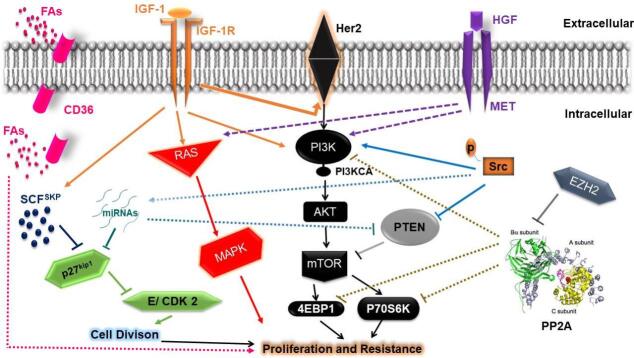
Figure 1
Figure 1
Signaling pathways involved in the development of resistance to Human epidermal growth factor receptor 2 (Her2)-targeted therapy. A central element of resistance appears to be PI3K/AKT/mTOR signaling, which may demonstrate persistent activation through c-MET, IGF-1, p-Src, or interference with PTEN and PP2A mediated suppression of mTOR and downstream signaling at the level of p70S6K and 4EBP1. PP2A activity could also be inhibited by EZH2-mediated slicing of the PP2A regulatory B-subunit. miRNAs and p-Src can also promote the loss of PTEN activity. Resistance could also be mediated through c-MET or IGF1 activation of the RAS/MAPK signaling pathway well as IGF-1; IGF1 can also induce Her2 receptor phosphorylation. p27Kip1 expression is reduced via SCFSKP E3 ubiquitin-mediated degradation, which can be augmented by IGF-1 or via miRNAs which are overexpressed through p-Src, causing loss of cyclin E/CDK2 control and promoting cell cycle progression. CD36 contributed to tumor growth and resistance to Her 2 targeted therapies by providing FAs as a critical energy source for tumorigenesis. PTEN: Phosphatase and tensin homolog; IGF: insulin-like growth factor; MAPK: mitogen-activated protein kinase; FAs: fatty acids.

References

    1. Siegel RL, Miller KD, Fuchs HE, Jemal A. Cancer statistics, 2021. CA Cancer J Clin. 2021;71:7–33. doi: 10.3322/caac.21654. - DOI - PubMed
    1. Kohler BA, Sherman RL, Howlader N, et al. Annual report to the nation on the status of cancer, 1975-2011, featuring incidence of breast cancer subtypes by race/ethnicity, poverty, and state. J Natl Cancer Inst. 2015;107:djv048. doi: 10.1093/jnci/djv048. - DOI - PMC - PubMed
    1. WHO. Breast cancer. Available from: https://www.who.int/news-room/fact-sheets/detail/breast-cancer. [Last accessed on 2 Apr 2022]
    1. Kalimutho M, Parsons K, Mittal D, et al. Targeted therapies for triple-negative breast cancer: combating a stubborn disease. Trends Pharmacol Sci. 2015;36:822–46. doi: 10.1016/j.tips.2015.08.009. - DOI - PubMed
    1. Yarden Y, Sliwkowski MX. Untangling the ErbB signalling network. Nat Rev Mol Cell Biol. 2001;2:127–37. doi: 10.1038/35052073. - DOI - PubMed

LinkOut - more resources