


Using routine emergency department data for syndromic surveillance of acute respiratory illness, Germany, week 10 2017 until week 10 2021
- PMID: 35801521
- PMCID: PMC9264729
- DOI: 10.2807/1560-7917.ES.2022.27.27.2100865
Using routine emergency department data for syndromic surveillance of acute respiratory illness, Germany, week 10 2017 until week 10 2021
Abstract
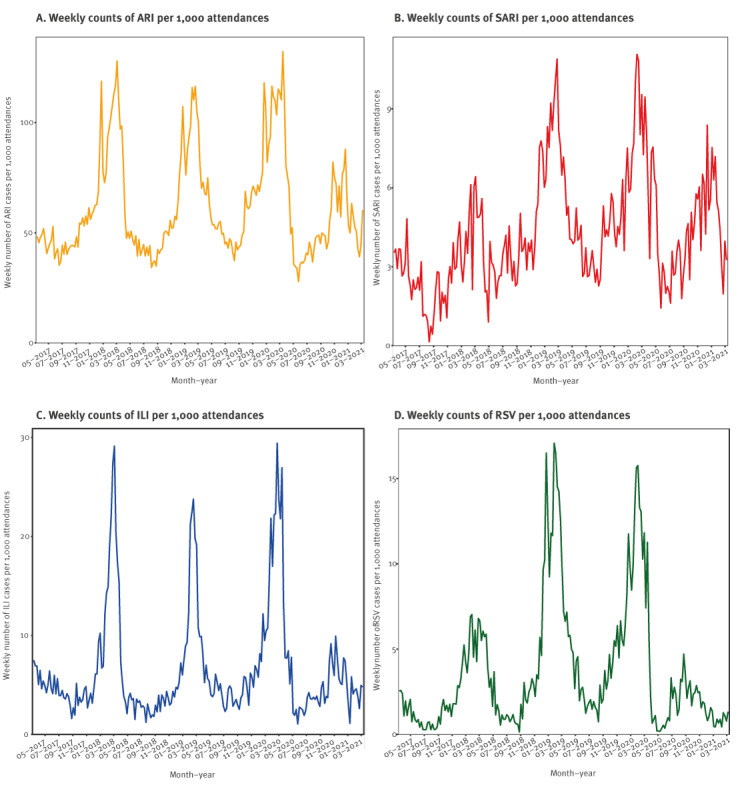
BackgroundThe COVID-19 pandemic expanded the need for timely information on acute respiratory illness at population level.AimWe explored the potential of routine emergency department data for syndromic surveillance of acute respiratory illness in Germany.MethodsWe used routine attendance data from emergency departments, which continuously transferred data between week 10 2017 and 10 2021, with ICD-10 codes available for > 75% of attendances. Case definitions for acute respiratory infection (ARI), severe acute respiratory infection (SARI), influenza-like illness (ILI), respiratory syncytial virus infection (RSV) and COVID-19 were based on a combination of ICD-10 codes, and/or chief complaints, sometimes combined with information on hospitalisation and age.ResultsWe included 1,372,958 attendances from eight emergency departments. The number of attendances dropped in March 2020 during the first COVID-19 pandemic wave, increased during summer, and declined again during the resurge of COVID-19 cases in autumn and winter of 2020/21. A pattern of seasonality of respiratory infections could be observed. By using different case definitions (i.e. for ARI, SARI, ILI, RSV) both the annual influenza seasons in the years 2017-2020 and the dynamics of the COVID-19 pandemic in 2020/21 were apparent. The absence of the 2020/21 influenza season was visible, parallel to the resurge of COVID-19 cases. SARI among ARI cases peaked in April-May 2020 (17%) and November 2020-January 2021 (14%).ConclusionSyndromic surveillance using routine emergency department data can potentially be used to monitor the trends, timing, duration, magnitude and severity of illness caused by respiratory viruses, including both influenza viruses and SARS-CoV-2.
Keywords: COVID-19; emergency service; hospital; public health surveillance; respiratory tract infections.
Conflict of interest statement
Figures



References
-
- Ullrich A, Schranz M, Rexroth U, Hamouda O, Schaade L, Diercke M, et al. Robert Koch’s Infectious Disease Surveillance Group . Impact of the COVID-19 pandemic and associated non-pharmaceutical interventions on other notifiable infectious diseases in Germany: An analysis of national surveillance data during week 1-2016 - week 32-2020. Lancet Reg Health Eur. 2021;6:100103. - PMC - PubMed
-
- World Health Organization (WHO) . Interpreting influenza surveillance data in the context of the COVID-19 pandemic. Wkly Epidemiol Rec. 2020;95(35):409- 15.
-
- European Centre for Disease Prevention and Control (ECDC). COVID-19 surveillance guidance - Transition from COVID-19 emergency surveillance to routine surveillance of respiratory pathogens. Stockholm: ECDC; October 2021. Available from: https://www.ecdc.europa.eu/en/publications-data/covid-19-surveillance-gu...
MeSH terms
LinkOut - more resources
Full Text Sources
Medical
Miscellaneous