


Health-related quality of life and psychological indicators of thriving 15-19 years after heart or lung transplantation
- PMID: 35801650
- PMCID: PMC9756395
- DOI: 10.1111/ctr.14768
Health-related quality of life and psychological indicators of thriving 15-19 years after heart or lung transplantation
Abstract
Background: Survival into the second decade after cardiothoracic transplantation (CTX) is no longer uncommon. Few data exist on any health-related quality of life (HRQOL) impairments survivors face, or whether they may even experience positive psychological outcomes indicative of "thriving" (e.g., personal growth). We provide such data in a long-term survivor cohort.
Methods: Among 304 patients prospectively studied across the first 2 years post-CTX, we re-interviewed patients ≥15 years post-CTX. We (a) examined levels of HRQOL and positive psychological outcomes (posttraumatic growth related to CTX, purpose in life, life satisfaction) at follow-up, (b) evaluated change since transplant with mixed-effects models, and (c) identified psychosocial and clinical correlates of study outcomes with multivariable regression.
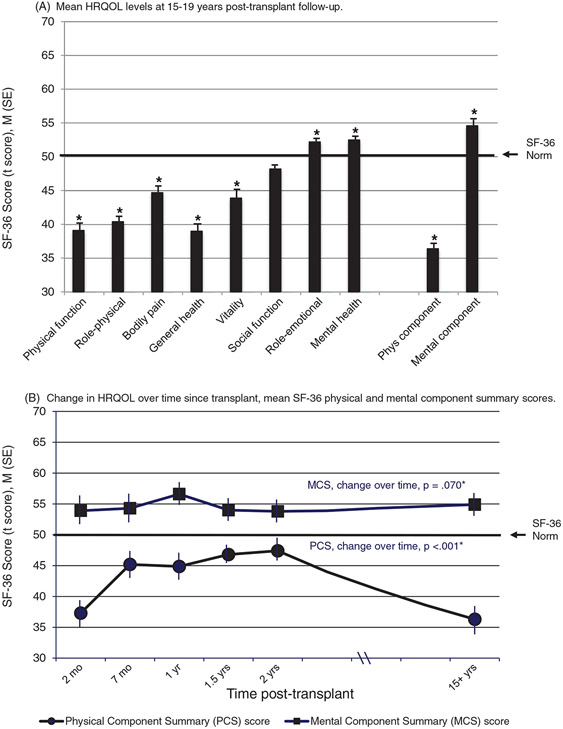
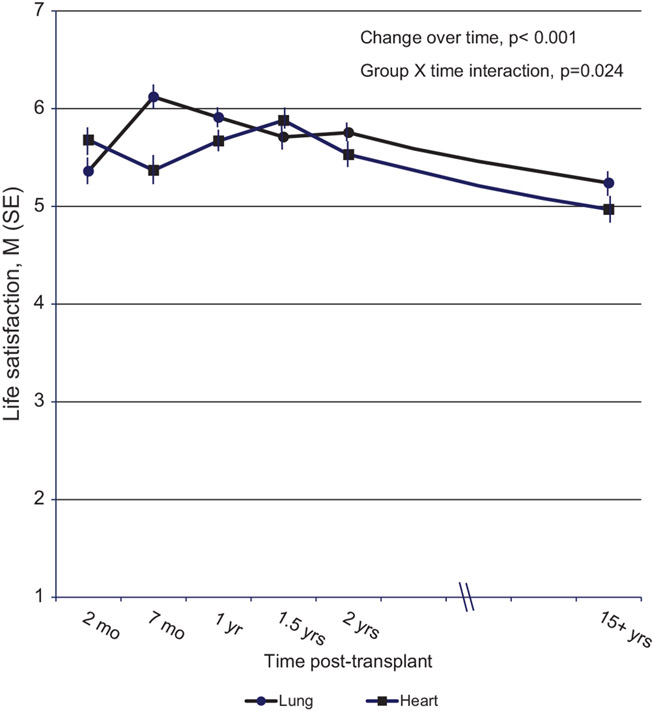
Results: Of 77 survivors, 64 (83%) were assessed (35 heart, 29 lung recipients; 15-19 years post-CTX). Physical HRQOL was poorer than the general population norm and earlier post-transplant levels (P's < .001). Mental HRQOL exceeded the norm (P < .001), with little temporal change (P = .070). Mean positive psychological outcome scores exceeded scales' midpoints at follow-up. Life satisfaction, assessed longitudinally, declined over time (P < .001) but remained similar to the norm at follow-up. Recent hospitalization and dyspnea increased patients' likelihood of poor physical HRQOL at follow-up (P's ≤ .022). Lower sense of mastery and poorer caregiver support lessened patients' likelihood of positive psychological outcomes (P's ≤ .049). Medical comorbidities and type of CTX were not associated with study outcomes at follow-up.
Conclusions: Despite physical HRQOL impairment, long-term CTX survivors otherwise showed favorable outcomes. Clinical attention to correlates of HRQOL and positive psychological outcomes may help maximize survivors' well-being.
Keywords: health-related quality of life; heart transplantation; lung transplantation; psychological outcomes; psychosocial factors; thriving.
© 2022 John Wiley & Sons A/S. Published by John Wiley & Sons Ltd.
Conflict of interest statement
CONFLICT OF INTEREST
The Authors declare no conflicts of interest with respect to the completion of this work.
Figures
References
-
- Chambers DC, Cherikh WS, Harhay MO, et al. The International Thoracic Organ Transplant Registry of the International Society for Heart and Lung Transplantation: thirty-sixth adult lung and heart–lung transplantation Report—2019; Focus theme: donor and recipient size match. J Heart Lung Transplant. 2019;38(10):1042–1055. - PMC - PubMed
-
- Khush KK, Cherikh WS, Chambers DC, et al. The International Thoracic Organ Transplant Registry of the International Society for Heart and Lung Transplantation: thirty-sixth adult heart transplantation report — 2019; focus theme: donor and recipient size match. J Heart Lung Transplant. 2019;38(10):1056–1066. - PMC - PubMed
-
- Dew MA, DiMartini AF, Dobbels F, et al. The 2018 ISHLT/APM/AST/ICCAC/STSW recommendations for the psychosocial evaluation of adult cardiothoracic transplant candidates and candidates for long-term mechanical circulatory support. J Heart Lung Transplant. 2018;37(7):803–823. - PubMed
-
- Kolaitis NA, Singer JP. Defining success in lung transplantation: from survival to quality of life. Semin Respir Crit Care Med. 2018;39(2):255–268. - PubMed
Publication types
MeSH terms
Grants and funding
LinkOut - more resources
Full Text Sources
Medical
