


Increased Colocalization and Interaction Between Decidual Protein Kinase A and Insulin-like Growth Factor-Binding Protein-1 in Intrauterine Growth Restriction
- PMID: 35801847
- PMCID: PMC9284236
- DOI: 10.1369/00221554221112702
Increased Colocalization and Interaction Between Decidual Protein Kinase A and Insulin-like Growth Factor-Binding Protein-1 in Intrauterine Growth Restriction
Abstract
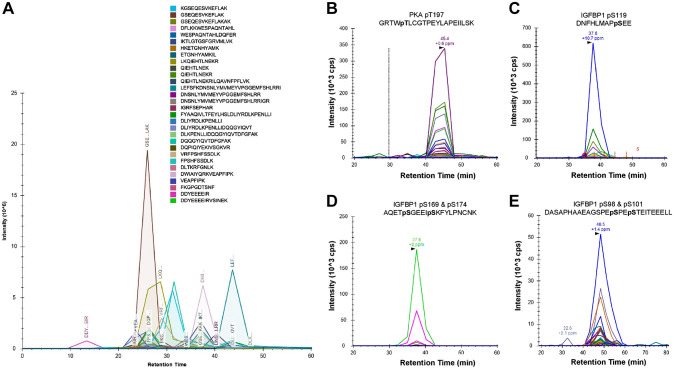
Increased phosphorylation of decidual insulin-like growth factor-binding protein-1 (IGFBP-1) can contribute to intrauterine growth restriction (IUGR) by decreasing the bioavailability of insulin-like growth factor-1 (IGF-1). However, the molecular mechanisms regulating IGFBP-1 phosphorylation at the maternal-fetal interface are poorly understood. Protein kinase A (PKA) is required for normal decidualization. Consensus sequences for PKA are present in IGFBP-1. We hypothesized that the expression/interaction of PKA with decidual IGFBP-1 is increased in IUGR. Parallel reaction monitoring-mass spectrometry (PRM-MS) identified multiple PKA peptides (n=>30) co-immunoprecipitating with IGFBP-1 in decidualized primary human endometrial stromal cells (HESC). PRM-MS also detected active PKApThr197 and greater site-specific IGFBP-1 phosphorylation(pSer119), (pSer98+pSer101) (pSer169+pSer174) in response to hypoxia. Hypoxia promoted colocalization [dual immunofluorescence (IF)] of PKA with IGFBP-1 in decidualized HESC. Colocalization (IF) and interaction (proximity ligation assay) of PKA and IGFBP-1 were increased in decidua collected from placenta of human IUGR pregnancies (n=8) compared with decidua from pregnancies with normal fetal growth. Similar changes were detected in decidual PKA/IGFBP-1 using placenta from baboons subjected to maternal nutrient reduction (MNR) vs controls (n=3 each). In baboons, these effects were evident in MNR at gestational day 120 prior to IUGR onset. Increased PKA-mediated phosphorylation of decidual IGFBP-1 may contribute to decreased IGF-1 bioavailability in the maternal-fetal interface in IUGR.
Keywords: fluorescent antibody technique; humans; hypoxia; mass spectrometry; maternal; nutrient reduction; papio; placenta; stromal cells.
Conflict of interest statement
Figures


References
-
- Gibson JM, Aplin JD, White A, Westwood M. Regulation of IGF bioavailability in pregnancy. Mol Hum Reprod. 2001;7(1):79–87. - PubMed
-
- Clemmons DR. IGF binding proteins and their functions. Mol Reprod Dev. 1993;35(4):368–74. - PubMed
-
- Martina NA, Kim E, Chitkara U, Wathen NC, Chard T, Giudice LC. Gestational age-dependent expression of insulin-like growth factor-binding protein-1 (IGFBP-1) phosphoisoforms in human extraembryonic cavities, maternal serum, and decidua suggests decidua as the primary source of IGFBP-1 in these fluids during early pregnancy. J Clin Endocrinol Metab. 1997;82(6):1894–8. - PubMed
-
- Westwood M, Gibson JM, Davies AJ, Young RJ, White A. The phosphorylation pattern of insulin-like growth factor-binding protein-1 in normal plasma is different from that in amniotic fluid and changes during pregnancy. J Clin Endocrinol Metab. 1994;79(6):1735–41. - PubMed
Publication types
MeSH terms
Substances
Grants and funding
LinkOut - more resources
Full Text Sources
Research Materials
Miscellaneous
