. 2022 Jun:6:e2200020.
doi: 10.1200/CCI.22.00020.

Supporting Structured Data Capture for Patients With Cancer: An Initiative of the University of Wisconsin Carbone Cancer Center Survivorship Program to Improve Capture of Malignant Diagnosis and Cancer Staging Data

Affiliations

Supporting Structured Data Capture for Patients With Cancer: An Initiative of the University of Wisconsin Carbone Cancer Center Survivorship Program to Improve Capture of Malignant Diagnosis and Cancer Staging Data

Hamid Emamekhoo et al. JCO Clin Cancer Inform. 2022 Jun.

Abstract

Purpose: Structured data elements within electronic health records are health-related information that can be entered, stored, and extracted in an organized manner at later time points. Tracking outcomes for cancer survivors is also enabled by structured data. We sought to increase structured data capture within oncology practices at multiple sites sharing the same electronic health records.

Methods: Applying engineering approaches and the Plan-Do-Study-Act cycle, we launched dual quality improvement initiatives to ensure that a malignant diagnosis and stage were captured as structured data. Intervention: Close Visit Validation (CVV) requires providers to satisfy certain criteria before closing ambulatory encounters. CVV may be used to track open clinical encounters and chart delinquencies to encourage optimal clinical workflows. We added two cancer-specific required criteria at the time of closing encounters in oncology clinics: (1) the presence of at least one malignant diagnosis on the Problem List and (2) staging all the malignant diagnoses on the Problem List when appropriate.

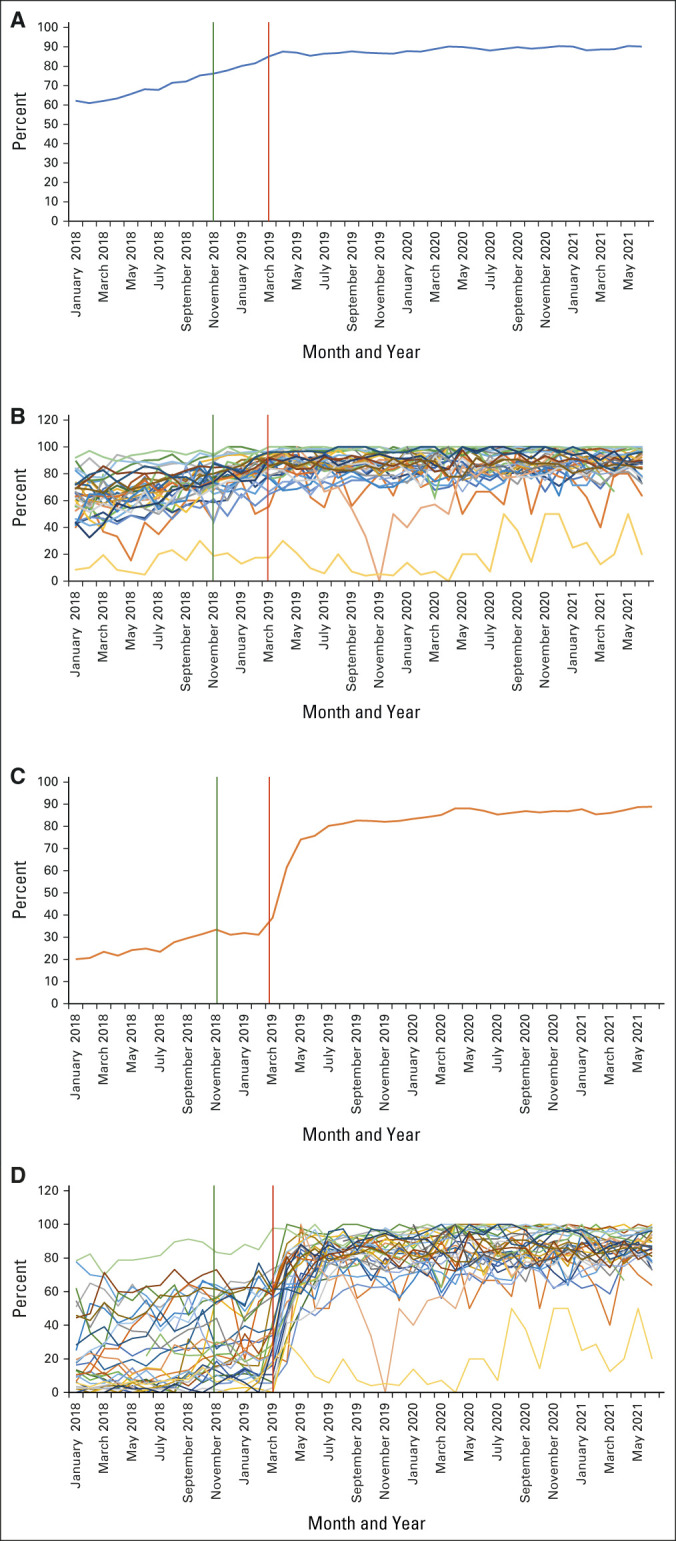
Results: Six months before the CVV implementation, the percentage of encounters with a malignant diagnosis on the Problem List at the time of the encounter was 65%, whereas the percentage of encounters with a staged diagnosis was 32%. Three months after cancer-specific CVV implementation, the percentages were 85% and 75%, respectively. Rates had increased to 90% and 88% more than 2 years after implementation.

Conclusion: Oncologist performance improved after the implementation of cancer-specific CVV criteria, with persistently high percentages of relevant malignant diagnoses and cancer stage structured data capture 2 years after the intervention.


Conflict of interest statement

Amye J. Tevaarwerk

Other Relationship: Epic Systems

No other potential conflicts of interest were reported.

Figures
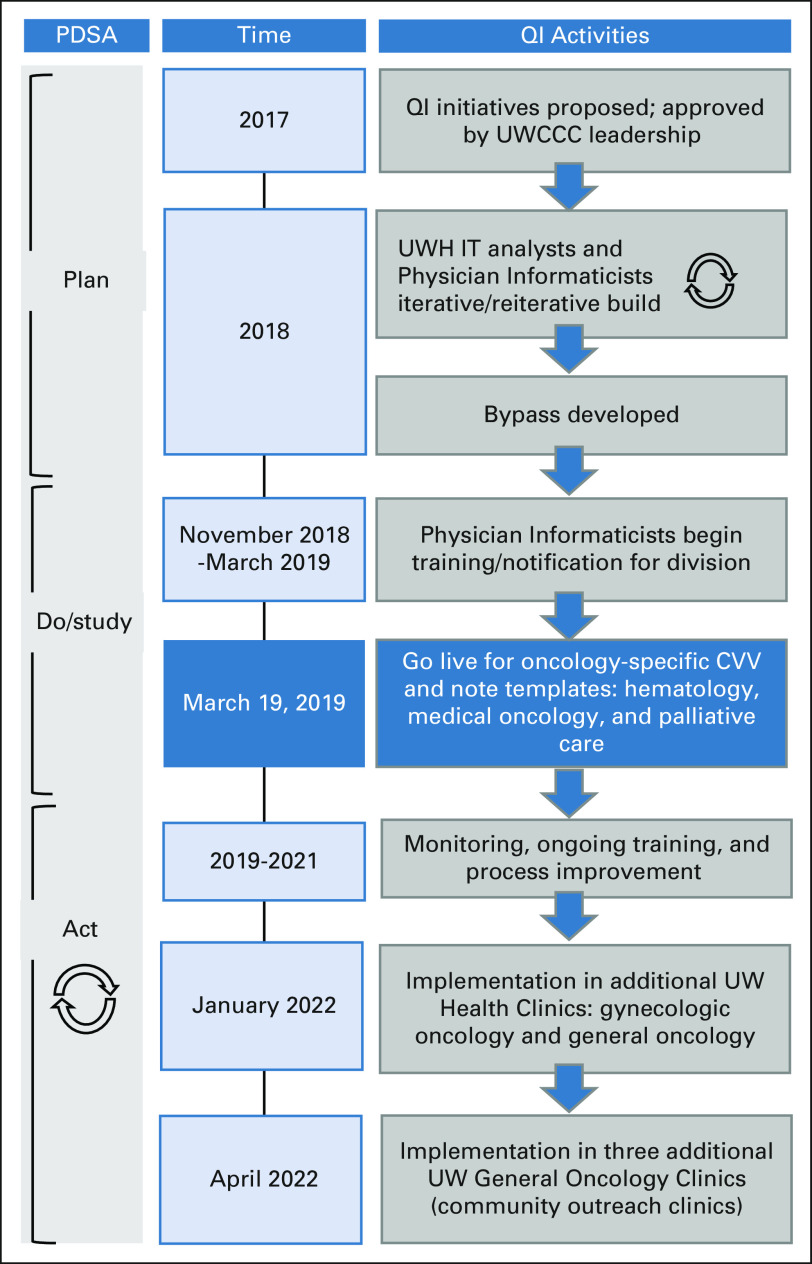
FIG 1.
FIG 1.
Study schema and intervention timeline. Timeline for cancer-specific CVV QI initiatives. CVV, Close Visit Validation; PDSA, Plan-Do-Study-Act; QI, quality improvement; UW, University of Wisconsin; UWCCC, University of Wisconsin Carbone Cancer Center; UWH IT, UW Health Information Technology.
FIG 2.
FIG 2.
Run charts with the percentage of encounters with malignant diagnosis in the Problem List and cancer stage report. (A) Percentage of encounters with malignant diagnosis documented in the Problem List. The blue line represents the percentage of encounters with malignant diagnosis documented in the Problem List over time. The green vertical line represents provider training in November 2018. The red vertical line represents the date that CVV went live in March 2019. (B) Percentage of encounters with malignant diagnosis documented in the Problem List per provider. Colored lines represent the percentage of encounters with malignant diagnosis documented in the Problem List over time per provider. The green vertical line represents provider training in November 2018. The red vertical line represents the date that CVV went live in March 2019. (C) Percentage of encounters with stage documented. The orange line represents the percentage of encounters with the malignant diagnosis stage documented over time. The green vertical line represents provider training in November 2018. The red vertical line represents the date that CVV went live in March 2019. (D) Percentage of encounters with stage documented per provider. Colored lines represent the percentage of encounters with malignant diagnosis stage documented over time per provider. The green vertical line represents provider training in November 2018. The red vertical line represents the date that CVV went live in March 2019. CVV, Close Visit Validation.
FIG 3.
FIG 3.
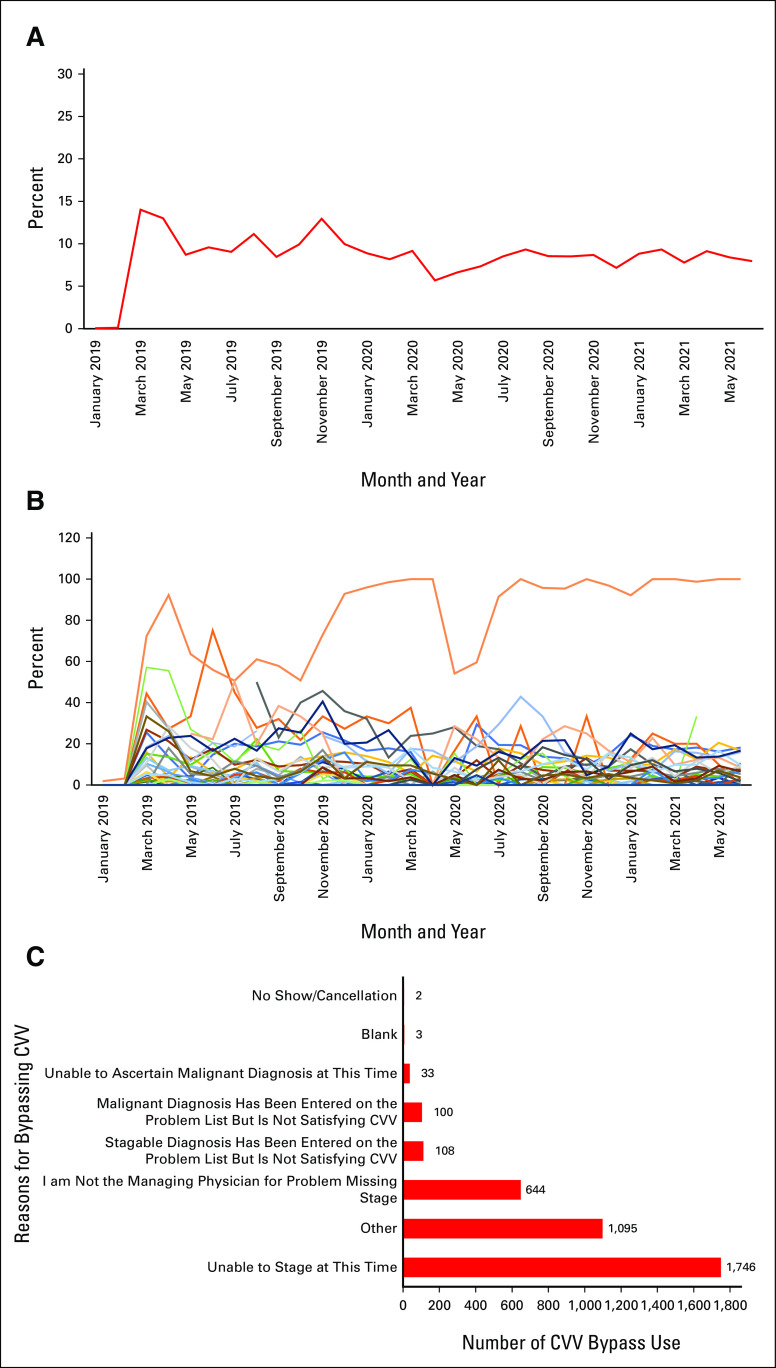
Percentage of encounters with CVV bypass and bypass reasons. (A) Percentage of encounters with CVV bypass use. The red line represents the percentage of encounters with bypassed CVV since January 2019. (B) Percentage of encounters with CVV bypass use per provider. Colored lines represent the percentage of encounters with bypassed CVV per provider since January 2019. (C) Close visit validation bypass reasons. Red bars represent reasons for bypassing CVV (n) since January 2019. CVV, Close Visit Validation.

References

    1. Joukes E, Abu-Hanna A, Cornet R, et al. Time spent on dedicated patient care and documentation tasks before and after the introduction of a structured and standardized electronic health record Appl Clin Inform 946–532018 - PMC - PubMed
    1. Häyrinen K, Saranto K.The core data elements of electronic health record in Finland Stud Health Technol Inform 116131–1362005 - PubMed
    1. Ehrenstein V, Kharrazi H, Lehmann H, et al. Obtaining data from electronic health records. In: Gliklich RE, Leavy MB, Dreyer NA, editors. Tools and Technologies for Registry Interoperability, Registries for Evaluating Patient Outcomes: A User's Guide. ed 3, Addendum 2. Rockville, MD: Agency for Healthcare Research and Quality (US); 2019. - PubMed
    1. Kong HJ.Managing unstructured big data in Healthcare system Healthc Inform Res 251–22019 - PMC - PubMed
    1. Abedian S, Sholle ET, Adekkanattu PM, et al. Automated extraction of tumor staging and diagnosis information from surgical pathology reports JCO Clin Cancer Inform 51054–10612021 - PMC - PubMed

Publication types