


The perspectives of healthcare professionals in mental health settings on stigma and recovery - A qualitative inquiry
- PMID: 35804378
- PMCID: PMC9270770
- DOI: 10.1186/s12913-022-08248-z
The perspectives of healthcare professionals in mental health settings on stigma and recovery - A qualitative inquiry
Abstract
Background: Mental health stigma is one of the most prominent barriers to recovery, and it is widely known that stigma may manifest differentially in different cultures. Healthcare professionals working closely with persons with mental illnesses (PMI) may provide important insights towards stigma that are otherwise unattainable from caregivers and consumers. However, there is a dearth of literature on healthcare professionals' perspectives on this topic. Thus, this study uses a multilevel approach to explore how stigma affects recovery from the perspectives of healthcare professionals that work closely with PMI in Singapore.
Methods: Semi-structured interviews were conducted with a total of 17 healthcare professionals who were working in mental health settings in Singapore. Participants were recruited via direct email invitation or through snowball sampling. Data collected was analysed with the inductive thematic analysis method. All coding and inter-rater analyses were performed with NVivo.
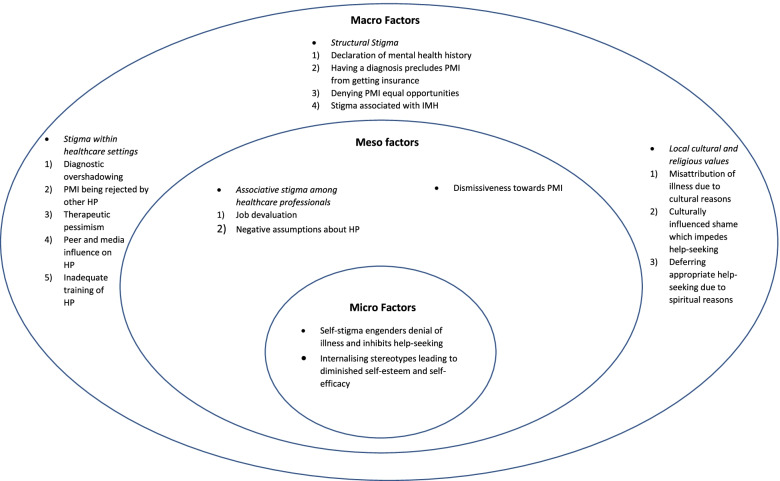
Results: The current study themes identified stigma-related factors that influence PMI's recovery from the perspectives of healthcare professionals working closely with PMI. These factors were organised into three overarching themes in a multilevel structure. The three themes were classified as Micro Factors (e.g., internalised stigma), Meso Factors (e.g., discrimination of people associated with the stigmatised group), and Macro Factors (e.g., structural stigma and stigma within healthcare settings).
Conclusions: The findings of this study gave us a greater understanding of how stigma influences recovery in Singapore, which could be used to guide the development and implementation of future policies and strategies to promote recovery. Importantly, our results suggest that improving mental health literacy, addressing cultural misgivings towards mental illness, implementing recovery-oriented practices, and making insurance more accessible for PMI could mitigate the deleterious impact that stigma has on recovery.
© 2022. The Author(s).
Conflict of interest statement
The authors have declared that no competing interests exist.
Figures
References
-
- Adams N, Daniels A, Compagni A. International Pathways to Mental Health Transformation. Int J Mental Health. 2009;38(1):30–45. doi: 10.2753/IMH0020-7411380103. - DOI
-
- Anthony WA. Recovery from mental illness: the guiding vision of the mental health service system in the 1990s. Psychosoc Rehabil J. 1993;16(4):11.
MeSH terms
LinkOut - more resources
Full Text Sources
Medical
