


Immune System Dysfunction and Inflammation in Hemodialysis Patients: Two Sides of the Same Coin
- PMID: 35807042
- PMCID: PMC9267256
- DOI: 10.3390/jcm11133759
Immune System Dysfunction and Inflammation in Hemodialysis Patients: Two Sides of the Same Coin
Abstract
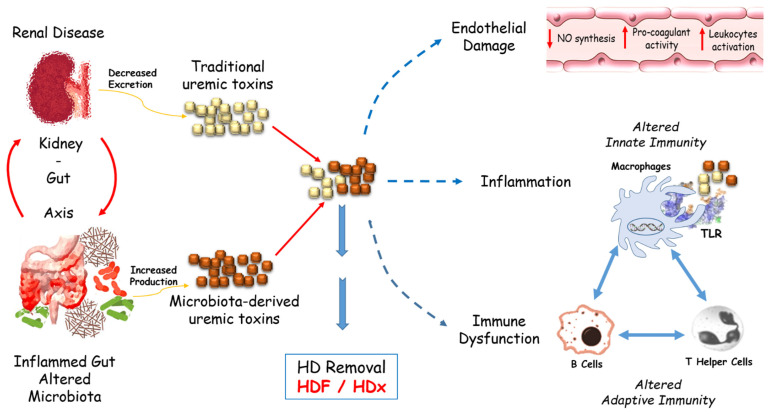
Biocompatibility in hemodialysis (HD) has considerably improved in recent decades, but remains an open issue to be solved, appearing essential to reduce systemic inflammation and enhance patients' clinical outcomes. Clotting prevention, reduction in complement and leukocyte activation, and improvement of antioxidant effect represent the main goals. This review aims to analyze the different pathways involved in HD patients, leading to immune system dysfunction and inflammation. In particular, we mostly review the evidence about thrombogenicity, which probably represents the most important characteristic of bio-incompatibility. Platelet activation is one of the first steps occurring in HD patients, determining several events causing chronic sub-clinical inflammation and immune dysfunction involvement. Moreover, oxidative stress processes, resulting from a loss of balance between pro-oxidant factors and antioxidant mechanisms, have been described, highlighting the link with inflammation. We updated both innate and acquired immune system dysfunctions and their close link with uremic toxins occurring in HD patients, with several consequences leading to increased mortality. The elucidation of the role of immune dysfunction and inflammation in HD patients would enhance not only the understanding of disease physiopathology, but also has the potential to provide new insights into the development of therapeutic strategies.
Keywords: hemodialysis; immune system dysfunction; inflammation.
Conflict of interest statement
The authors declare no conflict of interest.
Figures
References
Publication types
LinkOut - more resources
Full Text Sources
Other Literature Sources
