Review
. 2022 Jul 4;11(13):3883.
doi: 10.3390/jcm11133883.

Autonomic Dysfunction during Acute SARS-CoV-2 Infection: A Systematic Review

Affiliations
Review

Autonomic Dysfunction during Acute SARS-CoV-2 Infection: A Systematic Review

Irene Scala et al. J Clin Med. .

Abstract

Although autonomic dysfunction (AD) after the recovery from Coronavirus disease 2019 (COVID-19) has been thoroughly described, few data are available regarding the involvement of the autonomic nervous system (ANS) during the acute phase of SARS-CoV-2 infection. The primary aim of this review was to summarize current knowledge regarding the AD occurring during acute COVID-19. Secondarily, we aimed to clarify the prognostic value of ANS involvement and the role of autonomic parameters in predicting SARS-CoV-2 infection. According to the PRISMA guidelines, we performed a systematic review across Scopus and PubMed databases, resulting in 1585 records. The records check and the analysis of included reports' references allowed us to include 22 articles. The studies were widely heterogeneous for study population, dysautonomia assessment, and COVID-19 severity. Heart rate variability was the tool most frequently chosen to analyze autonomic parameters, followed by automated pupillometry. Most studies found ANS involvement during acute COVID-19, and AD was often related to a worse outcome. Further studies are needed to clarify the role of autonomic parameters in predicting SARS-CoV-2 infection. The evidence emerging from this review suggests that a complex autonomic nervous system imbalance is a prominent feature of acute COVID-19, often leading to a poor prognosis.

Keywords: COVID-19; SARS-CoV-2; autonomic dysfunction; autonomic nervous system; dysautonomia; heart rate variability; outcome; prognosis.


Conflict of interest statement

The authors declare no conflict of interest.

Figures
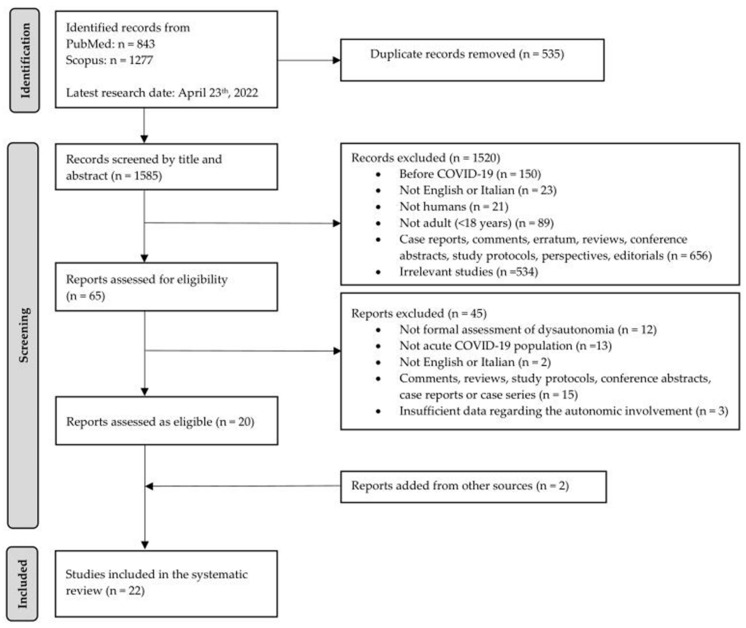
Figure 1
Figure 1
The PRISMA diagram of the systematic review. Reports excluded: Not formal assessment of dysautonomia—Refs. [66,67,68,69,70,71,72,73,74,75,76,77]; not acute COVID-19 population—Refs. [78,79,80,81,82,83,84,85,86,87,88,89,90]; not in English or Italian—Refs. [49,50]; study design—Refs. [51,52,53,54,55,56,57,58,59,60,61,62,63,64,65]; insufficient data regarding the autonomic involvement—Refs. [91,92,93]. Reports assessed as eligible—Refs. [29,30,31,32,33,34,35,36,37,38,39,40,41,42,43,44,45,46,47,48]. Reports added from other sources—Refs. [94,95]. Studies included in the systematic review—Refs. [29,30,31,32,33,34,35,36,37,38,39,40,41,42,43,44,45,46,47,48,94,95]. Abbreviations: COVID-19, Coronavirus disease 2019.
Figure 2
Figure 2
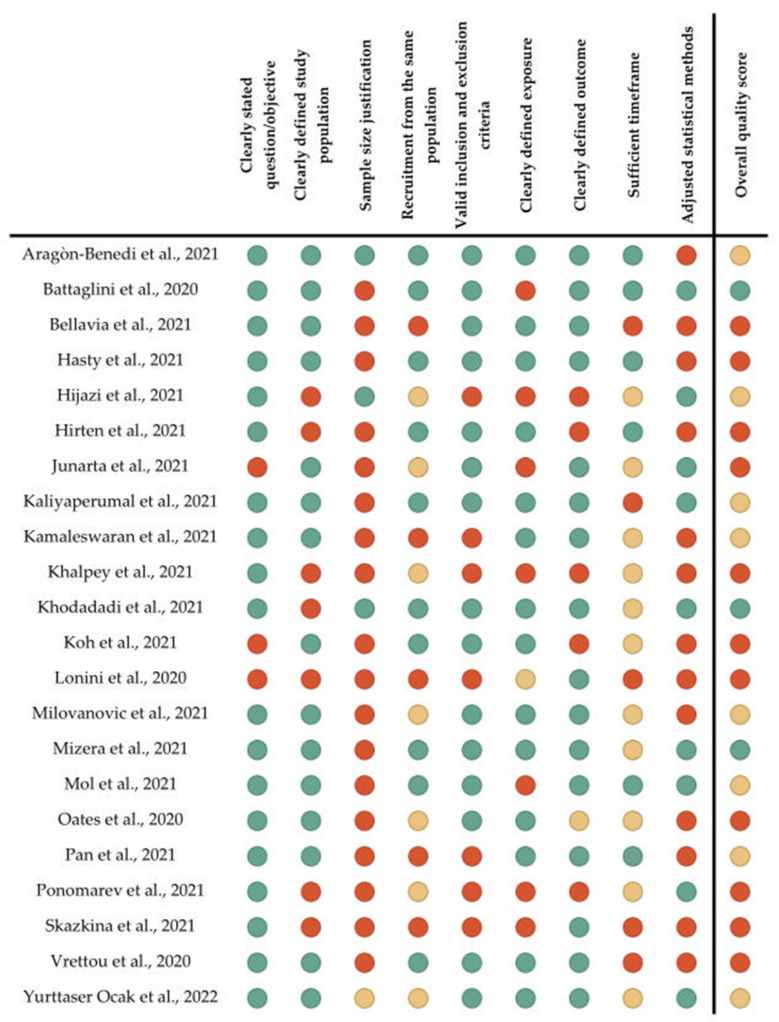
A summary of the quality assessment of the included studies according to the “Study Quality Assessment Tool” issued by the National Heart, Lung, and Blood Institute [29,30,31,32,33,34,35,36,37,38,39,40,41,42,43,44,45,46,47,48,94,95]. Color legend: Green, yes; Yellow, not applicable, not reported, or cannot be determined; Red, no.

References

    1. Cucinotta D., Vanelli M. WHO Declares COVID-19 a Pandemic. Acta Biomed. 2020;91:157–160. doi: 10.23750/abm.v91i1.9397. - DOI - PMC - PubMed
    1. Berlin D.A., Gulick R.M., Martinez F.J. Severe COVID-19. N. Engl. J. Med. 2020;383:2451–2460. doi: 10.1056/NEJMcp2009575. - DOI - PubMed
    1. Gandhi R.T., Lynch J.B., Del Rio C. Mild or Moderate COVID-19. N. Engl. J. Med. 2020;383:1757–1766. doi: 10.1056/NEJMcp2009249. - DOI - PubMed
    1. Gupta A., Madhavan M.V., Sehgal K., Nair N., Mahajan S., Sehrawat T.S., Bikdeli B., Ahluwalia N., Ausiello J.C., Wan E.Y., et al. Extrapulmonary manifestations of COVID-19. Nat. Med. 2020;26:1017–1032. doi: 10.1038/s41591-020-0968-3. - DOI - PMC - PubMed
    1. Mao L., Jin H., Wang M., Hu Y., Chen S., He Q., Chang J., Hong C., Zhou Y., Wang D., et al. Neurologic Manifestations of Hospitalized Patients With Coronavirus Disease 2019 in Wuhan, China. JAMA Neurol. 2020;77:683–690. doi: 10.1001/jamaneurol.2020.1127. - DOI - PMC - PubMed

LinkOut - more resources