


Recovering Ancient Grapevine Cultivars in the Balearic Islands: Sanitary Status Evaluation and Virus Elimination
- PMID: 35807705
- PMCID: PMC9268875
- DOI: 10.3390/plants11131754
Recovering Ancient Grapevine Cultivars in the Balearic Islands: Sanitary Status Evaluation and Virus Elimination
Abstract
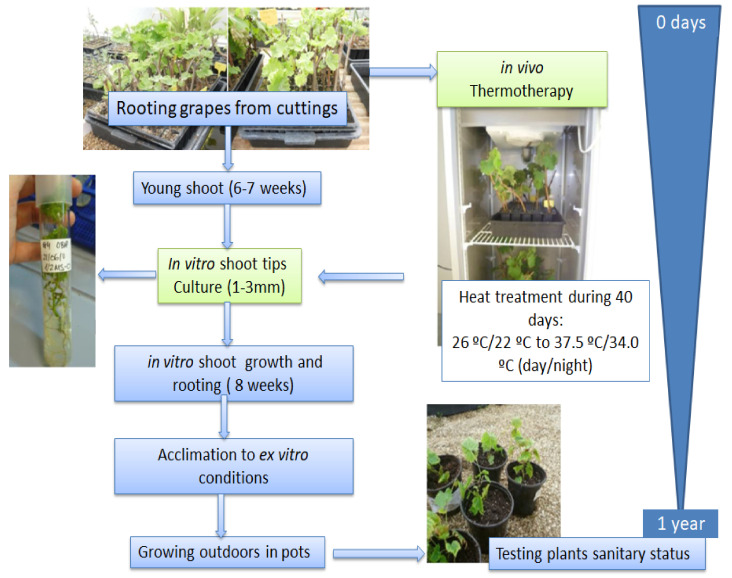
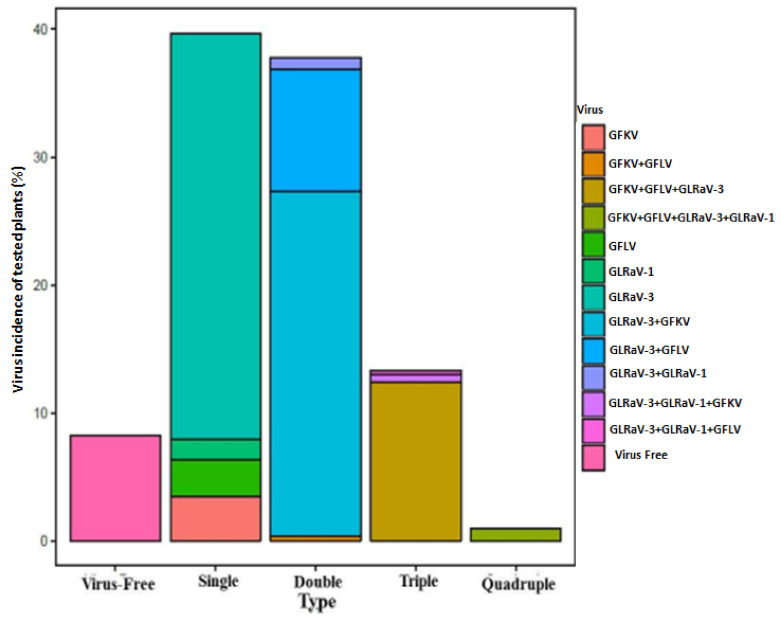
Recuperation and genetic diversity preservation of local cultivars have acquired a huge interest in viticulture areas worldwide. In the Balearic Islands, most of the old cultivars are only preserved in grapevine germplasm banks, and so far, the sanitary status of these local cultivars has remained unexplored. The aim of this study was to survey and detect the virus incidence of all conserved cultivars in the government Grapevine Germplasm Bank of the Balearic Islands and to promote the sanitary recovery of two important minor cultivars, Argamussa and Gorgollassa. Enzyme-linked immunosorbent assay (ELISA) screenings were performed on 315 vines of 33 local cultivars. It was shown that the local cultivars were highly infected with simple (39.7%) and mixed infections (52.1%) and only 8.25% of them were free from the viruses tested. Grapevine leafroll-associated virus 3 (GLRaV-3) infection was the most common (82%). Moreover, Grapevine fanleaf virus (GFLV) and Grapevine fleck virus (GFkV) were also present with considerable incidence (25.4% and 43.5%, respectively). In addition, two sanitation protocols were used: shoot tip culture (ST) and thermotherapy in combination with shoot tip culture (CT). Virus elimination using only ST was effective to obtain "healthy" vines of cvs. Argamussa and Gorgollassa. It is important to emphasize that the methods described in the current study were rapid and effective in eliminating both GLRaV-3 and GFLV, also in combination.
Keywords: Vitis vinifera L.; ancient grapevine cultivars; sanitation techniques; virus incidence.
Conflict of interest statement
The authors declare no conflict of interest regarding the publication of this paper.
Figures
References
-
- Cipriani G., Spadotto A., Jurman I., Di-Gaspero G., Crespan M., Meneghetti S., Frare E., Vignani R., Cresti M., Morgante M., et al. The SSR-based molecular profile of 1005 grapevine (Vitis vinifera L.) accessions uncovers new synonymy, parentages and reveals a large and mixture amongst varieties of different geographic origin. Theor. Appl. Genet. 2010;121:1569–1585. doi: 10.1007/s00122-010-1411-9. - DOI - PubMed
-
- Terral J.F., Tabard E., Bouby L., Ivorra S., Pastor T., Figueiral I., Picq S., Chevance J.B., Jung C., Fabre L., et al. Evolution and history of grapevine (Vitis vinifera) under domestication. new morphometric perspectives to understand seed domestication syndrome and reveal origins of ancient European cultivars. Ann. Bot. 2010;105:443–455. doi: 10.1093/aob/mcp298. - DOI - PMC - PubMed
-
- Maghradze D., Failla O., Bacilieri R., Imazio S., Vashakidze L., Chipashvili R., Mdinaradze I., Chkhartishvili N., This P., Scienza A. Georgian vitis germplasm. usage, conservation and investigation. Le Bull. De L’OIV. 2010;83:485–496.
-
- García Muñoz S., Lacombe T., De Andrés M.T., Gaforio L., Muñoz Organero G., Lacuou V., This P., Cabello F. Grape varieties (Vitis vinifera L.) from the Balearic Islands. genetic characterization and relationship with Iberian Peninsula and Mediterranean Basin. Genet. Resour. Crop Ev. 2012;59:589–605. doi: 10.1007/s10722-011-9706-5. - DOI
LinkOut - more resources
Full Text Sources
