


IQ Was Not Improved by Post-Discharge Fortification of Breastmilk in Very Preterm Infants
- PMID: 35807888
- PMCID: PMC9268839
- DOI: 10.3390/nu14132709
IQ Was Not Improved by Post-Discharge Fortification of Breastmilk in Very Preterm Infants
Abstract
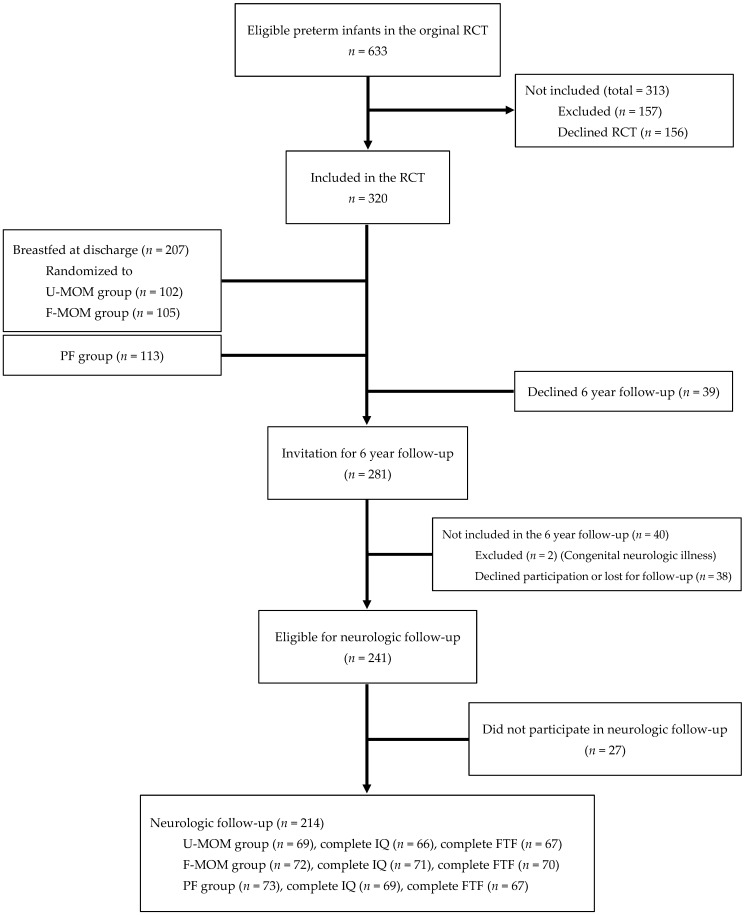
(1) Very preterm infants are at increased risk of cognitive deficits, motor impairments, and behavioural problems. Studies have tied insufficient nutrition and growth to an increased risk of neurodevelopmental impairment; (2) Methods: Follow-up study on cognitive and neuropsychological development at 6 years corrected age (CA) in 214 very preterm infants, including 141 breastfed infants randomised to mother's own milk (MOM) with (F-MOM) or without (U-MOM) fortification and 73 infants fed a preterm formula (PF-group), from shortly before discharge to 4 months CA. Infants with serious congenital anomalies or major neonatal morbidities were excluded prior to intervention. The Wechsler Intelligence Scale for Children IV was used for cognitive testing, and the children's parents completed the Five to Fifteen Questionnaire (FTF); (3) Results: Post-discharge fortification of MOM did not improve either full-scale intelligence quotient (FSIQ) with a median of 104 vs. 105.5 (p = 0.29), subdomain scores, or any domain score on the FTF questionnaire. Compared to the PF group, the MOM group had significantly better verbal comprehension score with a median of 110 vs. 106 (p = 0.03) and significantly better motor skills scores on the FTF questionnaire (p = 0.01); (4) Conclusions: The study supports breastfeeding without fortification as post-discharge nutrition in very preterm infants, and it seems superior to preterm formula.
Keywords: Five to Fifteen Questionnaire; Wechsler Intelligence Scale for Children IV; breastfeeding; cognitive development; fortification; post-discharge nutrition; preterm infant.
Conflict of interest statement
The authors declare no conflict of interest. The funders had no role in the design of the study; in the collection, analyses, or interpretation of data; in the writing of the manuscript, or in the decision to publish the results.
References
-
- Twilhaar E.S., Wade R.M., de Kieviet J.F., van Goudoever J.B., van Elburg R.M., Oosterlaan J. Cognitive Outcomes of Children Born Extremely or Very Preterm Since the 1990s and Associated Risk Factors: A Meta-analysis and Meta-regression. JAMA Pediatr. 2018;172:361–367. doi: 10.1001/jamapediatrics.2017.5323. - DOI - PMC - PubMed
-
- Coviello C., Keunen K., Kersbergen K.J., Groenendaal F., Leemans A., Peels B., Isgum I., Viergever M.A., de Vries L.S., Buonocore G., et al. Effects of early nutrition and growth on brain volumes, white matter microstructure, and neurodevelopmental outcome in preterm newborns. Pediatr. Res. 2018;83:102–110. doi: 10.1038/pr.2017.227. - DOI - PubMed
-
- Arslanoglu S., Boquien C.Y., King C., Lamireau D., Tonetto P., Barnett D., Bertino E., Gaya A., Gebauer C., Grovslien A., et al. Fortification of Human Milk for Preterm Infants: Update and Recommendations of the European Milk Bank Association (EMBA) Working Group on Human Milk Fortification. Front. Pediatr. 2019;7:76. doi: 10.3389/fped.2019.00076. - DOI - PMC - PubMed
Publication types
MeSH terms
LinkOut - more resources
Full Text Sources
Medical
