Review
. 2022 Jun 22;12(13):2147.
doi: 10.3390/nano12132147.

Self-Assembled Peptide Nanostructures for ECM Biomimicry

Affiliations
Review

Self-Assembled Peptide Nanostructures for ECM Biomimicry

Davide Marin et al. Nanomaterials (Basel). .

Abstract

Proteins are functional building blocks of living organisms that exert a wide variety of functions, but their synthesis and industrial production can be cumbersome and expensive. By contrast, short peptides are very convenient to prepare at a low cost on a large scale, and their self-assembly into nanostructures and gels is a popular avenue for protein biomimicry. In this Review, we will analyze the last 5-year progress on the incorporation of bioactive motifs into self-assembling peptides to mimic functional proteins of the extracellular matrix (ECM) and guide cell fate inside hydrogel scaffolds.

Keywords: ECM; RGD; biomaterials; biomimicry; collagen; hydrogels; nanofibrils; peptides; proteins; self-assembly.


Conflict of interest statement

The authors declare no conflict of interest.

Figures
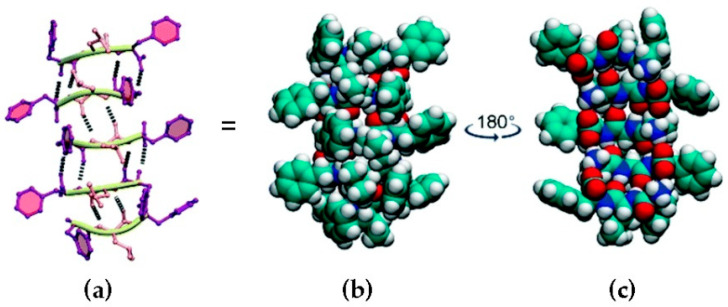
Figure 1
Figure 1
Heterochiral peptide self-assembly. l-Phe-d-Leu-l-Phe forms stacks held together by H-bonding between amides (a), and space-fill representations (b,c) show the amphipathic character of the stacks, which display a hydrophobic face with the peptide sidechains (b) and a hydrophilic face with amide bonds (c). Carbon atoms are shown in green, hydrogen in white, nitrogen in blue, and oxygen in red. Reproduced from [45].
Figure 2
Figure 2
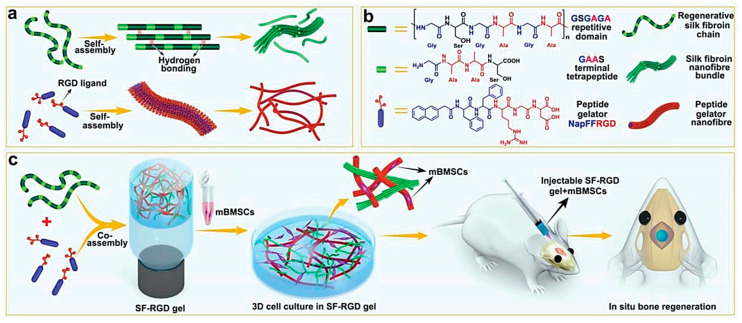
(a,b) Molecular structures and self-assembling properties of peptide gelator (Nap-FFRGD) and silk fibroin (SF) for the formation of nanofiber and nanofibril bundle structures individually; (c) illustration of the preparation process for SF-RGD gel from Nap-FFRGD and SF, and its biological functions to enhance osteogenesis of encapsulated mBMSCs for bone regeneration in calvarial defect areas of mice. Reprinted with permission from [67], © 2022 WILEY-VCH Verlag GmbH & Co. KGaA, Weinheim, Germany.
Figure 3
Figure 3
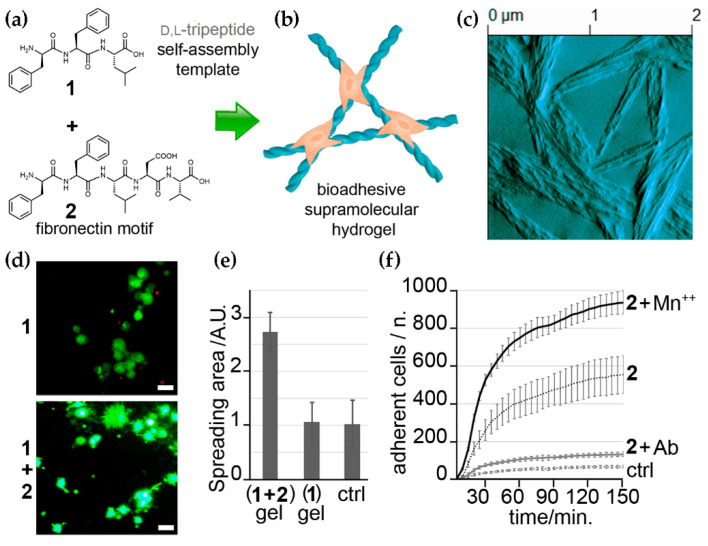
(a) Chemical structures of two self-assembling short peptides with structural (1) and bioactive (2) roles for the co-assembly into bioadhesive hydrogels (b). (c) AFM image of the co-assembled gel. (d) live-dead cell-microscopy images of the control (1) and the bioadhesive (1 + 2) hydrogels with fibroblasts. (e) Quantification of cell spreading. (f) Adherent cells’ count in the presence of Mn++ and a β1 integrin-blocking antibody (Ab) demonstrates integrin engagement for cell adhesion on the biomaterial and successful ECM mimicry. Adapted from [75].
Figure 4
Figure 4
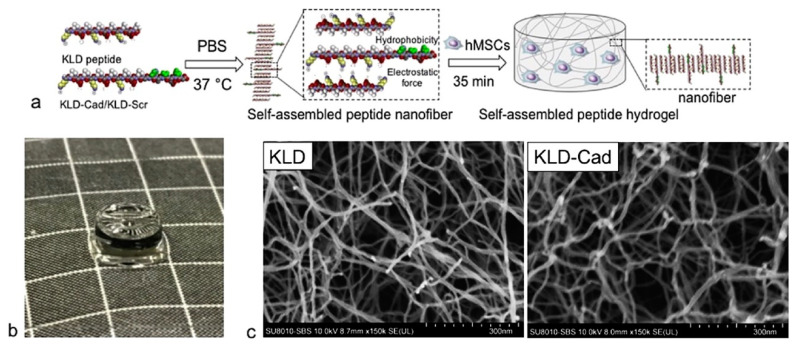
(a) Scheme of self-assembly of hMSC-encapsulated KLD-Cad/KLD-Scr hydrogels. (b) Photograph of KLD-Cad self-assembled hydrogel (d = 5 mm, h = 2.2 mm) (c) SEM images of KLD (left) and KLD-Cad (right) hydrogels after critical point drying show that the average diameter of self-assembled fiber in the KLD and KLD-Cad hydrogels are approximately 17.6 nm and 20.4 nm, respectively. Reprinted from [91], copyright © 2022, with permission from Elsevier.
Figure 5
Figure 5
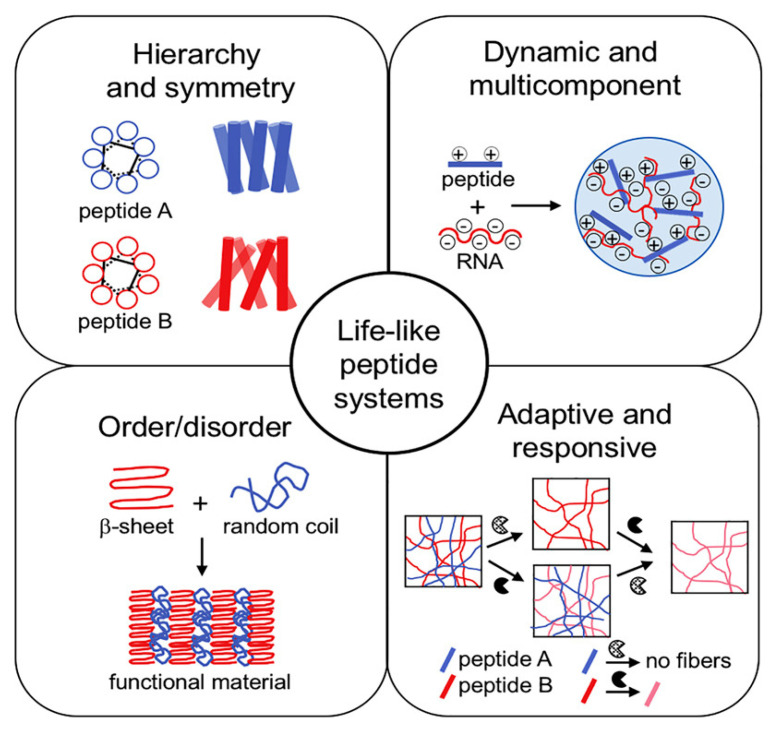
Life-like systems are out-of-equilibrium and present several useful features to mimic living tissues. Reproduced from [131], copyright © 2022, with permission from Elsevier.

References

    1. Kaur G., Narayanan G., Garg D., Sachdev A., Matai I. Biomaterials-based regenerative strategies for skin tissue wound healing. ACS Appl. Bio Mater. 2022;5:2069–2106. doi: 10.1021/acsabm.2c00035. - DOI - PubMed
    1. Kojima M., Abe S., Ueno T. Engineering of protein crystals for use as solid biomaterials. Biomater. Sci. 2022;10:354–367. doi: 10.1039/D1BM01752G. - DOI - PubMed
    1. Stie M.B., Kalouta K., Vetri V., Foderà V. Protein materials as sustainable non- and minimally invasive strategies for biomedical applications. J. Control. Release. 2022;344:12–25. doi: 10.1016/j.jconrel.2022.02.016. - DOI - PubMed
    1. Yi J., Liu Q., Zhang Q., Chew T.G., Ouyang H. Modular protein engineering-based biomaterials for skeletal tissue engineering. Biomaterials. 2022;282:121414. doi: 10.1016/j.biomaterials.2022.121414. - DOI - PubMed
    1. Tinoco A., Martins M., Cavaco-Paulo A., Ribeiro A. Biotechnology of functional proteins and peptides for hair cosmetic formulations. Trends Biotechnol. 2022;40:591–605. doi: 10.1016/j.tibtech.2021.09.010. - DOI - PubMed

LinkOut - more resources