. 2022 Jun 29;22(13):4934.
doi: 10.3390/s22134934.

A Systematic Review on Feature Extraction in Electroencephalography-Based Diagnostics and Therapy in Attention Deficit Hyperactivity Disorder

Affiliations

A Systematic Review on Feature Extraction in Electroencephalography-Based Diagnostics and Therapy in Attention Deficit Hyperactivity Disorder

Pasquale Arpaia et al. Sensors (Basel). .

Abstract

A systematic review on electroencephalographic (EEG)-based feature extraction strategies to diagnosis and therapy of attention deficit hyperactivity disorder (ADHD) in children is presented. The analysis is realized at an executive function level to improve the research of neurocorrelates of heterogeneous disorders such as ADHD. The Quality Assessment Tool for Quantitative Studies (QATQS) and field-weighted citation impact metric (Scopus) were used to assess the methodological rigor of the studies and their impact on the scientific community, respectively. One hundred and one articles, concerning the diagnostics and therapy of ADHD children aged from 8 to 14, were collected. Event-related potential components were mainly exploited for executive functions related to the cluster inhibition, whereas band power spectral density is the most considered EEG feature for executive functions related to the cluster working memory. This review identifies the most used (also by rigorous and relevant articles) EEG signal processing strategies for executive function assessment in ADHD.

Keywords: ADHD; ERP; P300; children; executive function.


Conflict of interest statement

The authors declare no competing interest.

Figures

Figure A1
Figure A1
ERP waveform.
Figure 1
Figure 1
PRISMA-flow of the articles selection process.
Figure 2
Figure 2
The flow-chart of the article analysis. Each article is subjected to two types of analysis in parallel: (i) the analysis to extract relationships between EEG features and executive functions (in orange) and (ii) the analysis to assess the rigor and scientific impact of the study (in blue).
Figure 3
Figure 3
EEG features classification pattern.
Figure 4
Figure 4
Number of articles per executive function considering the level of details in analysis of executive functions.
Figure 5
Figure 5
Articles focusing on the relationship between EFs from cluster inhibition and EEG features from time domain. P300 amplitude is the feature most studied: 12 articles verified (effective) the relationship, and 3 articles did not (not effective). LZC: Lempel–Ziv complexity; EEGVR: electroencephalogram valid rate. MSE: multi-scale entropy. SCP: slow cortical potentials; and ERP: event-related potential.
Figure 6
Figure 6
Articles focusing on the relationship between EFs from cluster inhibition and EEG features from frequency domain. Theta-band power is the feature most studied: 15 articles verified (effective) the relationship, and 6 articles did not (not effective). MI: modulation index. SMR: senso-motor rhythm.
Figure 7
Figure 7
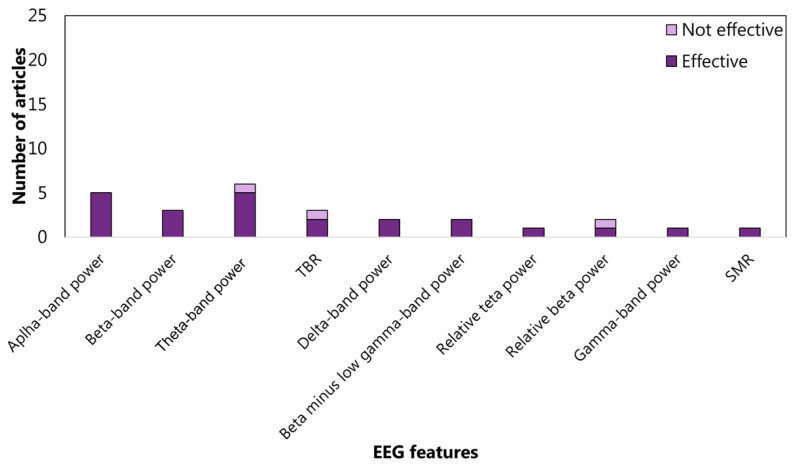
Articles focusing on the relationship between EFs from cluster working memory and EEG features from frequency domain. Theta-band power is the feature most studied: five articles verified (effective) the relationship. TBR: theta–beta ratio; SMR: senso-motor rhythm.
Figure 8
Figure 8
Articles focusing on the relationship between EFs from cluster working memory and EEG features from time domain. P300 amplitude is the feature most studied: four articles verified (effective) the relationship, and 1 article did not (was not effective). fd: fractal dimension; ApEn: Approximate Entropy; LRP: lateralised readiness potential; LE: Lyapunov Exponent; ERN: error-related negativity; and Pe: error positivity.
Figure 9
Figure 9
Articles focusing on the relationship between interference inhibition and EEG features from frequency domain. Theta-band power is the feature most studied: 10 articles verified (effective) the relationship, and 2 articles did not (not effective). TBR: theta-beta ratio; MI: modulation index; SMR: senso-motor rhythm; and CI: EEG consistency index.
Figure 10
Figure 10
Articles focusing on the relationship between response inhibition and EEG features from time domain. P300 and N100 amplitudes are the features most studied. As far as P300 is concerned, three articles verified (effective) the relationship, and three articles did not (not effective), while all six articles considered verified the effectiveness of N100. ERP: event-related potential; SCP: slow cortical potentials.
Figure 11
Figure 11
Articles focusing on the relationship between visuo-spatial working memory and EEG features from frequency domain. Theta-band power is the feature most studied: five articles verified (effective) the relationship, and one article did not (not effective). TBR: theta–beta ratio; SMR: senso-motor rhythm.
Figure 12
Figure 12
Global rating of articles on diagnostics.
Figure 13
Figure 13
Global Rating of articles on therapy.
Figure 14
Figure 14
EEG features for inhibition’s sub-function emerged from highest quality articles.
Figure 15
Figure 15
EEG features for inhibition emerged from highest quality articles.

References

    1. American Psychiatric Association . Diagnostic and Statistical Manual of Mental Disorders: DSM-5. Volume 5 American Psychiatric Association; Washington, DC, USA: 2013.
    1. Jasper H.H., Solomon P., Bradley C. Electroencephalographic analyses of behavior problem children. Am. J. Psychiatry. 1938;95:641–658. doi: 10.1176/ajp.95.3.641. - DOI
    1. Lenartowicz A., Loo S.K. Use of EEG to diagnose ADHD. Curr. Psychiatry Rep. 2014;16:498. doi: 10.1007/s11920-014-0498-0. - DOI - PMC - PubMed
    1. Lubar J.F. Discourse on the development of EEG diagnostics and biofeedback for attention-deficit/hyperactivity disorders. Biofeedback Self-Regul. 1991;16:201–225. doi: 10.1007/BF01000016. - DOI - PubMed
    1. Thomas T.A., Gaffney A. Neuropsychiatric EEG-based assessment aid system. US Pharm. 2017;42:25–27.

Publication types

MeSH terms