


Review of Phosphorus-Based Polymers for Mineral Scale and Corrosion Control in Oilfield
- PMID: 35808717
- PMCID: PMC9268766
- DOI: 10.3390/polym14132673
Review of Phosphorus-Based Polymers for Mineral Scale and Corrosion Control in Oilfield
Abstract
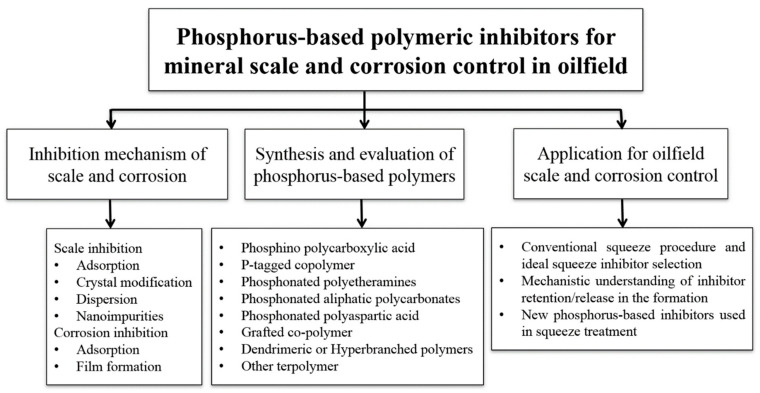
Production chemistry is an important field in the petroleum industry to study the physicochemical changes in the production system and associated impact on production fluid flow from reservoir to topsides facilities. Mineral scale deposition and metal corrosion are among the top three water-related production chemistry threats in the petroleum industry, particularly for offshore deepwater and shale operations. Mineral scale deposition is mainly driven by local supersaturation due to operational condition change and/or mixing of incompatible waters. Corrosion, in contrast, is an electrochemical oxidation-reduction process with local cathodic and anodic reactions taking place on metal surfaces. Both mineral scaling and metal corrosion can lead to severe operational risk and financial loss. The most common engineering solution for oilfield scale and corrosion control is to deploy chemical inhibitors, including scale inhibitors and corrosion inhibitors. In the past few decades, various chemical inhibitors have been prepared and applied for scaling and corrosion control. Phosphorus-based polymers are an important class of chemical inhibitors commonly adopted in oilfield operations. Due to the versatile molecular structures of these chemicals, phosphorus-based polymeric inhibitors have the advantage of a higher calcium tolerance, a higher thermal stability, and a wider pH tolerance range compared with other types of inhibitors. However, there are limited review articles to cover these polymeric chemicals for oilfield scale and corrosion control. To address this gap, this review article systematically reviews the synthesis, laboratory testing, and field applications of various phosphorus-based polymeric inhibitors in the oil and gas industry. Future research directions in terms of optimizing inhibitor design are also discussed. The objective is to keep the readers abreast of the latest development in the synthesis and application of these materials and to bridge chemistry knowledge with oilfield scale and corrosion control practice.
Keywords: corrosion; mineral scale; oilfield; phosphorus; polymers.
Conflict of interest statement
The authors declare no conflict of interest.
Figures






References
-
- Wang Z.M., Song G., Zhang J. Corrosion control in CO2 enhanced oil recovery from a perspective of multiphase fluids. Front. Mater. 2019;6:272. doi: 10.3389/fmats.2019.00272. - DOI
-
- Amjad Z., Demadis K.D., editors. Water-Formed Deposits: Fundamentals and Mitigation Strategies. Elsevier; Amsterdam, The Netherlands: 2022.
-
- Assis J., Santos A., Midori E., Vieira M., Anna S., Araujo M., Pérez C., Griza S. Corrosion damages of flow regulation valves for water injection in oil fields. Eng. Fail. Anal. 2019;96:362–373. doi: 10.1016/j.engfailanal.2018.11.002. - DOI
Publication types
Grants and funding
LinkOut - more resources
Full Text Sources
Miscellaneous
