


Serum uric acid to creatinine ratio is associated with higher prevalence of NAFLD detected by FibroScan in the United States
- PMID: 35808891
- PMCID: PMC9396182
- DOI: 10.1002/jcla.24590
Serum uric acid to creatinine ratio is associated with higher prevalence of NAFLD detected by FibroScan in the United States
Abstract
Background: The association between the serum uric acid (sUA) to creatinine ratio (sUA/Cr) and non-alcoholic fatty liver disease (NAFLD) has not been sufficiently clarified. In this study, we investigated the relationship between sUA/Cr and NAFLD among participants in the United States.
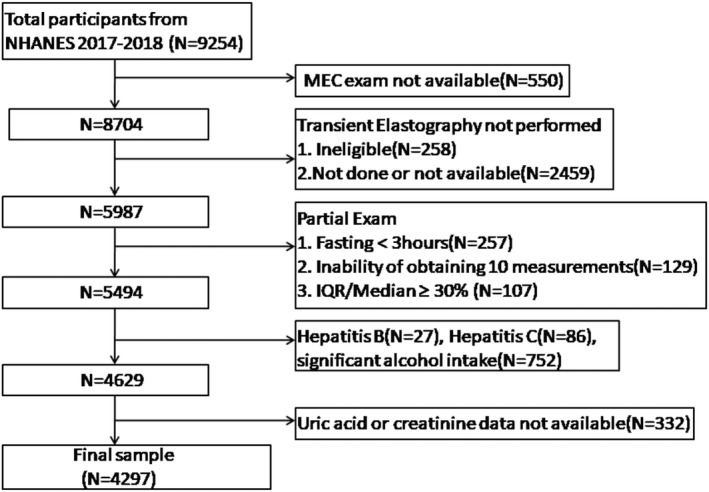
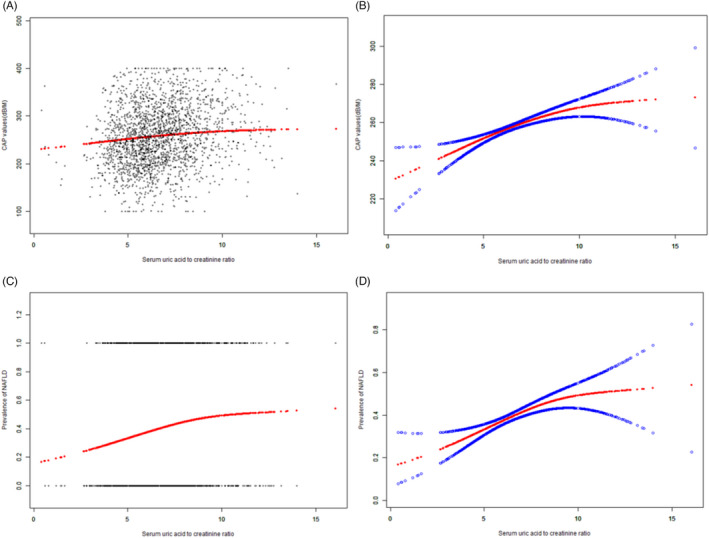
Methods: We performed a cross-sectional study based on data from the National Health and Nutrition examination Survey (NHANES) 2017-2018. A measured controlled attenuation parameter (CAP) value of ≥274 dB/m detected by Fibroscan was used to identify hepatic steatosis. SUA/Cr was calculated as sUA divided by serum creatinine. Multivariate logistic regression analysis was used to estimate the association between sUA/Cr and NAFLD. The adjusted odds ratio (OR) of sUA/Cr for NAFLD was estimated, and subgroup analysis stratified by sex was also conducted. The nonlinear relationship between sUA/Cr and NAFLD was further described using smooth curve fittings and threshold-effect analysis.
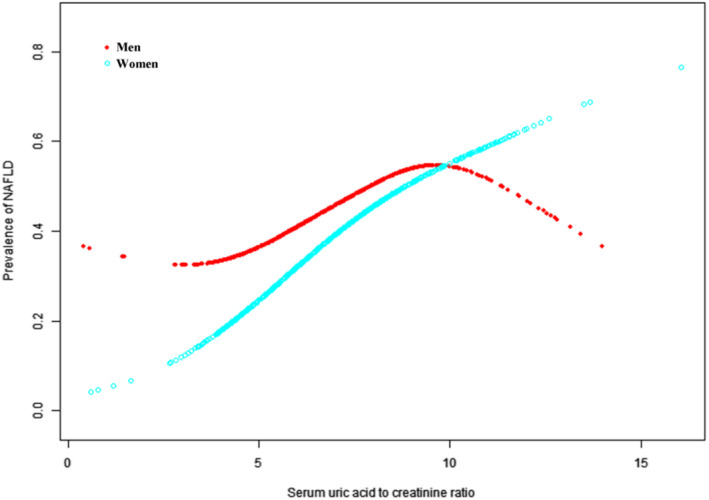
Results: We found that sUA/Cr was positively correlated with NAFLD status after fully adjustment for confounding factors. In subgroup analysis stratified by sex, the positive interaction between sUA/Cr and NAFLD status only existed in women but not in men. Moreover, the nonlinear association between sUA/Cr and NAFLD status was an inverted U-shaped curve with an inflection point at 9.7 among men.
Conclusions: Our study identified that sUA/Cr was positively associated with the risk of NAFLD among individuals in the United States. Moreover, the correlation between sUA/Cr and NAFLD differed according to sex.
Keywords: NAFLD; NHANES; inflammation; serum uric acid to creatinine ratio; steatosis.
© 2022 The Authors. Journal of Clinical Laboratory Analysis published by Wiley Periodicals LLC.
Conflict of interest statement
The authors have no conflicts of interest to declare.
Figures
References
-
- Younossi ZM, Koenig AB, Abdelatif D, Fazel Y, Henry L, Wymer M. Global epidemiology of nonalcoholic fatty liver disease‐Meta‐analytic assessment of prevalence, incidence, and outcomes. Hepatology. 2016;64:73‐84. - PubMed
-
- European Association for the Study of the L, European Association for the Study of D, European Association for the Study of O . EASL‐EASD‐EASO Clinical Practice Guidelines for the management of non‐alcoholic fatty liver disease. J Hepatol. 2016;64:1388‐1402. - PubMed
-
- Rinella ME, Sanyal AJ. Management of NAFLD: a stage‐based approach. Nat Rev Gastroenterol Hepatol. 2016;13:196‐205. - PubMed
-
- Byrne CD, Targher G. NAFLD: a multisystem disease. J Hepatol. 2015;62:S47‐S64. - PubMed
MeSH terms
Substances
LinkOut - more resources
Full Text Sources
Medical
Miscellaneous
