


Editorial
doi: 10.1093/schbul/sbac077.
The Role of Disability Benefits as an Environmental Factor Contributing to Negative Symptoms
Affiliations
- PMID: 35808961
- PMCID: PMC9810000
- DOI: 10.1093/schbul/sbac077
Item in Clipboard
Editorial
The Role of Disability Benefits as an Environmental Factor Contributing to Negative Symptoms
Schizophr Bull.
.
No abstract available
Figures
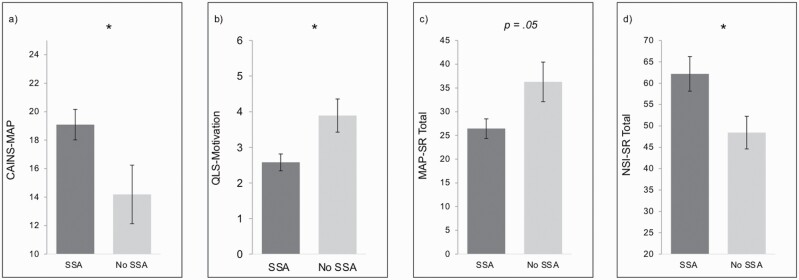
Differences in negative symptom severity among those receiving and not receiving social security administration (SSA) benefits. (A–C) Longitudinal analyses of the control group from Luther et al. showing that after controlling for baseline levels, schizophrenia participants receiving SSA benefits at baseline (n = 6) had greater motivation and pleasure (MAP) dimension negative symptoms on the Clinical Assessment Interview for Negative Symptoms (CAINS) 8 weeks later (F(1, 25) = 4.45, p = .04, d = .55) (A), higher 8-week motivation reductions on the motivation item on the Heinrich’s Quality of Life Scale (QLS) (F(1, 25) = 6.14, p = .02, d = ‐.65) (B), and trending lower self-reported 8-week motivation and pleasure on the Motivation and Pleasure Scale: Self-Report (MAP-SR) (higher = less negative symptoms) (F(1, 25) = 4.23, p = .05, d = ‐.54) (C) than those not receiving SSA benefits at baseline (n = 22). (D) Cross-sectional comparison of schizophrenia participants from Strauss et al. showing that SSA recipients (n = 12) have greater negative symptoms (measured using the Negative Symptom Inventory-Self-Report (NSI-SR)) than non-SSA recipients (n = 14); t(24)= ‐2.47, p = .02, d = .97). * p < .05.
References
-
- Harvey PD, Strassnig MT, Silberstein J.. Prediction of disability in schizophrenia: Symptoms, cognition, and self-assessment. J Exp Psychopathol. 2019;10(3):204380871986569.
-
- U.S. Social Security Administration. Annual Statistical Report on the Social Security Disability Insurance Program, 2020. 2021. No. 13-11826. https://www.ssa.gov/policy/docs/statcomps/di_asr/2020/di_asr20.pdf. Accessed August 30, 2021.
-
- U.S. Social Security Administration. SSI Annual Statistical Report, 2019. 2020. No. 13-11827. https://www.ssa.gov/policy/docs/statcomps/ssi_asr/2019/ssi_asr19.pdf. Accessed August 30, 2021.
-
- Rosenheck RA, Estroff SE, Sint K, et al. . Incomes and outcomes: social security disability benefits in first-episode psychosis. Am J Psychiatry. 2017;174(9):886–894. - PubMed
Publication types
MeSH terms
Grants and funding
LinkOut - more resources
Full Text Sources
Medical
