


Associations among fatty food sensations and saliva's emulsifying properties
- PMID: 35809054
- PMCID: PMC9270849
- DOI: 10.1093/chemse/bjac013
Associations among fatty food sensations and saliva's emulsifying properties
Abstract
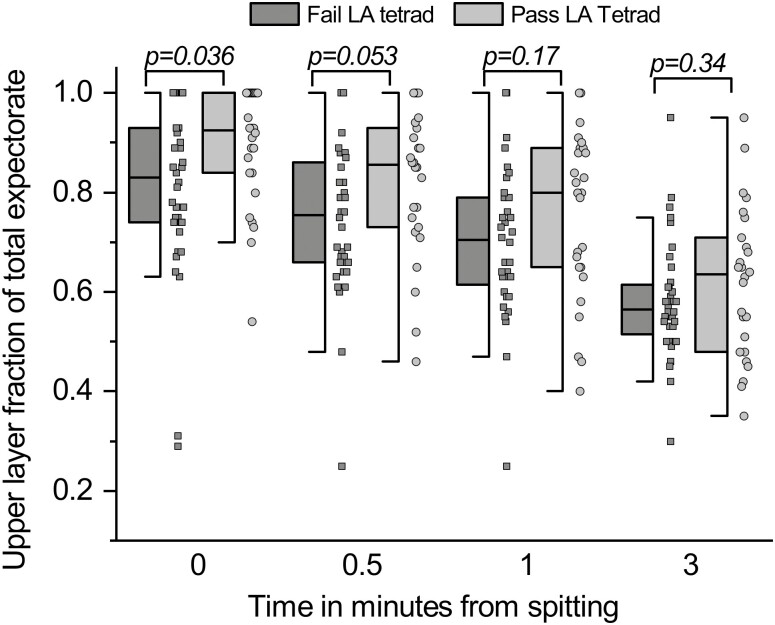
Individuals vary in saliva composition, which could in turn influence variability of oral sensations. This study was designed to investigate associations among saliva's ability to emulsify an oil/water mixture, fatty sensations, and diet. Participants (N = 62) gave sensory ratings for a white chocolate substitute with 0, 0.1, and 1% added linoleic acid. Discrimination sorting tasks were performed using the chocolate substitute with/without linoleic acid and with high/low-fat salad dressing. Participants swished and expectorated an oil/water mixture, and the size of the emulsified layer of this spat-out sample was measured. This novel technique was used to estimate the emulsifying ability of saliva, as oral swishing caused the fat to disperse into the water, stabilized by saliva. Estimated macronutrient intake was assessed by 3-day dietary recalls. Results indicate that people who correctly sorted the chocolate substitute with/without linoleic acid had saliva that better emulsified the oil/water mixture and rated the 1% linoleic acid sample as fattier. Those who incorrectly sorted the chocolate samples rated the 1% linoleic acid sample as more bitter. The same pattern for fattiness and bitterness of 1% linoleic acid samples was observed for those who correctly/incorrectly sorted the high/low-fat salad dressings. Regarding dietary data, the only observed relationship was higher dietary protein intake associated with less saliva emulsion stability over time. Overall, the results indicate relationships among how saliva influences dispersions of fat and fatty sensations, but the role of diet should be reexamined with larger and more tightly controlled groups.
Keywords: diet; emulsions; fat sensation; fattiness; oleogustus; saliva.
© The Author(s) 2022. Published by Oxford University Press. All rights reserved. For permissions, please e-mail: journals.permissions@oup.com.
Figures



References
-
- Black AE, Goldberg GR, Jebb SA, Livingstone MB, Cole TJ, Prentice AM.. Critical evaluation of energy intake data using fundamental principles of energy physiology: 2. Evaluating the results of published surveys. Eur J Clin Nutr. 1991;45:583–599. - PubMed
-
- Block G, Gillespie C, Rosenbaum EH, Jenson C.. A rapid food screener to assess fat and fruit and vegetable intake. Am J Prev Med. 2000;18:284–288. - PubMed
-
- Chalé-Rush A, Burgess JR, Mattes RD.. Evidence for human orosensory (taste?) Sensitivity to free fatty acids. Chem Senses. 2007;32:423–431. - PubMed
-
- Cheon E, Mattes R.. Fatty acids taste intensity ratings before and after sour taste adaptation. Curr Dev Nutr. 2020;4:742–742.
Publication types
MeSH terms
Substances
Grants and funding
LinkOut - more resources
Full Text Sources
