


Treatment of cracked teeth: A comprehensive narrative review
- PMID: 35809233
- PMCID: PMC9562569
- DOI: 10.1002/cre2.617
Treatment of cracked teeth: A comprehensive narrative review
Abstract
Objectives: The term "cracked tooth" is used to describe an incomplete fracture initiated from the crown and progressing towards a subgingival direction. Despite the high prevalence of cracked teeth and their frequent association with symptoms and pulpal or periapical pathoses, there is still no consensus in the literature with regard to their restorative and endodontic management. Therefore, the aim of this narrative review was to evaluate the most relevant research and provide an up-to-date comprehensive overview regarding the treatment of cracked teeth.
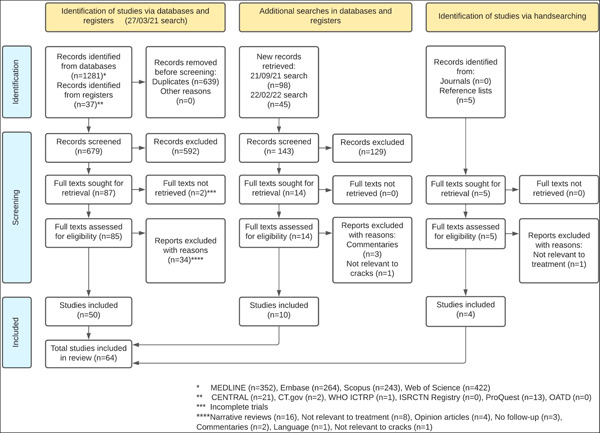
Materials and methods: An electronic literature search was carried out in MEDLINE (via Ovid), Embase (via Ovid), Scopus, and Web of Science as well as several "Grey literature" sources up to February 22nd 2022 using a combination of pre-specified 'free-text' terms (keywords) and "subject headings." The search process was supplemented by handsearching in relevant dental journals and reference lists. This narrative review focused on clinical follow-up studies (observational or interventional studies, case series/reports), laboratory studies and systematic reviews written in English language that reported data on treatment of permanent cracked teeth. The selection of relevant studies was carried out by two reviewers (AK and DG) working independently in two consecutive stages: title/abstract screening and full-text retrieval. Any discrepancies in the study selection were resolved by discussion between the reviewers.
Results: In total, 64 articles were selected for inclusion in this narrative review.
Conclusions: Cracked teeth with normal pulp or reversible pulpitis have exhibited high pulp and tooth survival rates by the provision of direct or indirect composite restorations. Besides, recent data favour monitoring, especially in the absence of symptoms or compromised tooth structure. When endodontic intervention is required, current evidence suggests that along with appropriate restorative management, outcomes of cracked teeth may be comparable to those of non-cracked root filled teeth.
Keywords: composite resins; cracked tooth syndrome; dental onlay; dental restoration failure.
© 2022 The Authors. Clinical and Experimental Dental Research published by John Wiley & Sons Ltd.
Conflict of interest statement
The authors declare no conflicts of interest.
Figures
References
-
- Abbott, P. V. (2001). Managing cracked teeth with pulpitis. Journal of Dental Research, 80, 980.
-
- Abbott, P. V. , & Leow, N. (2009). Predictable management of cracked teeth with reversible pulpitis. Australian Dental Journal, 54, 306–315. - PubMed
-
- Abou‐Rass, M. (1983). Crack lines: The precursors of tooth fractures: Their diagnosis and treatment. Quintessence International, Dental Digest, 14, 437–447. - PubMed
-
- Alkhalifah, S. , Alkandari, H. , Sharma, P. N. , & Moule, A. J. (2017). Treatment of cracked teeth. Journal of Endodontics, 43, 1579–86. - PubMed
-
- Anton Y. Otero, C. , Bijelic‐Donova, J. , Saratti, Vallittu, P. K. , di Bella, E. , Krejci, I. , & Rocca, G. T. C. M. (2021). The influence of FRC base and bonded CAD/CAM resin composite endocrowns on fatigue behavior of cracked endodontically‐treated molars. Journal of the Mechanical Behavior of Biomedical Materials, 121, 104647. - PubMed
Publication types
MeSH terms
LinkOut - more resources
Full Text Sources
